African dwarf crocodile (Osteolaemus tetraspis)
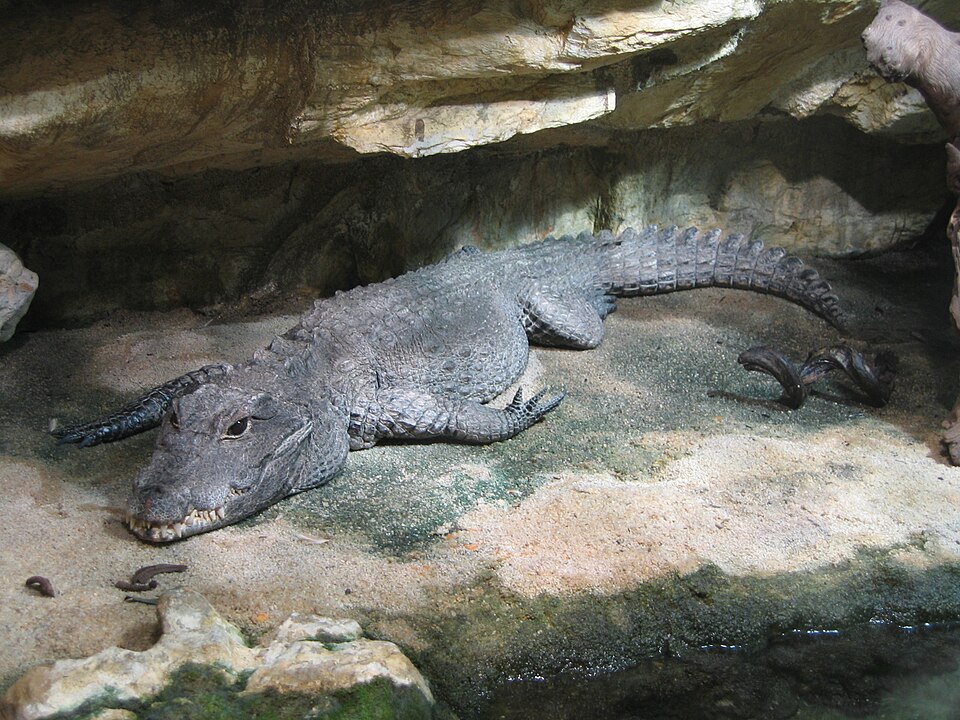
Crocodilians · Difficulty: Expert
Key facts and care guidance for African dwarf crocodile (Osteolaemus tetraspis) (origin: West and Central Africa — streams, small rivers and ponds in dense rainforest). Adult size around usually ~150 cm, exceptionally up to ~230 cm. Life expectancy Several decades. The values below are carefully researched guidance.
Short answers
African dwarf crocodile: How big does the enclosure need to be?
About 400 × 250 × 150 cm for a pair — 3 m² of land and 7 m² of water, split into one third land, one third shallows (10–20 cm) and one third deeper water from 50 cm. Add 1 m² of land and 1 m² of water per further animal.
African dwarf crocodile: What temperature does it need?
Daytime 25–30 °C, basking spot Locally up to 40 °C under the heat lamp above the land section, at night Not below 22 °C.
African dwarf crocodile: Does it need UVB lighting?
UVB: Required (UV-A and UV-B); 10–12 hours of lighting in total. This species rarely basks and is mostly nocturnal, so subdued light and hiding places matter.
African dwarf crocodile: How long do they live?
Life expectancy: Several decades.
African dwarf crocodile: Is it suitable for beginners?
No – better suited to experienced keepers (difficulty: Expert).
Climate
- Daytime temperature
- 25–30 °C
- Night temperature
- Not below 22 °C
- Basking spot
- Locally up to 40 °C under the heat lamp above the land section
- UVB
- Required (UV-A and UV-B); 10–12 hours of lighting in total. This species rarely basks and is mostly nocturnal, so subdued light and hiding places matter.
Enclosure
- Minimum size
- About 400 × 250 × 150 cm for a pair — 3 m² of land and 7 m² of water, split into one third land, one third shallows (10–20 cm) and one third deeper water from 50 cm. Add 1 m² of land and 1 m² of water per further animal.
- Substrate
- Soil, peat, bark mulch, sand or fine rounded gravel. Rounded pebbles must be within reach as gastroliths.
Feeding
- Food
- Fish, crustaceans, worms, reptiles, frogs and even fruit; in captivity meat, fish and the occasional rodent dusted with calcium and vitamins, plus insects
- Feeding interval
- Adults once a week; juveniles daily with 1–2 fasting days
Key facts
- Adult size
- usually ~150 cm, exceptionally up to ~230 cm
- Life expectancy
- Several decades
- Origin
- West and Central Africa — streams, small rivers and ponds in dense rainforest
- Protection status
- CITES Appendix I / EU Annex A — commercial use prohibited, sale only with an EU certificate; must be reported to the German nature conservation authority
- Brumation
- None. In the wild it sits out the dry season in burrows — the enclosure needs matching retreats
- Cohabitation
- Keep singly or in pairs once mature; juveniles can be kept in groups.
Notes
LEGAL: In Germany crocodilians count as dangerous animals. Keeping them is governed by each federal state — several ban it in private hands, the rest require a permit. Settle this with the responsible authority before acquiring an animal, not after. On top of that come species protection law (CITES / EU Regulation 338/97), a duty to notify the nature conservation authority and, for many species, mandatory microchipping. Proof of expertise is required. DANGER: Even the small species can inflict serious injuries. The enclosure must be escape-proof, digging out must be impossible, and there must be a way to separate animals safely. ROOM FOR A LIFETIME: Crocodilians live for decades. An animal that has outgrown its enclosure is next to impossible to rehome — the enclosure has to be big enough for the adult animal from the start. Reptoria does not broker crocodilians. This page is for information only.
Do you keep this species?
Add your animal to Reptoria – Reptoria reminds you about feeding and shedding. Add your animal for free →
Look for African dwarf crocodile (Osteolaemus tetraspis) in the marketplace →
Related species
What you need to start
To keep African dwarf crocodile (Osteolaemus tetraspis) you typically need: a suitable enclosure (About 400 × 250 × 150 cm for a pair — 3 m² of land and 7 m² of water, split into one third land, one third shallows (10–20 cm) and one third deeper water from 50 cm. Add 1 m² of land and 1 m² of water per further animal.), substrate (Soil, peat, bark mulch, sand or fine rounded gravel. Rounded pebbles must be within reach as gastroliths.), a heat source with a thermostat, UVB lighting, thermometer and hygrometer, a water dish and hides. You will find equipment in the Reptoria marketplace.
The complete, interactive care database is in the Reptoria app.
Last updated: 8 November 2026 · Editor: Reptoria editorial team · Sources include: AG Krokodile in der DGHT: Mindestanforderungen an die artgerechte Haltung von Krokodilen in privaten Haltungen (kroko-treff.de), Wikipedia, https://de.wikipedia.org/wiki/Stumpfkrokodil, https://en.wikipedia.org/wiki/Dwarf_crocodile, https://reptile-database.reptarium.cz/species?genus=Osteolaemus&species=tetraspis
All values are non-binding guidance and do not replace expert advice. Research thoroughly from several sources before acquiring and keeping an animal, and observe the applicable law (species and animal protection in particular).