Bawangling leopard gecko (Goniurosaurus bawanglingensis)
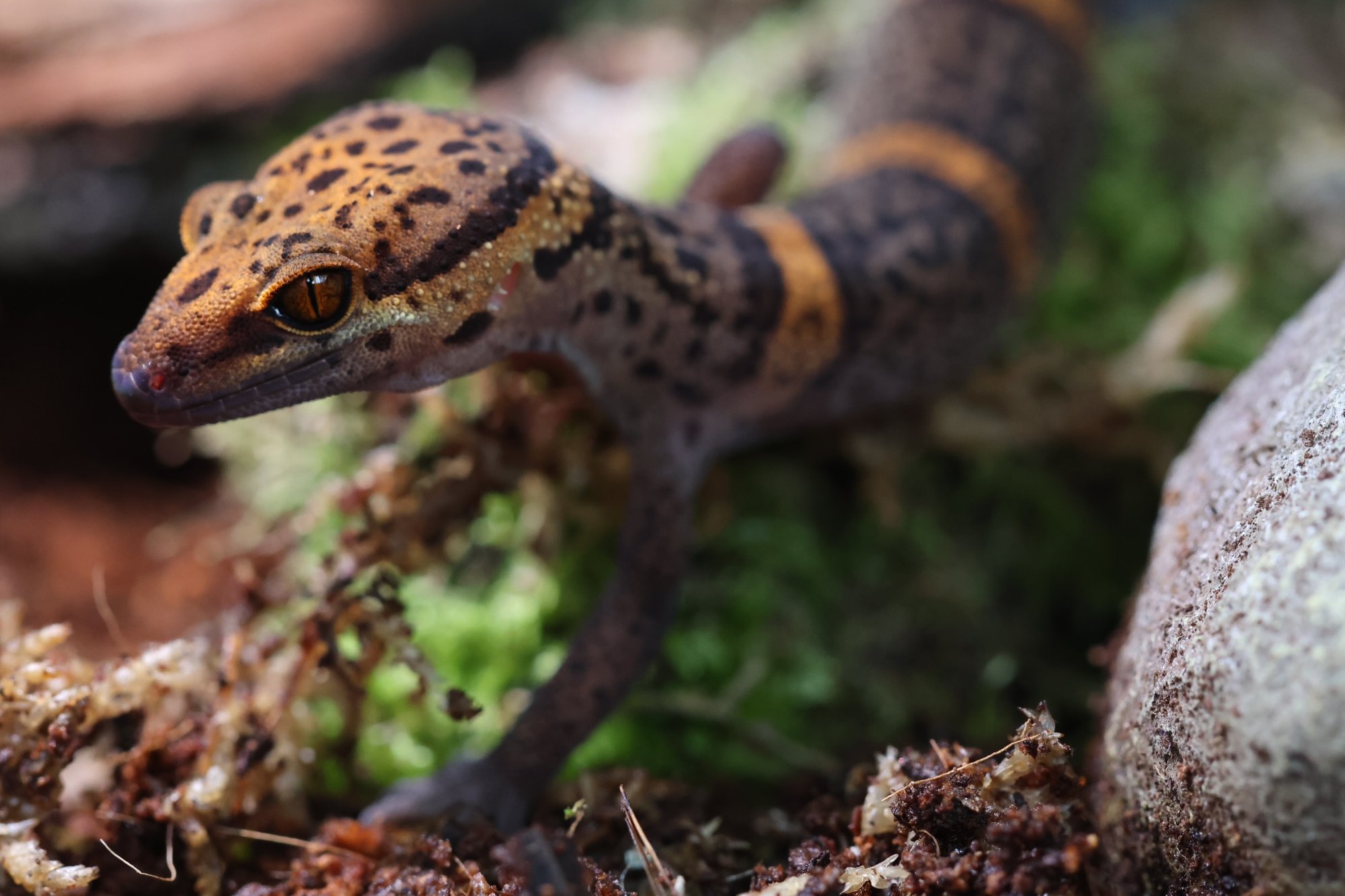
Geckos · Difficulty: Intermediate
Key facts and care guidance for Bawangling leopard gecko (Goniurosaurus bawanglingensis) (origin: Bawangling National Nature Reserve in the southwest of Hainan Island, China). Adult size around 16–19 cm. Life expectancy 10–15 years. The values below are carefully researched guidance.
Short answers
Bawangling leopard gecko: How big does the enclosure need to be?
60×40×40 cm for a pair.
Bawangling leopard gecko: What temperature does it need?
Daytime 22–26 °C, basking spot No basking spot — at most a warm corner up to 27 °C, at night 18–20 °C.
Bawangling leopard gecko: Does it need UVB lighting?
UVB: Not essential (nocturnal), weak UVB is possible.
Bawangling leopard gecko: How long do they live?
Life expectancy: 10–15 years.
Bawangling leopard gecko: Is it suitable for beginners?
Rather not – it is considered an intermediate species (difficulty: Intermediate).
Climate
- Daytime temperature
- 22–26 °C
- Night temperature
- 18–20 °C
- Basking spot
- No basking spot — at most a warm corner up to 27 °C
- Humidity
- 60–70 %, plus a permanently humid box and drier areas alongside
- UVB
- Not essential (nocturnal), weak UVB is possible
Enclosure
- Minimum size
- 60×40×40 cm for a pair
- Substrate
- About 4 cm of forest-floor mix made of coco fibre and sphagnum with leaf litter, bark mulch and a little charcoal; slate slabs and hides on top. Keep one corner permanently damp and let the rest dry out; a bioactive setup with springtails and isopods works well.
Feeding
- Food
- Crickets, roaches and house crickets, dusted regularly with calcium and vitamins
- Feeding interval
- adults 2×/week
Key facts
- Adult size
- 16–19 cm
- Life expectancy
- 10–15 years
- Origin
- Bawangling National Nature Reserve in the southwest of Hainan Island, China
- Protection status
- CITES II — proof of origin required
- Brumation
- A cooler winter period of 8–10 weeks at around 16–18 °C, with shortened lighting
- Cohabitation
- 1.1 or 1.2; never males together. The reason: several males fight over territory and the best hiding places until one is injured or permanently confined to a corner. Females usually get along but need their own hiding places each; feed separately if there is a size difference.
Notes
A cave dweller. Warmth above 28 °C is dangerous for every species in this genus, and that is the commonest keeping mistake.
Do you keep this species?
Add your animal to Reptoria – Reptoria reminds you about feeding and shedding. Add your animal for free →
Look for Bawangling leopard gecko (Goniurosaurus bawanglingensis) in the marketplace →
Related species
- Cave gecko – Araneus (Goniurosaurus araneus) – Intermediate
- Cave gecko – Cat Ba (Goniurosaurus catbaensis) – Expert
- Cave gecko – Hainan (Goniurosaurus hainanensis) – Intermediate
- Cave gecko – Kuroiwa (Goniurosaurus kuroiwae) – Intermediate
- Cave gecko – Lichtenfelder (Goniurosaurus lichtenfelderi) – Intermediate
- Cave gecko – Lui (Goniurosaurus luii) – Intermediate
- Cave gecko – Orientalis (Goniurosaurus orientalis) – Expert
- Cave gecko – Splendens (Goniurosaurus splendens) – Expert
What you need to start
To keep Bawangling leopard gecko (Goniurosaurus bawanglingensis) you typically need: a suitable enclosure (60×40×40 cm for a pair), substrate (About 4 cm of forest-floor mix made of coco fibre and sphagnum with leaf litter, bark mulch and a little charcoal; slate slabs and hides on top. Keep one corner permanently damp and let the rest dry out; a bioactive setup with springtails and isopods works well.), a heat source with a thermostat, UVB lighting, thermometer and hygrometer, a water dish and hides. You will find equipment in the Reptoria marketplace.
The complete, interactive care database is in the Reptoria app.
Last updated: 9 October 2026 · Editor: Reptoria editorial team · Sources include: Wikipedia EN, reptile-database.reptarium.cz, eu_annex.txt (lokal, VO (EU) 2026/1383), herpetoculturenetwork.com (Haltungsbericht Goniurosaurus, Rob Hoke), nlwkn.niedersachsen.de (Meldepflicht BArtSchV)
All values are non-binding guidance and do not replace expert advice. Research thoroughly from several sources before acquiring and keeping an animal, and observe the applicable law (species and animal protection in particular).