Bernhard's mantella (Mantella bernhardi)
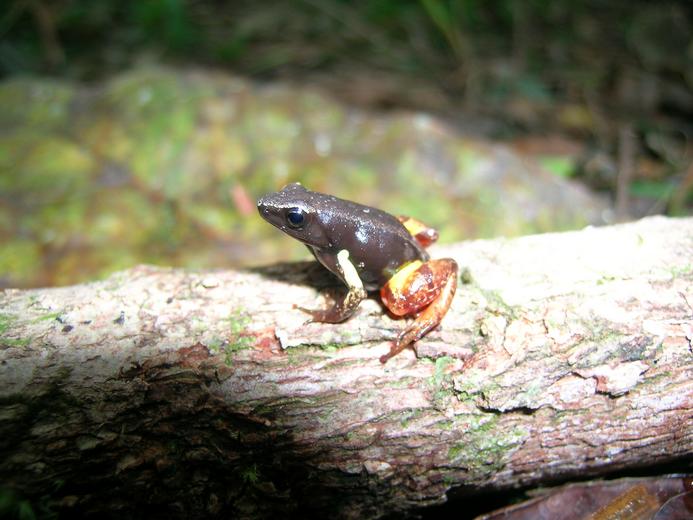
Amphibians · Difficulty: Intermediate
Key facts and care guidance for Bernhard's mantella (Mantella bernhardi) (origin: Southeast Madagascar, lowland rainforest between 60 and 630 m; range only around 500 km², mainly around Ranomafana National Park and the Manombo Reserve). Adult size around 1,8–2,3 cm. Life expectancy 5–10 years. The values below are carefully researched guidance.
Short answers
Bernhard's mantella: How big does the enclosure need to be?
50×40×50 cm for a group, planted.
Bernhard's mantella: What temperature does it need?
Daytime 20–25 °C, basking spot No basking spot — direct heat is harmful, at night 16–19 °C.
Bernhard's mantella: Does it need UVB lighting?
UVB: Weak UVB recommended (UVB 2.0).
Bernhard's mantella: How long do they live?
Life expectancy: 5–10 years.
Bernhard's mantella: Is it suitable for beginners?
Rather not – it is considered an intermediate species (difficulty: Intermediate).
Climate
- Daytime temperature
- 20–25 °C
- Night temperature
- 16–19 °C
- Basking spot
- No basking spot — direct heat is harmful
- Humidity
- 80–95 %
- UVB
- Weak UVB recommended (UVB 2.0)
Enclosure
- Minimum size
- 50×40×50 cm for a group, planted
- Substrate
- Forest-floor substrate with a drainage layer, moss, leaf litter and a shallow water section
Feeding
- Food
- Crickets, house crickets, fruit flies and firebrats, dusted regularly with calcium and vitamins
- Feeding interval
- adults 3–4×/week
Key facts
- Adult size
- 1,8–2,3 cm
- Life expectancy
- 5–10 years
- Origin
- Southeast Madagascar, lowland rainforest between 60 and 630 m; range only around 500 km², mainly around Ranomafana National Park and the Manombo Reserve
- Protection status
- CITES II, IUCN "Vulnerable" — proof of origin required
- Brumation
- A short dry season of 4–6 weeks
- Cohabitation
- Group housing is possible and sensible. Raise juveniles separately from adults — not because they would be eaten, these animals are far too small for that, but because the larger ones get to the food first and the smaller ones fall behind. Provide enough ground structure of leaf litter and moss so that every animal can retreat, and spread the food over several spots in the enclosure instead of one point.
Notes
The smallest species in the genus, with a very small range.
Do you keep this species?
Add your animal to Reptoria – Reptoria reminds you about feeding and shedding. Add your animal for free →
Look for Bernhard's mantella (Mantella bernhardi) in the marketplace →
Related species
- Baron's mantella (Mantella baroni) – Intermediate
- Blue-legged mantella (Mantella expectata) – Intermediate
- Betsileo mantella (Mantella betsileo) – Beginner
- Cowan's mantella (Mantella cowanii) – Intermediate
- Black-eared mantella (Mantella milotympanum) – Intermediate
- Yellow mantella (Mantella crocea) – Intermediate
- Golden mantella (Mantella aurantiaca) – Intermediate
- Green mantella (Mantella viridis) – Intermediate
What you need to start
To keep Bernhard's mantella (Mantella bernhardi) you typically need: a suitable enclosure (50×40×50 cm for a group, planted), substrate (Forest-floor substrate with a drainage layer, moss, leaf litter and a shallow water section), a heat source with a thermostat, UVB lighting, thermometer and hygrometer, a water dish and hides. You will find equipment in the Reptoria marketplace.
The complete, interactive care database is in the Reptoria app.
Last updated: 9 October 2026 · Editor: Reptoria editorial team · Sources include: Wikipedia FR, Wikipedia NL, Wikipedia DE (Mantella), Wikipedia EN (Mantella bernhardi), Wikipedia EN (Mantella)
All values are non-binding guidance and do not replace expert advice. Research thoroughly from several sources before acquiring and keeping an animal, and observe the applicable law (species and animal protection in particular).