Blanford's flying lizard (Draco blanfordii)
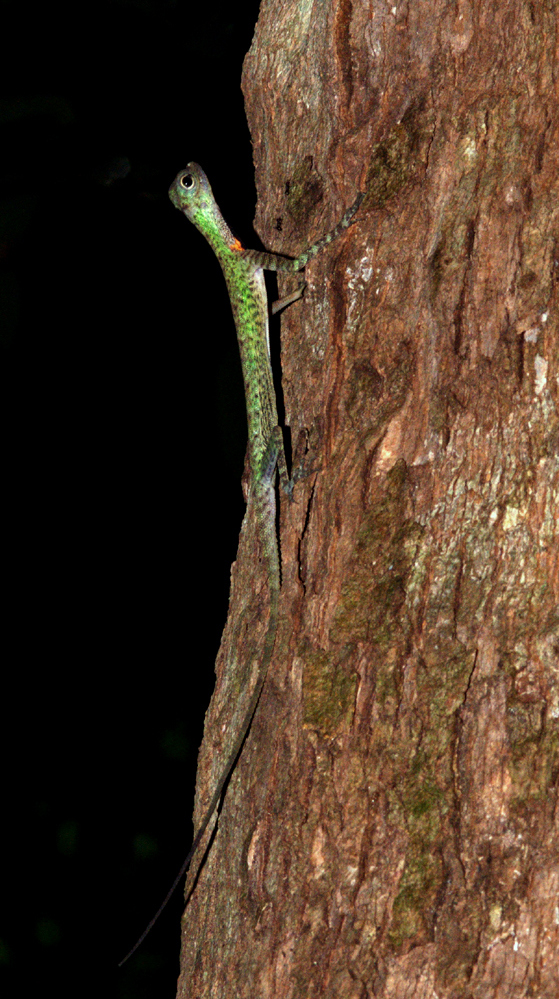
Agamas · Difficulty: Expert
Key facts and care guidance for Blanford's flying lizard (Draco blanfordii) (origin: Myanmar, Thailand, Laos, Vietnam, southwest China (Yunnan), northeast India, Bangladesh and West Malaysia; dense, seasonally moist forest from the lowlands up to about 1,200 m). Adult size around approx. 30–35 cm total length (snout–vent about 12 cm, tail about 23 cm). Life expectancy approx. 5–8 years (a genus-level figure; there is no husbandry data for Blanford's flying dragon itself). The values below are carefully researched guidance.
Short answers
Blanford's flying lizard: How big does the enclosure need to be?
100×80×180 cm for a pair.
Blanford's flying lizard: What temperature does it need?
Daytime 26–31 °C, basking spot Basking spot 33–37 °C, at night 21–24 °C.
Blanford's flying lizard: Does it need UVB lighting?
UVB: Essential (UVB 10.0).
Blanford's flying lizard: How long do they live?
Life expectancy: approx. 5–8 years (a genus-level figure; there is no husbandry data for Blanford's flying dragon itself).
Blanford's flying lizard: Is it suitable for beginners?
No – better suited to experienced keepers (difficulty: Expert).
Climate
- Daytime temperature
- 26–31 °C
- Night temperature
- 21–24 °C
- Basking spot
- Basking spot 33–37 °C
- Humidity
- 70–85 %
- UVB
- Essential (UVB 10.0)
Enclosure
- Minimum size
- 100×80×180 cm for a pair
- Substrate
- Forest-floor substrate with several vertical cork trunks
Feeding
- Food
- A specialist in arboreal ants and termites. Crickets, house crickets and roaches are frequently refused; substitutes are micro-crickets, firebrats and fruit flies, all dusted with calcium and vitamins. Without a permanent source of ants or termites, this species cannot be fed properly.
- Feeding interval
- adults 3×/week
Key facts
- Adult size
- approx. 30–35 cm total length (snout–vent about 12 cm, tail about 23 cm)
- Life expectancy
- approx. 5–8 years (a genus-level figure; there is no husbandry data for Blanford's flying dragon itself)
- Origin
- Myanmar, Thailand, Laos, Vietnam, southwest China (Yunnan), northeast India, Bangladesh and West Malaysia; dense, seasonally moist forest from the lowlands up to about 1,200 m
- Protection status
- Not listed under CITES
- Brumation
- No winter rest
- Cohabitation
- 1.2; never keep males together. The reason: several males fight over territory and the warm spot until one is injured or spends its life in a corner. Females usually get on, but each needs its own warm spot and hide; feed them separately once they differ in size.
Notes
The largest species in the genus.
Do you keep this species?
Add your animal to Reptoria – Reptoria reminds you about feeding and shedding. Add your animal for free →
Look for Blanford's flying lizard (Draco blanfordii) in the marketplace →
Related species
- Five-banded flying lizard (Draco quinquefasciatus) – Intermediate
- Spotted flying dragon (Draco maculatus) – Intermediate
- Common flying dragon (Draco volans) – Expert
- Black-bearded flying dragon (Draco melanopogon) – Intermediate
- Eared forest dragon (Hypsilurus auritus) – Expert
- Inland earless dragon (Tympanocryptis intima) – Expert
- Borneo angle-headed lizard (Gonocephalus bornensis) – Expert
- Bruijn's forest dragon (Hypsilurus bruijnii) – Expert
What you need to start
To keep Blanford's flying lizard (Draco blanfordii) you typically need: a suitable enclosure (100×80×180 cm for a pair), substrate (Forest-floor substrate with several vertical cork trunks), a heat source with a thermostat, UVB lighting, thermometer and hygrometer, a water dish and hides. You will find equipment in the Reptoria marketplace.
The complete, interactive care database is in the Reptoria app.
Last updated: 2 November 2026 · Editor: Reptoria editorial team · Sources include: Wikipedia EN, Wikipedia DE, reptilien-freunde.aktiv-forum.com, reptile-database.reptarium.cz, echsen.net
All values are non-binding guidance and do not replace expert advice. Research thoroughly from several sources before acquiring and keeping an animal, and observe the applicable law (species and animal protection in particular).