Copperhead (Agkistrodon contortrix)
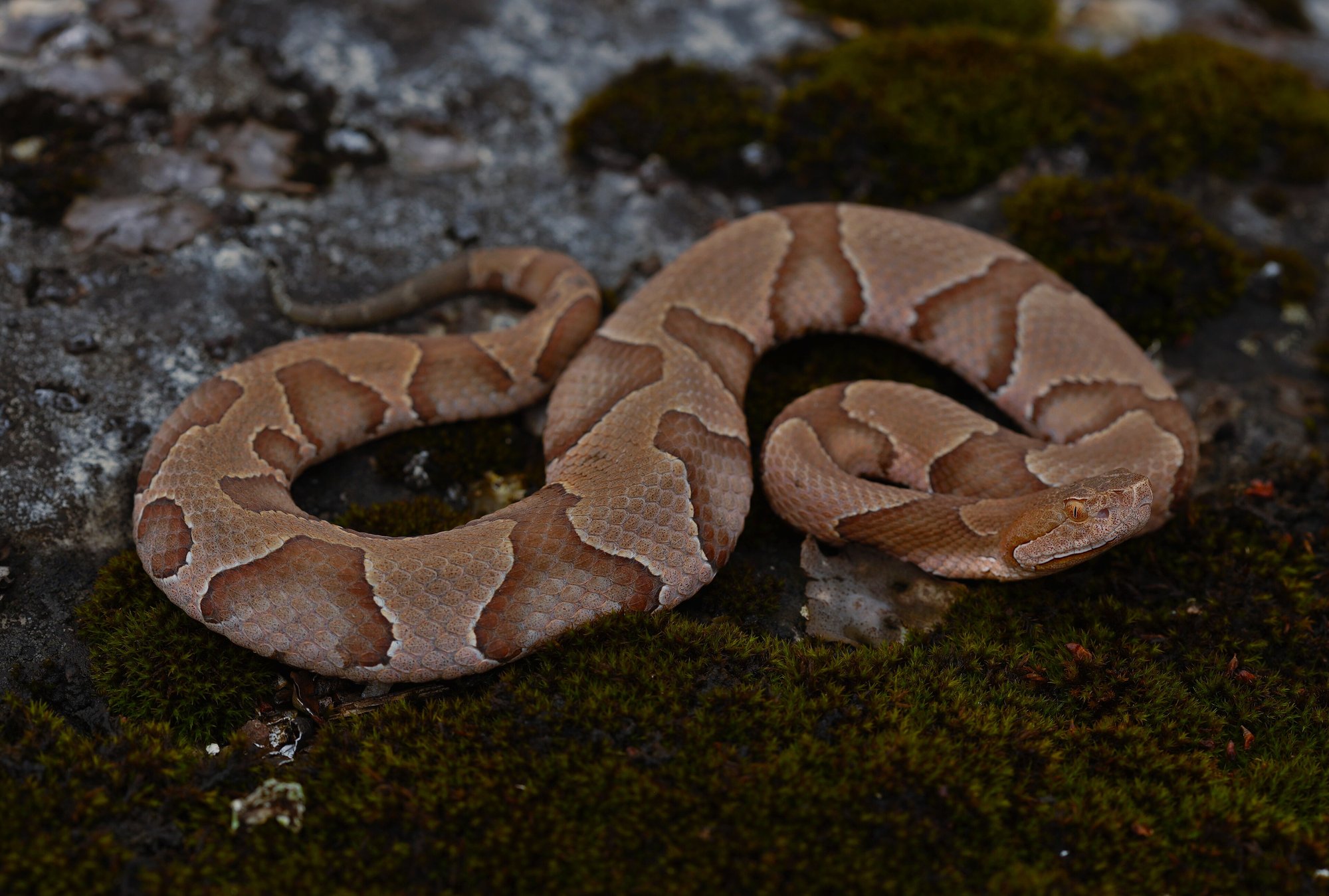
Snakes · Difficulty: Expert
Key facts and care guidance for Copperhead (Agkistrodon contortrix) (origin: The east and centre of the USA – deciduous forest). Adult size around 60–90 cm. Life expectancy 15–20 years. The values below are carefully researched guidance.
Short answers
Copperhead: How big does the enclosure need to be?
120×60×50 cm.
Copperhead: What temperature does it need?
Daytime 24–29 °C, basking spot 32–34 °C, at night 16–20 °C.
Copperhead: Does it need UVB lighting?
UVB: UVB recommended.
Copperhead: How long do they live?
Life expectancy: 15–20 years.
Copperhead: Is it suitable for beginners?
No – better suited to experienced keepers (difficulty: Expert).
Climate
- Daytime temperature
- 24–29 °C
- Night temperature
- 16–20 °C
- Basking spot
- 32–34 °C
- Humidity
- 50–65 %
- UVB
- UVB recommended
Enclosure
- Minimum size
- 120×60×50 cm
- Substrate
- Forest floor with leaf litter, pieces of bark, stone slabs
Feeding
- Food
- Frozen-thawed mice
- Feeding interval
- adults every 10–14 days
Key facts
- Adult size
- 60–90 cm
- Life expectancy
- 15–20 years
- Origin
- The east and centre of the USA – deciduous forest
- Protection status
- VENOMOUS (mostly cytotoxic, rarely fatal) – a dangerous animal
- Brumation
- A winter rest of 10–14 weeks at 8–12 °C
- Cohabitation
- Keep them singly. Snakes are solitary and do not seek company — a shared hide is competition for the best spot, not social behaviour. The concrete reason is the feeding accident: if two animals grab the same food item, one can swallow the other along with it. On top of that, once they are kept together you can no longer tell which animal has eaten and which is losing weight. For breeding, put them together under supervision and separate them again afterwards.
Notes
A well-camouflaged ambush hunter that relies on camouflage rather than flight – bites usually happen when it is overlooked. A winter rest matters.
Do you keep this species?
Add your animal to Reptoria – Reptoria reminds you about feeding and shedding. Add your animal for free →
Look for Copperhead (Agkistrodon contortrix) in the marketplace →
Related species
- Cantil (Agkistrodon bilineatus) – Expert
- Cottonmouth (Agkistrodon piscivorus) – Expert
- Savanna vine snake (Thelotornis capensis) – Expert
- Egyptian cobra (Naja haje) – Expert
- Egyptian saw-scaled viper (Echis pyramidum) – Expert
- Barnett's lancehead (Bothrops barnetti) – Expert
- Usambara bush viper (Atheris ceratophora) – Expert
- Ottoman viper (Montivipera xanthina) – Expert
What you need to start
To keep Copperhead (Agkistrodon contortrix) you typically need: a suitable enclosure (120×60×50 cm), substrate (Forest floor with leaf litter, pieces of bark, stone slabs), a heat source with a thermostat, UVB lighting, thermometer and hygrometer, a water dish and hides. You will find equipment in the Reptoria marketplace.
The complete, interactive care database is in the Reptoria app.
Last updated: 8 November 2026 · Editor: Reptoria editorial team · Sources include: Reptile Database: Agkistrodon contortrix - Reproduction – https://reptile-database.reptarium.cz/species?genus=Agkistrodon&species=contortrix, Wikipedia: Copperhead, ovoviviparous – https://en.wikipedia.org/wiki/Copperhead_(snake), https://animaldiversity.org/accounts/Agkistrodon_contortrix/, https://en.wikipedia.org/wiki/Agkistrodon_contortrix, https://reptile-database.reptarium.cz/species?genus=Agkistrodon&species=contortrix
All values are non-binding guidance and do not replace expert advice. Research thoroughly from several sources before acquiring and keeping an animal, and observe the applicable law (species and animal protection in particular).