Corn snake (Pantherophis guttatus)
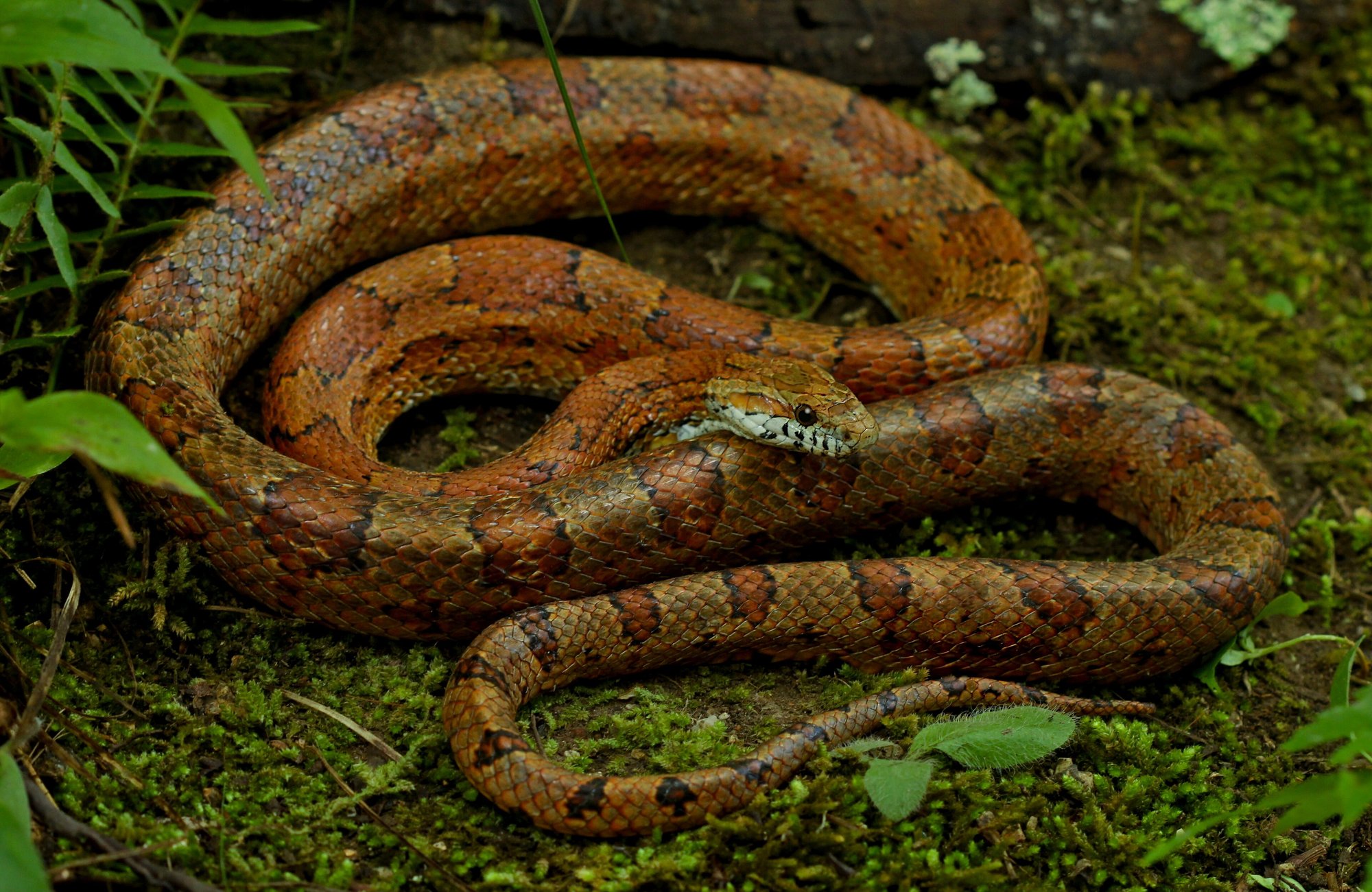
Snakes · Difficulty: Beginner
Key facts and care guidance for Corn snake (Pantherophis guttatus) (origin: The south-eastern USA). Adult size around 120–150 cm. Life expectancy 15–20 years. The values below are carefully researched guidance.
Short answers
Corn snake: How big does the enclosure need to be?
From 150×75×150 cm for an adult animal.
Corn snake: What temperature does it need?
Daytime 24–28 °C, basking spot 30–32 °C, at night 18–20 °C.
Corn snake: Does it need UVB lighting?
UVB: Optional.
Corn snake: How long do they live?
Life expectancy: 15–20 years.
Corn snake: Is it suitable for beginners?
Yes – it is considered suitable for beginners (difficulty: Beginner).
Climate
- Daytime temperature
- 24–28 °C
- Night temperature
- 18–20 °C
- Basking spot
- 30–32 °C
- Humidity
- 50–60 %
- UVB
- Optional
Enclosure
- Minimum size
- from 150×75×150 cm for an adult animal
- Substrate
- Beech chips, bark mulch or forest-floor substrate, at least 5 cm deep. Plus climbing branches — corn snakes climb noticeably more than their reputation suggests — hides at ground level and up high, and a water dish the snake can fit into completely.
Feeding
- Food
- Mice (frozen-thawed)
- Feeding interval
- adults every 7–14 days
Key facts
- Adult size
- 120–150 cm
- Life expectancy
- 15–20 years
- Origin
- The south-eastern USA
- Protection status
- —
- Brumation
- Winter rest recommended: 3–4 months at 15–18 °C. Withhold food for two to three weeks beforehand and ramp down temperature and lighting slowly. Necessary for breeding, and otherwise beneficial to health.
- Cohabitation
- Keeping a single animal is the least stressful and safest option. Two animals in a clearly larger enclosure are possible, but they must then be fed separately, because feeding together — especially with juveniles — can lead to feeding accidents up to one snake swallowing the other; you also can no longer tell which animal is eating and which is losing weight.
Notes
A classic for beginners, very robust and keen to escape – close the terrarium well. A good climber, so offer climbing opportunities.
Do you keep this species?
Add your animal to Reptoria – Reptoria reminds you about feeding and shedding. Add your animal for free →
Corn snake (Pantherophis guttatus) currently offered
- Kornnatter – Villingen-Schwenningen · 30 €
- 0.1 Pantherophis guttatus aus 2024 – Bad Bederkesa · 70 €
- Kornnatter – Wildfarbe Motley · Schriesheim · 80 €
- Kornnatter – Amelanistic Motley · Schriesheim · 100 €
- Kornnatter – Amelanistic Tessera · Schriesheim · 95 €
- Kornnatter – Amelanistic · Schriesheim · 80 €
Related species
- Baird's rat snake (Pantherophis bairdi) – Beginner
- Great Plains rat snake (Pantherophis emoryi) – Beginner
- Western fox snake (Pantherophis vulpinus) – Beginner
- Eastern rat snake (Pantherophis alleghaniensis) – Beginner
- Black rat snake (Pantherophis obsoletus) – Intermediate
- Slowinski's corn snake (Pantherophis slowinskii) – Beginner
- Texas rat snake (Pantherophis obsoletus lindheimeri) – Intermediate
- Egyptian sand boa (Eryx colubrinus colubrinus) – Beginner
What you need to start
To keep Corn snake (Pantherophis guttatus) you typically need: a suitable enclosure (from 150×75×150 cm for an adult animal), substrate (Beech chips, bark mulch or forest-floor substrate, at least 5 cm deep. Plus climbing branches — corn snakes climb noticeably more than their reputation suggests — hides at ground level and up high, and a water dish the snake can fit into completely.), a heat source with a thermostat, UVB lighting, thermometer and hygrometer, a water dish and hides. You will find equipment in the Reptoria marketplace.
The complete, interactive care database is in the Reptoria app.
Last updated: 2 November 2026 · Editor: Reptoria editorial team · Sources include: dahmstierleben.de, drta-archiv.de, einrichtungsbeispiele.de, schlangeninfos.de, Gutachten 1997
All values are non-binding guidance and do not replace expert advice. Research thoroughly from several sources before acquiring and keeping an animal, and observe the applicable law (species and animal protection in particular).