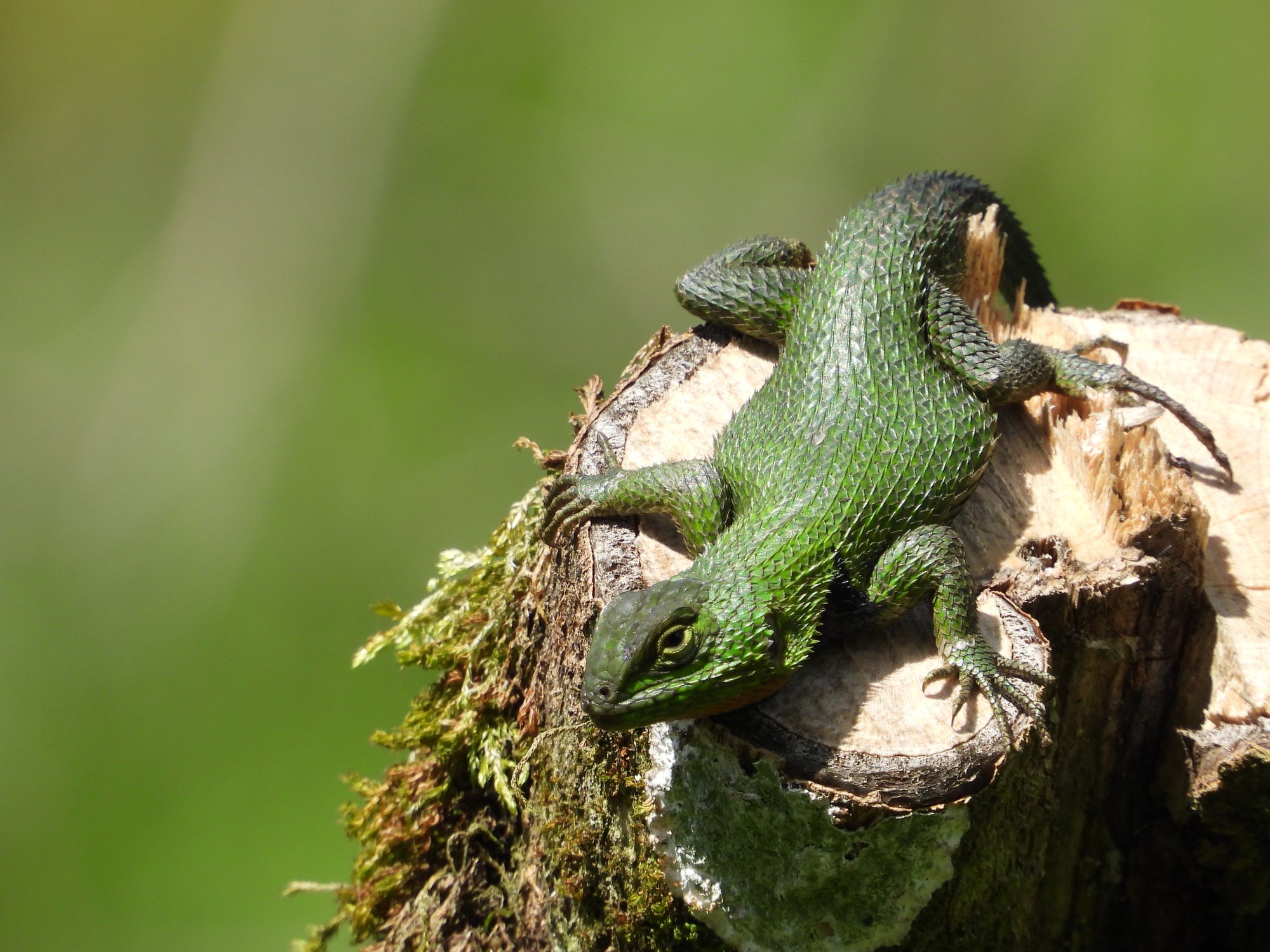
Emerald spiny lizard (Sceloporus formosus)
Iguanas · Difficulty: Beginner with some knowledge
Key facts and care guidance for Emerald spiny lizard (Sceloporus formosus) (origin: Southern and central Mexico). Adult size around 15–20 cm. Life expectancy 5–10 years. The values below are carefully researched guidance.
Short answers
Emerald spiny lizard: How big does the enclosure need to be?
120×60×60 cm for a group.
Emerald spiny lizard: What temperature does it need?
Daytime 27–33 °C, basking spot Basking spot 42–48 °C, at night 15–20 °C.
Emerald spiny lizard: Does it need UVB lighting?
UVB: Essential (UVB 10.0–12.0).
Emerald spiny lizard: How long do they live?
Life expectancy: 5–10 years.
Emerald spiny lizard: Is it suitable for beginners?
Partly – manageable with some prior knowledge (difficulty: Beginner with some knowledge).
Climate
- Daytime temperature
- 27–33 °C
- Night temperature
- 15–20 °C
- Basking spot
- Basking spot 42–48 °C
- Humidity
- 30–50 %
- UVB
- Essential (UVB 10.0–12.0)
Enclosure
- Minimum size
- 120×60×60 cm for a group
- Substrate
- A sand-loam mix they can dig in, with stone slabs, roots and a few twigs
Feeding
- Food
- Crickets, house crickets, roaches and locusts, dusted regularly with calcium and vitamins
- Feeding interval
- adults 3×/week
Key facts
- Adult size
- 15–20 cm
- Life expectancy
- 5–10 years
- Origin
- Southern and central Mexico
- Protection status
- Not listed under CITES
- Brumation
- A cooler rest of 8–12 weeks at 10–15 °C
- Cohabitation
- Keeping them singly is the least stressful option. One male with two to three females (1,2 or 1,3) is also possible if every animal gets its own basking spot and hide, and animals of different sizes are fed separately. Never keep males together: in the closely related S. malachiticus, male territorial fights regularly end in injury.
Notes
Brilliant green to turquoise. A montane forest species, more humid than the desert forms.
Do you keep this species?
Add your animal to Reptoria – Reptoria reminds you about feeding and shedding. Add your animal for free →
Look for Emerald spiny lizard (Sceloporus formosus) in the marketplace →
Related species
- Bunch-grass lizard (Sceloporus mucronatus) – Beginner with some knowledge
- Blue spiny lizard (Sceloporus cyanogenys) – Intermediate
- Clark's spiny lizard (Sceloporus clarkii) – Beginner
- Eastern spiny lizard (Sceloporus spinosus) – Beginner with some knowledge
- Crevice spiny lizard (Sceloporus poinsettii) – Beginner
- Fire-headed spiny lizard (Sceloporus pyrocephalus) – Beginner with some knowledge
- Florida scrub lizard (Sceloporus woodi) – Beginner with some knowledge
- Blue spiny lizard (Sceloporus serrifer) – Intermediate
What you need to start
To keep Emerald spiny lizard (Sceloporus formosus) you typically need: a suitable enclosure (120×60×60 cm for a group), substrate (A sand-loam mix they can dig in, with stone slabs, roots and a few twigs), a heat source with a thermostat, UVB lighting, thermometer and hygrometer, a water dish and hides. You will find equipment in the Reptoria marketplace.
The complete, interactive care database is in the Reptoria app.
Last updated: 9 October 2026 · Editor: Reptoria editorial team · Sources include: https://en.wikipedia.org/wiki/Sceloporus_formosus, https://reptile-database.reptarium.cz/species?genus=Sceloporus&species=formosus
All values are non-binding guidance and do not replace expert advice. Research thoroughly from several sources before acquiring and keeping an animal, and observe the applicable law (species and animal protection in particular).