Forest cobra (Naja melanoleuca)
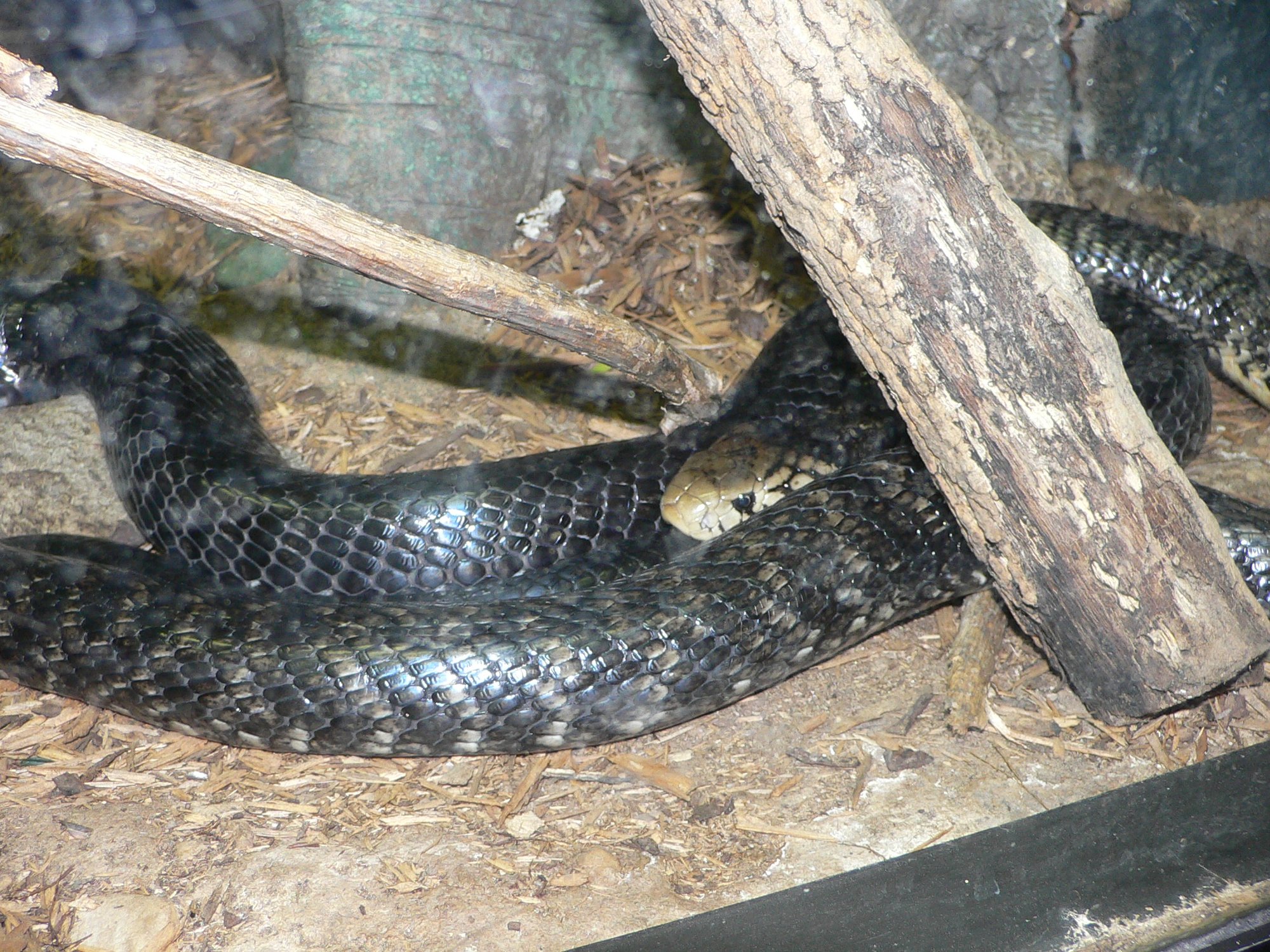
Snakes · Difficulty: Expert
Key facts and care guidance for Forest cobra (Naja melanoleuca) (origin: Zentralafrika (Nigeria, Kamerun, Zentralafrikanische Republik, Äquatorialguinea, Gabun, Kongo, DR Kongo, Nordangola, Ruanda, Südsudan); Tiefland-, Galerie- und Sumpfwald). Adult size around 180–250 cm (the largest true cobra), record up to approx. 320 cm. Life expectancy 15–25 years. The values below are carefully researched guidance.
Short answers
Forest cobra: How big does the enclosure need to be?
From 480×240×200 cm (minimum size according to the 1997 expert report, cobras).
Forest cobra: What temperature does it need?
Daytime 26–30 °C, basking spot 32–34 °C, at night 20–24 °C.
Forest cobra: Does it need UVB lighting?
UVB: UVB recommended (diurnal).
Forest cobra: How long do they live?
Life expectancy: 15–25 years.
Forest cobra: Is it suitable for beginners?
No – better suited to experienced keepers (difficulty: Expert).
Climate
- Daytime temperature
- 26–30 °C
- Night temperature
- 20–24 °C
- Basking spot
- 32–34 °C
- Humidity
- 60–80 % (the forest form more humid; the savannah form / subfulva drier, good ventilation)
- UVB
- UVB recommended (diurnal)
Enclosure
- Minimum size
- from 480×240×200 cm (minimum size according to the 1997 expert report, cobras)
- Substrate
- A peat substitute and sand mix or woodland substrate; a shedding box with damp soil, a large water basin
Feeding
- Food
- Rodents (mice or rats), birds, amphibians, reptiles and fish too
- Feeding interval
- adults 1× every 7–10 days, juveniles 1× every 5–7 days
Key facts
- Adult size
- 180–250 cm (the largest true cobra), record up to approx. 320 cm
- Life expectancy
- 15–25 years
- Origin
- Zentralafrika (Nigeria, Kamerun, Zentralafrikanische Republik, Äquatorialguinea, Gabun, Kongo, DR Kongo, Nordangola, Ruanda, Südsudan); Tiefland-, Galerie- und Sumpfwald
- Protection status
- Highly venomous (neurotoxic), very defensive and large - not CITES-listed; keeping it requires a permit or notification, or is banned outright, depending on the German state.
- Brumation
- No real winter rest; only a night-time drop (~20 °C) and a shorter photoperiod
- Cohabitation
- Keep singly. Forest cobras also eat other snakes and are large and defensive – one animal per enclosure is the only safe and stress-free solution, not least because during every task you must know where the animal is. For breeding, put them together only briefly and under supervision.
Notes
It reacts defensively to disturbance and does not flee at once; a very good swimmer, semi-aquatic and climbing → a large, well-secured terrarium with water and climbing opportunities. For experts only.
Do you keep this species?
Add your animal to Reptoria – Reptoria reminds you about feeding and shedding. Add your animal for free →
Look for Forest cobra (Naja melanoleuca) in the marketplace →
Related species
- Egyptian cobra (Naja haje) – Expert
- Indian cobra (Naja naja) – Expert
- Chinese cobra (Naja atra) – Expert
- Indochinese spitting cobra (Naja siamensis) – Expert
- Javan spitting cobra (Naja sputatrix) – Expert
- Cape cobra (Naja nivea) – Expert
- Monocled cobra (Naja kaouthia) – Expert
- Mozambique spitting cobra (Naja mossambica) – Expert
What you need to start
To keep Forest cobra (Naja melanoleuca) you typically need: a suitable enclosure (from 480×240×200 cm (minimum size according to the 1997 expert report, cobras)), substrate (A peat substitute and sand mix or woodland substrate; a shedding box with damp soil, a large water basin), a heat source with a thermostat, UVB lighting, thermometer and hygrometer, a water dish and hides. You will find equipment in the Reptoria marketplace.
The complete, interactive care database is in the Reptoria app.
Last updated: 5 November 2026 · Editor: Reptoria editorial team · Sources include: https://reptile-database.reptarium.cz/species?genus=Naja&species=melanoleuca, https://en.wikipedia.org/wiki/Forest_cobra, https://academy.herpeton.net/en/caresheets/snakes/naja-melanoleuca/, Animal Diversity Web Naja melanoleuca (tagaktiv in unbewohnten Gebieten, nachtaktiv nahe Siedlungen); African Snakebite Institute (tags und nachts aktiv); African Reptiles & Venom (tagaktiv, vor allem gegen Abend)
All values are non-binding guidance and do not replace expert advice. Research thoroughly from several sources before acquiring and keeping an animal, and observe the applicable law (species and animal protection in particular).