Henkel's leaf-tailed gecko (Uroplatus henkeli)
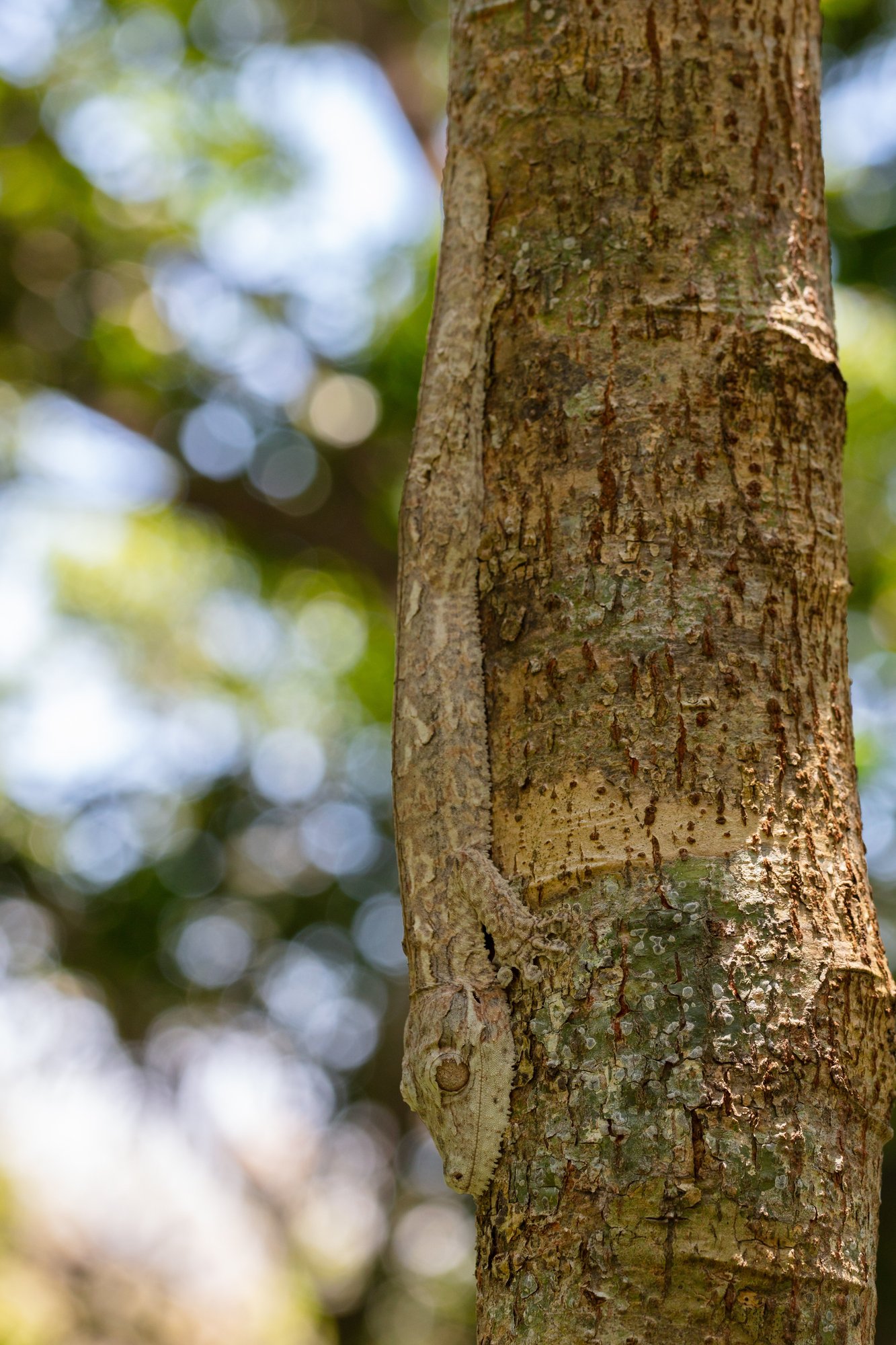
Geckos · Difficulty: Expert
Key facts and care guidance for Henkel's leaf-tailed gecko (Uroplatus henkeli) (origin: North-western Madagascar (Sambirano, Nosy Be, Nosy Komba, Ankarafantsika, Tsingy de Bemaraha); dry and humid forest). Adult size around up to ~28 cm total length (one of the largest Uroplatus species). Life expectancy approx. 7–10 years (up to ~15 with optimal care). The values below are carefully researched guidance.
Short answers
Henkel's leaf-tailed gecko: How big does the enclosure need to be?
A large tall enclosure, approx. 60×50×80 cm for one animal; considerably larger for a pair or trio (e.g. 60×60×120 cm).
Henkel's leaf-tailed gecko: What temperature does it need?
Daytime 24–26 °C (max. 28 °C, never permanently above 28–30 °C), basking spot — (no classic basking spot; keep cool), at night 20–22 °C (a night-time drop matters).
Henkel's leaf-tailed gecko: Does it need UVB lighting?
UVB: Low UVB recommended (Ferguson zone 1–2, UV index 1–2), especially for females and juveniles; nocturnal.
Henkel's leaf-tailed gecko: How long do they live?
Life expectancy: approx. 7–10 years (up to ~15 with optimal care).
Henkel's leaf-tailed gecko: Is it suitable for beginners?
No – better suited to experienced keepers (difficulty: Expert).
Climate
- Daytime temperature
- 24–26 °C (max. 28 °C, never permanently above 28–30 °C)
- Night temperature
- 20–22 °C (a night-time drop matters)
- Basking spot
- — (no classic basking spot; keep cool)
- Humidity
- 60–80 % by day, up to ~90–100 % at night (misting at night)
- UVB
- Low UVB recommended (Ferguson zone 1–2, UV index 1–2), especially for females and juveniles; nocturnal
Enclosure
- Minimum size
- a large tall enclosure, approx. 60×50×80 cm for one animal; considerably larger for a pair or trio (e.g. 60×60×120 cm)
- Substrate
- Damp bioactive woodland or coco substrate with leaf litter, live plants, plenty of vertical branches
Feeding
- Food
- Large insects (crickets, roaches, locusts); calcium and vitamins
- Feeding interval
- adults 2–3×/week, juveniles daily; calcium and vitamins weekly (juveniles) to fortnightly (adults)
Key facts
- Adult size
- up to ~28 cm total length (one of the largest Uroplatus species)
- Life expectancy
- approx. 7–10 years (up to ~15 with optimal care)
- Origin
- North-western Madagascar (Sambirano, Nosy Be, Nosy Komba, Ankarafantsika, Tsingy de Bemaraha); dry and humid forest
- Protection status
- CITES Appendix II / EU Regulation Annex B (Uroplatus spp. since 2005); proof of origin + registration requirement; frequently wild-caught.
- Brumation
- No real winter rest; a slight seasonal variation in temperature and humidity (a cooler, drier period) is recommended
- Cohabitation
- Keeping singly or in pairs (1.1) is possible; males must never be together (territorial). Suitable only for experienced keepers and breeders.
Notes
Not very forgiving of mistakes – it reacts badly to heat (above 28–30 °C: heat stress, dehydration, infertility) and to permanent damp without ventilation. Wild-caught animals are burdened with parasites; captive-bred ones are markedly more robust. The terrarium size varies by source.
Do you keep this species?
Add your animal to Reptoria – Reptoria reminds you about feeding and shedding. Add your animal for free →
Look for Henkel's leaf-tailed gecko (Uroplatus henkeli) in the marketplace →
Related species
- Alluaud's leaf-tailed gecko (Uroplatus alluaudi) – Expert
- Ebenau's leaf-tailed gecko (Uroplatus ebenaui) – Intermediate to expert
- Finiavana leaf-tailed gecko (Uroplatus finiavana) – Intermediate
- Common flat-tail gecko (Uroplatus fimbriatus) – Intermediate to expert
- Günther's leaf-tailed gecko (Uroplatus guentheri) – Expert
- Pietschmann's leaf-tailed gecko (Uroplatus pietschmanni) – Expert
- Lined leaf-tailed gecko (Uroplatus lineatus) – Expert
- Mossy leaf-tailed gecko (Uroplatus sikorae) – Expert
What you need to start
To keep Henkel's leaf-tailed gecko (Uroplatus henkeli) you typically need: a suitable enclosure (a large tall enclosure, approx. 60×50×80 cm for one animal; considerably larger for a pair or trio (e.g. 60×60×120 cm)), substrate (Damp bioactive woodland or coco substrate with leaf litter, live plants, plenty of vertical branches), a heat source with a thermostat, UVB lighting, thermometer and hygrometer, a water dish and hides. You will find equipment in the Reptoria marketplace.
The complete, interactive care database is in the Reptoria app.
Last updated: 9 October 2026 · Editor: Reptoria editorial team · Sources include: https://en.wikipedia.org/wiki/Uroplatus, https://en.wikipedia.org/wiki/Uroplatus_henkeli
All values are non-binding guidance and do not replace expert advice. Research thoroughly from several sources before acquiring and keeping an animal, and observe the applicable law (species and animal protection in particular).