Johnston's chameleon (Trioceros johnstoni)
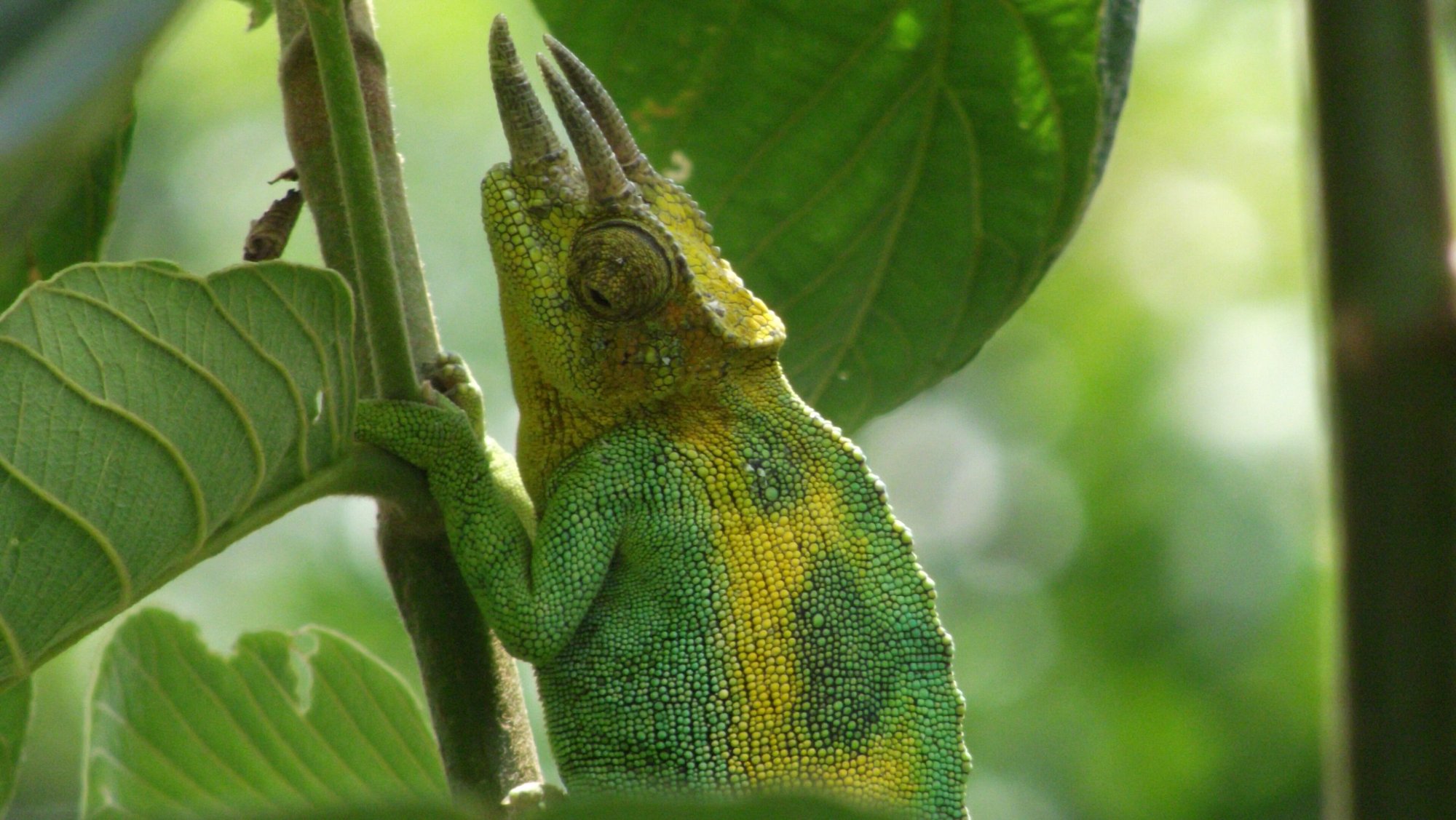
Chameleons · Difficulty: Expert
Key facts and care guidance for Johnston's chameleon (Trioceros johnstoni) (origin: Uganda, Rwanda, DR Congo – montane forest). Adult size around 20–30 cm. Life expectancy 5–8 years. The values below are carefully researched guidance.
Short answers
Johnston's chameleon: How big does the enclosure need to be?
60×60×120 cm, well ventilated.
Johnston's chameleon: What temperature does it need?
Daytime 20–26 °C, basking spot 28 °C (small basking spot), at night 14–18 °C.
Johnston's chameleon: Does it need UVB lighting?
UVB: Essential (UVB 5.0–6 %).
Johnston's chameleon: How long do they live?
Life expectancy: 5–8 years.
Johnston's chameleon: Is it suitable for beginners?
No – better suited to experienced keepers (difficulty: Expert).
Climate
- Daytime temperature
- 20–26 °C
- Night temperature
- 14–18 °C
- Basking spot
- 28 °C (small basking spot)
- Humidity
- 70–85 %, mist twice a day
- UVB
- Essential (UVB 5.0–6 %)
Enclosure
- Minimum size
- 60×60×120 cm, well ventilated
- Substrate
- A planted terrarium, fine twigs, a drip system
Feeding
- Food
- Insects (house crickets, flies, roaches)
- Feeding interval
- adults every other day
Key facts
- Adult size
- 20–30 cm
- Life expectancy
- 5–8 years
- Origin
- Uganda, Rwanda, DR Congo – montane forest
- Protection status
- CITES II
- Brumation
- None
- Cohabitation
- Keep singly. Males and females are kept separately, males must not see each other either; gravid females belong alone. Pairs or a group (one male with 2-3 females) are only possible in a very large, densely planted enclosure (about 90x90x180 cm) and mean more stress; screen neighbouring enclosures from each other.
Notes
A montane forest species: cool, humid, very well ventilated. Above 27 °C is tolerated poorly. It drinks only from leaves – a drip system or repeated misting is essential.
Do you keep this species?
Add your animal to Reptoria – Reptoria reminds you about feeding and shedding. Add your animal for free →
Look for Johnston's chameleon (Trioceros johnstoni) in the marketplace →
Related species
- Affinis chameleon (Trioceros affinis) – Expert
- Bale two-horned chameleon (Trioceros balebicornutus) – Expert
- Usambara three-horned chameleon (Trioceros deremensis) – Intermediate to expert
- Elliot's chameleon (Trioceros ellioti) – Intermediate
- Fea's chameleon (Trioceros feae) – Expert
- Goetze's chameleon (Trioceros goetzei) – Expert
- Harenna chameleon (Trioceros harennae) – Expert
- Von Höhnel's chameleon (Trioceros hoehnelii) – Intermediate
What you need to start
To keep Johnston's chameleon (Trioceros johnstoni) you typically need: a suitable enclosure (60×60×120 cm, well ventilated), substrate (A planted terrarium, fine twigs, a drip system), a heat source with a thermostat, UVB lighting, thermometer and hygrometer, a water dish and hides. You will find equipment in the Reptoria marketplace.
The complete, interactive care database is in the Reptoria app.
Last updated: 7 November 2026 · Editor: Reptoria editorial team · Sources include: Chameleon Academy: Trioceros johnstoni, Eier schlüpfen nach ca. 100 Tagen bei 18-21°C – https://chameleonacademy.com/trioceros-johnstoni/, Wikipedia Trioceros johnstoni: oviparous, 12-18 Eier – https://en.wikipedia.org/wiki/Trioceros_johnstoni, https://chameleonacademy.com/trioceros-johnstoni/, https://en.wikipedia.org/wiki/Johnston%27s_chameleon, https://reptile-database.reptarium.cz/species?genus=Trioceros&species=johnstoni
All values are non-binding guidance and do not replace expert advice. Research thoroughly from several sources before acquiring and keeping an animal, and observe the applicable law (species and animal protection in particular).