Malayan krait (Bungarus candidus)
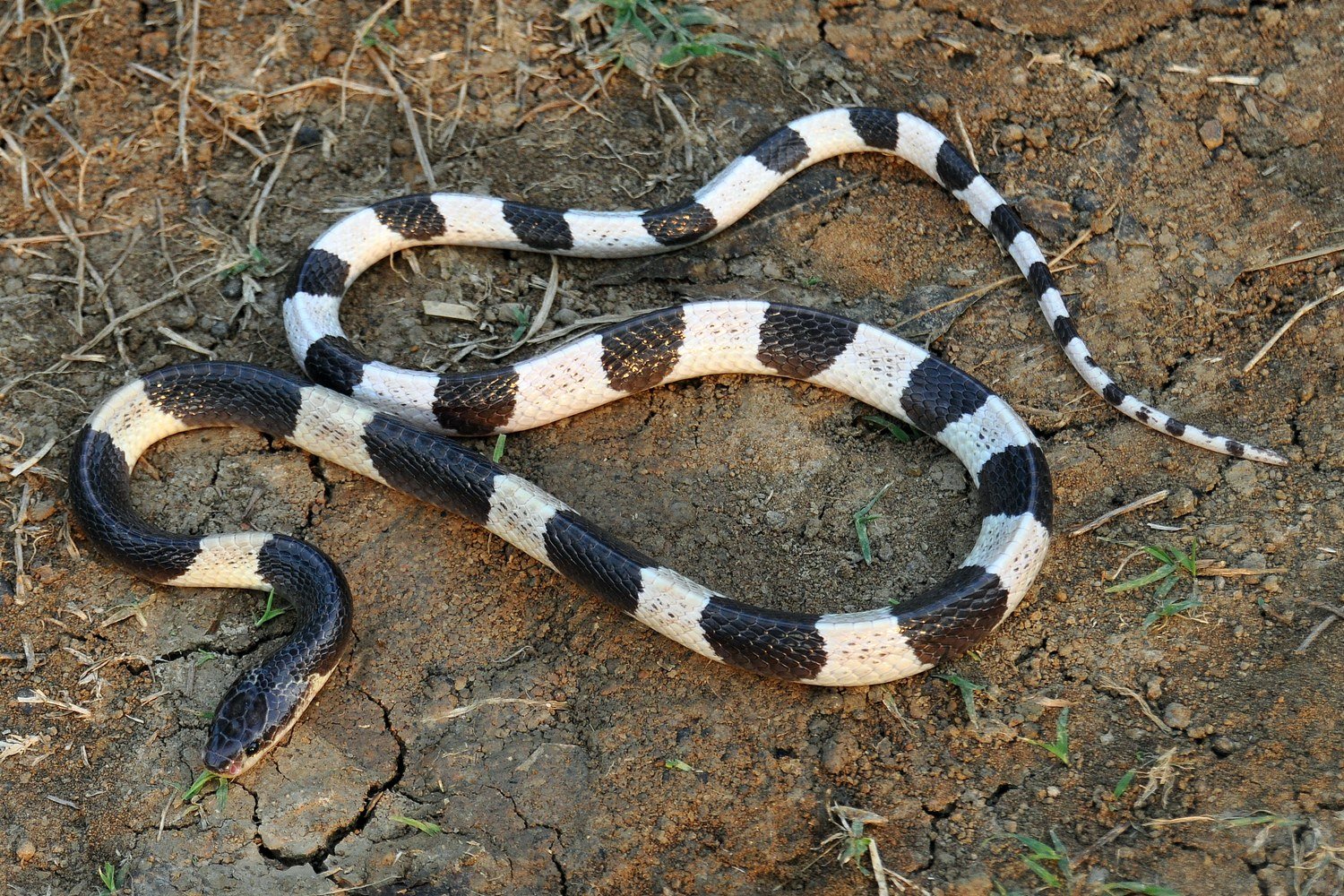
Snakes · Difficulty: Expert
Key facts and care guidance for Malayan krait (Bungarus candidus) (origin: South-East Asia (Thailand, Malaysia, Indonesia)). Adult size around 100–150 cm. Life expectancy 15–20 years. The values below are carefully researched guidance.
Short answers
Malayan krait: How big does the enclosure need to be?
For an animal of 120–160 cm total length, per the expert-report formula (1.0 x 0.75 x 0.5 times total length), around 150 x 110 x 80 cm, lockable with a secured sliding door.
Malayan krait: What temperature does it need?
Daytime 25–29 °C, basking spot 30–31 °C, at night 21–24 °C.
Malayan krait: Does it need UVB lighting?
UVB: Not essential.
Malayan krait: How long do they live?
Life expectancy: 15–20 years.
Malayan krait: Is it suitable for beginners?
No – better suited to experienced keepers (difficulty: Expert).
Climate
- Daytime temperature
- 25–29 °C
- Night temperature
- 21–24 °C
- Basking spot
- 30–31 °C
- Humidity
- 65–80 %
- UVB
- Not essential
Enclosure
- Minimum size
- for an animal of 120–160 cm total length, per the expert-report formula (1.0 x 0.75 x 0.5 times total length), around 150 x 110 x 80 cm, lockable with a secured sliding door
- Substrate
- Damp substrate, hides, a water basin
Feeding
- Food
- Snakes, fish, amphibian substitutes
- Feeding interval
- adults every 10–14 days
Key facts
- Adult size
- 100–150 cm
- Life expectancy
- 15–20 years
- Origin
- South-East Asia (Thailand, Malaysia, Indonesia)
- Protection status
- VENOMOUS – a highly potent neurotoxin; a dangerous animal
- Brumation
- None
- Cohabitation
- Keep them singly. Snakes are solitary and do not seek company — a shared hide is competition for the best spot, not social behaviour. The concrete reason is the feeding accident: if two animals grab the same food item, one can swallow the other along with it. On top of that, once they are kept together you can no longer tell which animal has eaten and which is losing weight. For breeding, put them together under supervision and separate them again afterwards.
Notes
Nocturnal, sluggish and seemingly harmless by day – markedly more active and defensive at night. Bites are often barely painful, with delayed respiratory paralysis.
Do you keep this species?
Add your animal to Reptoria – Reptoria reminds you about feeding and shedding. Add your animal for free →
Look for Malayan krait (Bungarus candidus) in the marketplace →
Related species
- Banded krait (Bungarus fasciatus) – Expert
- Common krait (Bungarus caeruleus) – Expert
- Many-banded krait (Bungarus multicinctus) – Expert
- Savanna vine snake (Thelotornis capensis) – Expert
- Egyptian cobra (Naja haje) – Expert
- Egyptian saw-scaled viper (Echis pyramidum) – Expert
- Barnett's lancehead (Bothrops barnetti) – Expert
- Usambara bush viper (Atheris ceratophora) – Expert
What you need to start
To keep Malayan krait (Bungarus candidus) you typically need: a suitable enclosure (for an animal of 120–160 cm total length, per the expert-report formula (1.0 x 0.75 x 0.5 times total length), around 150 x 110 x 80 cm, lockable with a secured sliding door), substrate (Damp substrate, hides, a water basin), a heat source with a thermostat, UVB lighting, thermometer and hygrometer, a water dish and hides. You will find equipment in the Reptoria marketplace.
The complete, interactive care database is in the Reptoria app.
Last updated: 9 October 2026 · Editor: Reptoria editorial team · Sources include: Wikipedia DE (Blauer Krait), Wikipedia DE (Giftschlangen), Wikipedia EN (Bungarus candidus), eu_annex.txt (lokal, VO (EU) 2026/1383), gutachten.txt (BML 1997, lokal)
All values are non-binding guidance and do not replace expert advice. Research thoroughly from several sources before acquiring and keeping an animal, and observe the applicable law (species and animal protection in particular).