Nelson's milk snake (Lampropeltis triangulum nelsoni)
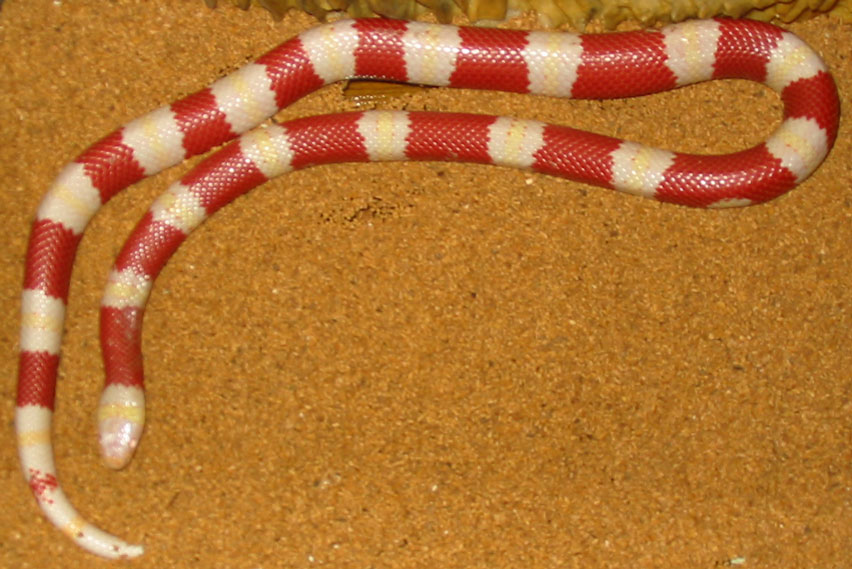
Snakes · Difficulty: Beginner
Key facts and care guidance for Nelson's milk snake (Lampropeltis triangulum nelsoni) (origin: The Pacific coastal region of western and central Mexico (Guanajuato, Jalisco, Michoacán, the Tres Marías Islands)). Adult size around approx. 100–130 cm. Life expectancy 15–20+ years in captivity. The values below are carefully researched guidance.
Short answers
Nelson's milk snake: How big does the enclosure need to be?
From 130×65×65 cm (minimum size according to the 1997 expert report, kingsnakes, 1 adult animal).
Nelson's milk snake: What temperature does it need?
Daytime 24–28 °C, basking spot 30–33 °C, at night 20–22 °C (not below 18 °C).
Nelson's milk snake: Does it need UVB lighting?
UVB: UVB not strictly needed; low UVB (Ferguson zone 1, UV index 0.5–1) is optional and beneficial.
Nelson's milk snake: How long do they live?
Life expectancy: 15–20+ years in captivity.
Nelson's milk snake: Is it suitable for beginners?
Yes – it is considered suitable for beginners (difficulty: Beginner).
Climate
- Daytime temperature
- 24–28 °C
- Night temperature
- 20–22 °C (not below 18 °C)
- Basking spot
- 30–33 °C
- Humidity
- 40–60 %
- UVB
- UVB not strictly needed; low UVB (Ferguson zone 1, UV index 0.5–1) is optional and beneficial
Enclosure
- Minimum size
- from 130×65×65 cm (minimum size according to the 1997 expert report, kingsnakes, 1 adult animal)
- Substrate
- Bark mulch, beech chips or coco humus, dry with one slightly damp zone; cork tubes and hides
Feeding
- Food
- Thawed frozen mice or small rats of a suitable size
- Feeding interval
- adults every 10–14 days, juveniles every 5–7 days
Key facts
- Adult size
- approx. 100–130 cm
- Life expectancy
- 15–20+ years in captivity
- Origin
- The Pacific coastal region of western and central Mexico (Guanajuato, Jalisco, Michoacán, the Tres Marías Islands)
- Protection status
- Not listed under CITES, not relevant under German species protection law; in the trade virtually only captive-bred animals
- Brumation
- An optional winter rest of 6–8 weeks at ~12–16 °C with a shortened photoperiod (mainly to stimulate breeding); not essential
- Cohabitation
- Keep singly. Milk snakes are not social and eat other snakes, so single housing is the only safe choice. A pair only briefly for mating and under observation, then separate; always feed separately.
Notes
A calm, robust beginner's snake; a powerful constrictor. Common mistakes: conditions that are too damp (skin problems), keeping them together (cannibalism), and feeder animals that are too large. Keep a water container always available. Similar in colour to the venomous coral snake (mimicry), but entirely non-venomous.
Do you keep this species?
Add your animal to Reptoria – Reptoria reminds you about feeding and shedding. Add your animal for free →
Look for Nelson's milk snake (Lampropeltis triangulum nelsoni) in the marketplace →
Related species
- Andean milk snake (Lampropeltis micropholis) – Intermediate
- Sonoran mountain kingsnake (Lampropeltis pyromelana) – Intermediate
- Isla Todos Santos kingsnake (Lampropeltis herrerae) – Expert
- California mountain kingsnake (Lampropeltis zonata) – Intermediate
- Chihuahuan mountain kingsnake (Lampropeltis knoblochi) – Intermediate
- Desert kingsnake (Lampropeltis splendida) – Beginner
- Florida kingsnake (Lampropeltis getula floridana) – Beginner
- Eastern kingsnake (Lampropeltis getula getula) – Beginner
What you need to start
To keep Nelson's milk snake (Lampropeltis triangulum nelsoni) you typically need: a suitable enclosure (from 130×65×65 cm (minimum size according to the 1997 expert report, kingsnakes, 1 adult animal)), substrate (Bark mulch, beech chips or coco humus, dry with one slightly damp zone; cork tubes and hides), a heat source with a thermostat, UVB lighting, thermometer and hygrometer, a water dish and hides. You will find equipment in the Reptoria marketplace.
The complete, interactive care database is in the Reptoria app.
Last updated: 7 November 2026 · Editor: Reptoria editorial team · Sources include: Reptile Database: Lampropeltis triangulum – oviparous – https://reptile-database.reptarium.cz/species?genus=Lampropeltis&species=triangulum, Wikipedia: Milk snake – Zuchtstandard 24-27°C, 55-70 Tage (Gattung) – https://en.wikipedia.org/wiki/Milk_snake, https://en.wikipedia.org/wiki/Lampropeltis_triangulum, https://reptifiles.com/milksnake-care-sheet, https://reptile-database.reptarium.cz/species?genus=Lampropeltis&species=polyzona
All values are non-binding guidance and do not replace expert advice. Research thoroughly from several sources before acquiring and keeping an animal, and observe the applicable law (species and animal protection in particular).