Red diamond rattlesnake (Crotalus ruber)
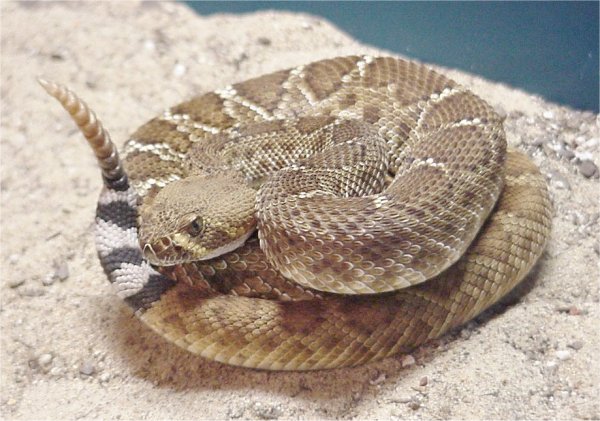
Snakes · Difficulty: Expert
Key facts and care guidance for Red diamond rattlesnake (Crotalus ruber) (origin: Southern California and Baja California (Mexico)). Adult size around 100–140 cm (record 162 cm). Life expectancy 15–20 years. The values below are carefully researched guidance.
Short answers
Red diamond rattlesnake: How big does the enclosure need to be?
From 205×85×125 cm (minimum size according to the 1997 expert report, rattlesnakes).
Red diamond rattlesnake: What temperature does it need?
Daytime 24–30 °C, basking spot 32–35 °C, at night 18–22 °C.
Red diamond rattlesnake: Does it need UVB lighting?
UVB: UVB recommended.
Red diamond rattlesnake: How long do they live?
Life expectancy: 15–20 years.
Red diamond rattlesnake: Is it suitable for beginners?
No – better suited to experienced keepers (difficulty: Expert).
Climate
- Daytime temperature
- 24–30 °C
- Night temperature
- 18–22 °C
- Basking spot
- 32–35 °C
- Humidity
- 30–45 %
- UVB
- UVB recommended
Enclosure
- Minimum size
- from 205×85×125 cm (minimum size according to the 1997 expert report, rattlesnakes)
- Substrate
- Sand-clay mix or gravel, stable rock structures, cork hides, a large water dish
Feeding
- Food
- Frozen-thawed mice and rats
- Feeding interval
- adults every 10–14 days
Key facts
- Adult size
- 100–140 cm (record 162 cm)
- Life expectancy
- 15–20 years
- Origin
- Southern California and Baja California (Mexico)
- Protection status
- VENOMOUS (haemotoxic) - a dangerous animal, requiring a permit or notification depending on the German state; IUCN: Near Threatened.
- Brumation
- A cooler rest period of 8–12 weeks at 15–20 °C (December–February)
- Cohabitation
- Single housing. Snakes live solitary and do not seek company — a shared hiding place is competition for the best spot, not social behaviour. The concrete reason is a feeding accident: if two animals strike at the same prey, one can swallow the other along with it. With a venomous snake there is the added factor that every regrouping and separation is an extra step at an open enclosure. Bring together under supervision for pairing and separate again afterwards.
Notes
Considered a comparatively calm rattlesnake that reliably warns with its rattle before striking. Its venom is relatively weak for a rattlesnake, but the amount delivered is large — a bite remains an emergency requiring antivenom. Keeping it requires a permit under state law, a secured enclosure and confirmed access to antivenom. Young are born in late summer.
Do you keep this species?
Add your animal to Reptoria – Reptoria reminds you about feeding and shedding. Add your animal for free →
Red diamond rattlesnake (Crotalus ruber) currently offered
- Crotalus ruber Rote-Diamant-Klapperschlange – Hardisleben · 200 €
Related species
- Eastern diamondback rattlesnake (Crotalus adamanteus) – Expert
- Ridge-nosed rattlesnake (Crotalus willardi) – Expert
- Mojave rattlesnake (Crotalus scutulatus) – Expert
- Prairie rattlesnake (Crotalus viridis) – Expert
- Neotropical rattlesnake (Crotalus durissus) – Expert
- Black-tailed rattlesnake (Crotalus molossus) – Expert
- Sidewinder (Crotalus cerastes) – Expert
- Western diamondback rattlesnake (Crotalus atrox) – Expert
What you need to start
To keep Red diamond rattlesnake (Crotalus ruber) you typically need: a suitable enclosure (from 205×85×125 cm (minimum size according to the 1997 expert report, rattlesnakes)), substrate (Sand-clay mix or gravel, stable rock structures, cork hides, a large water dish), a heat source with a thermostat, UVB lighting, thermometer and hygrometer, a water dish and hides. You will find equipment in the Reptoria marketplace.
The complete, interactive care database is in the Reptoria app.
Last updated: 9 October 2026 · Editor: Reptoria editorial team · Sources include: Wikipedia DE, Wikipedia EN, animaldiversity.org, boa-constrictor.net, giftschlangenfarm.de
All values are non-binding guidance and do not replace expert advice. Research thoroughly from several sources before acquiring and keeping an animal, and observe the applicable law (species and animal protection in particular).