Russell's viper (Daboia russelii)
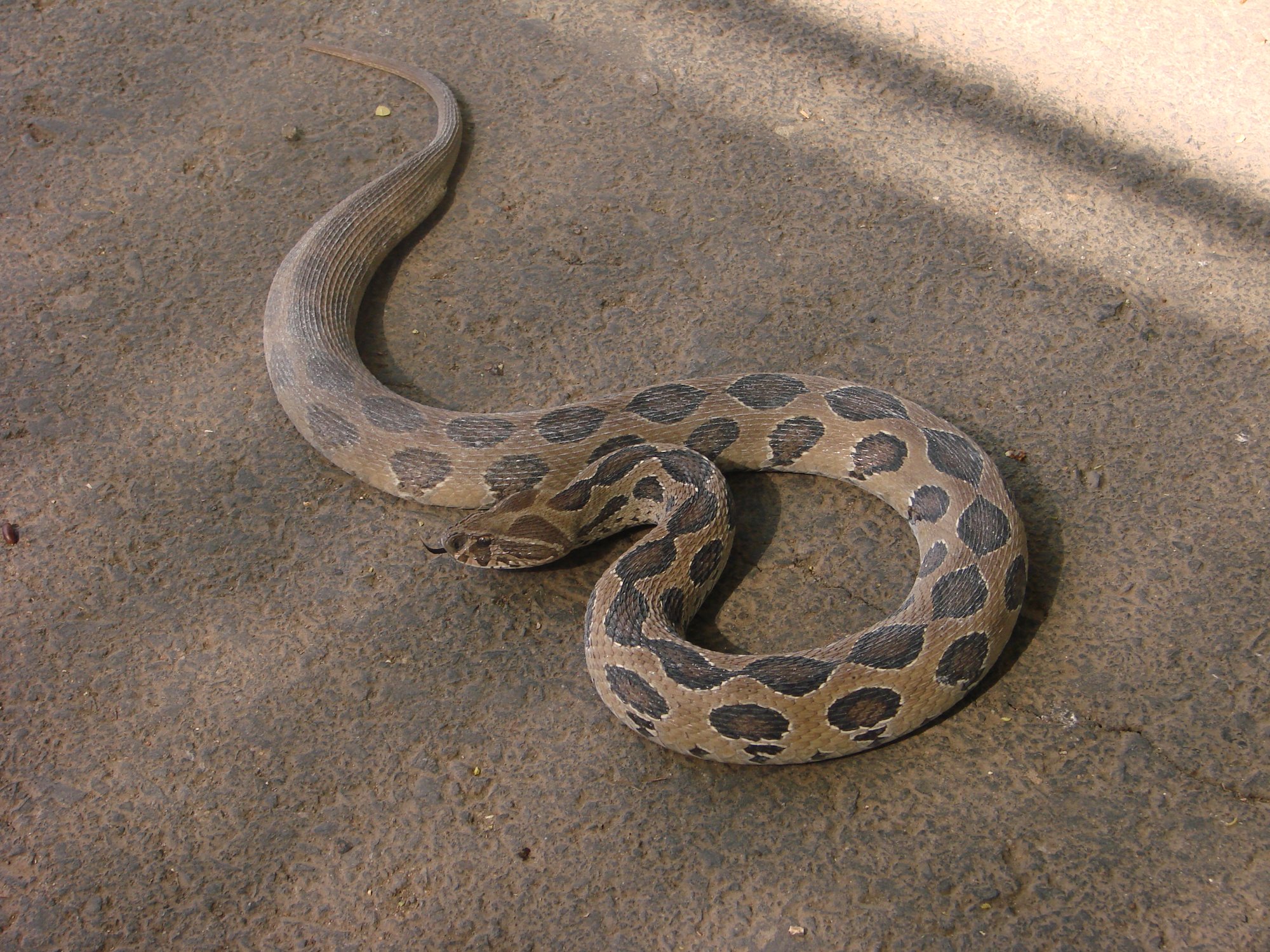
Snakes · Difficulty: Expert
Key facts and care guidance for Russell's viper (Daboia russelii) (origin: India, Sri Lanka, Pakistan, Bangladesh). Adult size around 100–150 cm. Life expectancy 15–20 years. The values below are carefully researched guidance.
Short answers
Russell's viper: How big does the enclosure need to be?
From 190×115×75 cm (minimum size per the 1997 expert report, oriental vipers).
Russell's viper: What temperature does it need?
Daytime 26–31 °C, basking spot 33–35 °C, at night 20–23 °C.
Russell's viper: Does it need UVB lighting?
UVB: UVB recommended.
Russell's viper: How long do they live?
Life expectancy: 15–20 years.
Russell's viper: Is it suitable for beginners?
No – better suited to experienced keepers (difficulty: Expert).
Climate
- Daytime temperature
- 26–31 °C
- Night temperature
- 20–23 °C
- Basking spot
- 33–35 °C
- Humidity
- 50–65 %
- UVB
- UVB recommended
Enclosure
- Minimum size
- from 190×115×75 cm (minimum size per the 1997 expert report, oriental vipers)
- Substrate
- Sand-loam with tussocks of grass and hides
Feeding
- Food
- Frozen-thawed mice and rats
- Feeding interval
- adults every 10–14 days
Key facts
- Adult size
- 100–150 cm
- Life expectancy
- 15–20 years
- Origin
- India, Sri Lanka, Pakistan, Bangladesh
- Protection status
- VENOMOUS – one of the most medically significant snakes in the world; a dangerous animal
- Brumation
- A cooler dry spell of 6–8 weeks
- Cohabitation
- Keep them singly. Snakes are solitary and do not seek company — a shared hide is competition for the best spot, not social behaviour. The concrete reason is the feeding accident: if two animals grab the same food item, one can swallow the other along with it. On top of that, once they are kept together you can no longer tell which animal has eaten and which is losing weight. For breeding, put them together under supervision and separate them again afterwards.
Notes
One of India's "Big Four", and it causes very many deaths there. Loudly hissing, extremely defensive, with a large venom yield. Keep it only with access to antivenom and an emergency plan.
Do you keep this species?
Add your animal to Reptoria – Reptoria reminds you about feeding and shedding. Add your animal for free →
Look for Russell's viper (Daboia russelii) in the marketplace →
Related species
- Palestine viper (Daboia palaestinae) – Expert
- Eastern Russell's viper (Daboia siamensis) – Expert
- Savanna vine snake (Thelotornis capensis) – Expert
- Egyptian cobra (Naja haje) – Expert
- Egyptian saw-scaled viper (Echis pyramidum) – Expert
- Barnett's lancehead (Bothrops barnetti) – Expert
- Usambara bush viper (Atheris ceratophora) – Expert
- Ottoman viper (Montivipera xanthina) – Expert
What you need to start
To keep Russell's viper (Daboia russelii) you typically need: a suitable enclosure (from 190×115×75 cm (minimum size per the 1997 expert report, oriental vipers)), substrate (Sand-loam with tussocks of grass and hides), a heat source with a thermostat, UVB lighting, thermometer and hygrometer, a water dish and hides. You will find equipment in the Reptoria marketplace.
The complete, interactive care database is in the Reptoria app.
Last updated: 8 November 2026 · Editor: Reptoria editorial team · Sources include: Reptile Database: Daboia russelii - Reproduction – https://reptile-database.reptarium.cz/species?genus=Daboia&species=russelii, Wikipedia: Russell's viper, ovoviviparous, 5-50 Jungtiere – https://en.wikipedia.org/wiki/Russell's_viper, https://de.wikipedia.org/wiki/Kettenviper, https://en.wikipedia.org/wiki/Daboia, https://en.wikipedia.org/wiki/Russell%27s_viper
All values are non-binding guidance and do not replace expert advice. Research thoroughly from several sources before acquiring and keeping an animal, and observe the applicable law (species and animal protection in particular).