Short-horned chameleon (Calumma brevicorne)
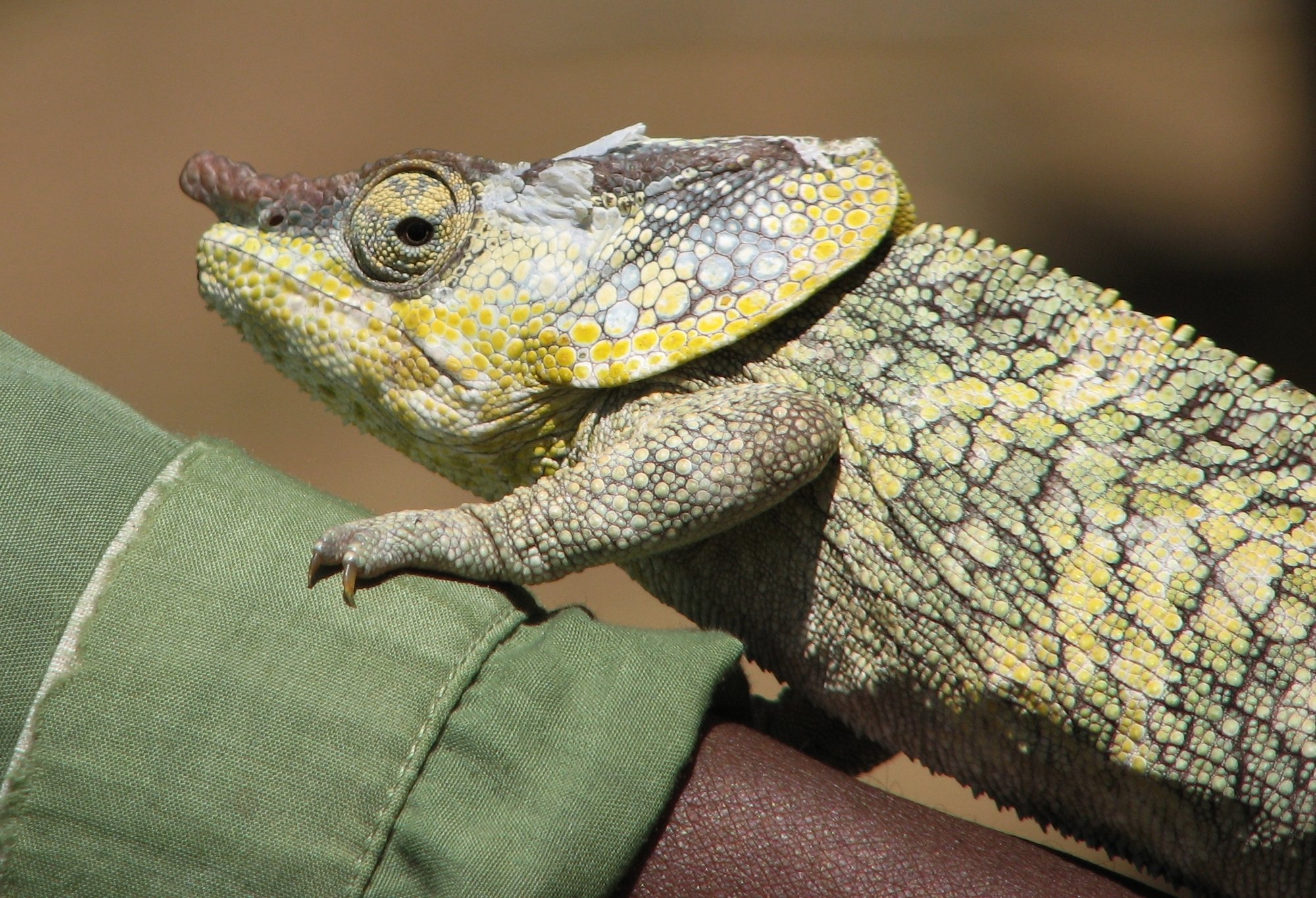
Chameleons · Difficulty: Expert
Key facts and care guidance for Short-horned chameleon (Calumma brevicorne) (origin: Eastern Madagascar, mid-altitude humid forest ~810–1,000 m (forest edges and disturbed areas)). Adult size around approx. 20–28 cm total length (medium-sized; males with larger occipital lobes). Life expectancy approx. 3–5 years (captive data uncertain). The values below are carefully researched guidance.
Short answers
Short-horned chameleon: How big does the enclosure need to be?
80×60×100 cm for one adult animal (Chameleon Academy: at least 90×45×90 cm; a 'forest edge' setup).
Short-horned chameleon: What temperature does it need?
Daytime 22–25 °C, basking spot 27–28 °C (moderate), at night 15–20 °C (summer ~20 °C, dry season/winter ~15 °C).
Short-horned chameleon: Does it need UVB lighting?
UVB: UVB needed (Ferguson zone 2–3, UV index 3 at the basking spot, max. ~6).
Short-horned chameleon: How long do they live?
Life expectancy: approx. 3–5 years (captive data uncertain).
Short-horned chameleon: Is it suitable for beginners?
No – better suited to experienced keepers (difficulty: Expert).
Climate
- Daytime temperature
- 22–25 °C
- Night temperature
- 15–20 °C (summer ~20 °C, dry season/winter ~15 °C)
- Basking spot
- 27–28 °C (moderate)
- Humidity
- 40–60 % during the day, 80–100 % at night
- UVB
- UVB needed (Ferguson zone 2–3, UV index 3 at the basking spot, max. ~6)
Enclosure
- Minimum size
- 80×60×100 cm for one adult animal (Chameleon Academy: at least 90×45×90 cm; a 'forest edge' setup)
- Substrate
- Forest floor or humus, leaf litter; dense mid-level planting as a retreat plus an open sunny area; a sand-soil mix for egg-laying
Feeding
- Food
- Insects: crickets, locusts, roaches, flying insects; calcium at every feed, a multivitamin (A and D3) every two weeks
- Feeding interval
- adults 3–4 feeder insects every other day, juveniles daily (ad libitum)
Key facts
- Adult size
- approx. 20–28 cm total length (medium-sized; males with larger occipital lobes)
- Life expectancy
- approx. 3–5 years (captive data uncertain)
- Origin
- Eastern Madagascar, mid-altitude humid forest ~810–1,000 m (forest edges and disturbed areas)
- Protection status
- CITES Appendix II / EU Regulation Annex B – specially protected: proof of origin plus registration required; usually wild-caught
- Brumation
- No brumation; recreate a pronounced rainy and dry season – cooler in the dry season (nights ~15 °C) and with less misting
- Cohabitation
- Keep them singly ("one chameleon per cage"). Territorial and solitary; put them together only briefly for mating. NEVER keep males together
Notes
An active montane forest species to be kept cool; with characteristic raisable occipital lobes. A common mistake: too warm. It needs a temperature gradient and seasonal cycles. The final size and lifespan are not exact in the sources.
Do you keep this species?
Add your animal to Reptoria – Reptoria reminds you about feeding and shedding. Add your animal for free →
Look for Short-horned chameleon (Calumma brevicorne) in the marketplace →
Related species
- Amber Mountain chameleon (Calumma ambreense) – Expert
- Andringitra chameleon (Calumma andringitraense) – Expert
- Side-striped chameleon (Calumma gastrotaenia) – Intermediate
- Amber Mountain chameleon (Calumma amber) – Intermediate to expert
- Boettger's chameleon (Calumma boettgeri) – Intermediate
- Capuron's chameleon (Calumma capuroni) – Expert
- Forked chameleon (Calumma furcifer) – Expert
- Glaw's chameleon (Calumma glawi) – Expert
What you need to start
To keep Short-horned chameleon (Calumma brevicorne) you typically need: a suitable enclosure (80×60×100 cm for one adult animal (Chameleon Academy: at least 90×45×90 cm; a 'forest edge' setup)), substrate (Forest floor or humus, leaf litter; dense mid-level planting as a retreat plus an open sunny area; a sand-soil mix for egg-laying), a heat source with a thermostat, UVB lighting, thermometer and hygrometer, a water dish and hides. You will find equipment in the Reptoria marketplace.
The complete, interactive care database is in the Reptoria app.
Last updated: 9 October 2026 · Editor: Reptoria editorial team · Sources include: https://chameleonacademy.com/short-horned-chameleon-calumma-brevicorne/, https://en.wikipedia.org/wiki/Calumma_brevicorne
All values are non-binding guidance and do not replace expert advice. Research thoroughly from several sources before acquiring and keeping an animal, and observe the applicable law (species and animal protection in particular).