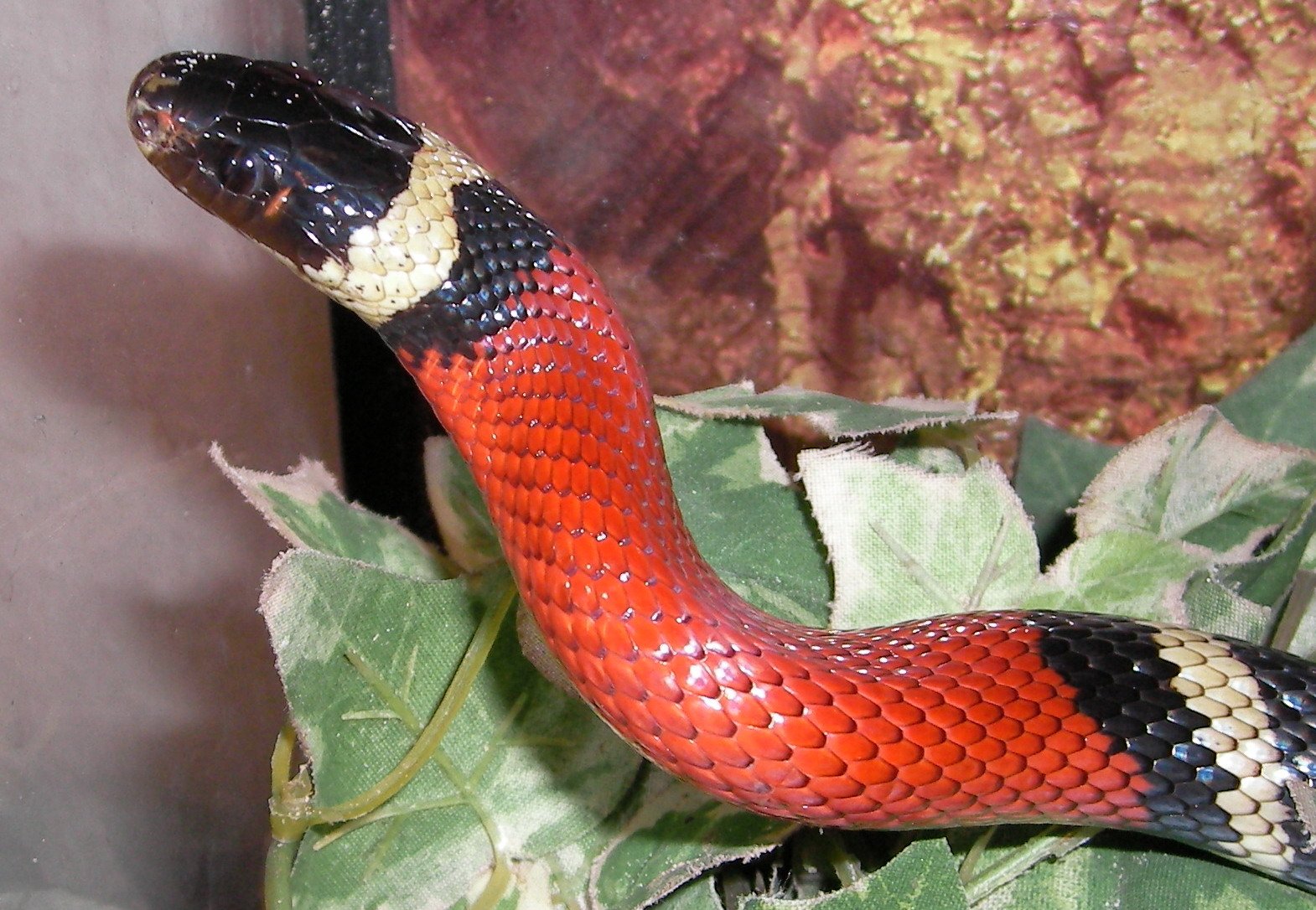
Sinaloan milk snake (Lampropeltis triangulum sinaloae)
Snakes · Difficulty: Beginner
Key facts and care guidance for Sinaloan milk snake (Lampropeltis triangulum sinaloae) (origin: North-western Mexico (Sinaloa, Sonora, south-western Chihuahua) – rocky semi-arid regions). Adult size around approx. 90–120 cm (rarely up to 130 cm). Life expectancy 15–20 years in captivity. The values below are carefully researched guidance.
Short answers
Sinaloan milk snake: How big does the enclosure need to be?
From 130×65×65 cm (minimum size according to the 1997 expert report, kingsnakes, 1 adult animal).
Sinaloan milk snake: What temperature does it need?
Daytime 24–28 °C, basking spot 30–33 °C, at night 20–22 °C (not below 18 °C).
Sinaloan milk snake: Does it need UVB lighting?
UVB: UVB not strictly needed; low UVB (Ferguson zone 1) optional and beneficial.
Sinaloan milk snake: How long do they live?
Life expectancy: 15–20 years in captivity.
Sinaloan milk snake: Is it suitable for beginners?
Yes – it is considered suitable for beginners (difficulty: Beginner).
Climate
- Daytime temperature
- 24–28 °C
- Night temperature
- 20–22 °C (not below 18 °C)
- Basking spot
- 30–33 °C
- Humidity
- 40–60 %
- UVB
- UVB not strictly needed; low UVB (Ferguson zone 1) optional and beneficial
Enclosure
- Minimum size
- from 130×65×65 cm (minimum size according to the 1997 expert report, kingsnakes, 1 adult animal)
- Substrate
- Bark mulch, beech chips or coco humus, dry with a slightly damp zone; cork hides
Feeding
- Food
- Thawed frozen mice or small rats of a suitable size
- Feeding interval
- adults every 10–14 days, juveniles every 5–7 days
Key facts
- Adult size
- approx. 90–120 cm (rarely up to 130 cm)
- Life expectancy
- 15–20 years in captivity
- Origin
- North-western Mexico (Sinaloa, Sonora, south-western Chihuahua) – rocky semi-arid regions
- Protection status
- Not listed under CITES, not relevant under German species protection law; in the trade virtually only captive-bred animals
- Brumation
- An optional winter rest of 6–8 weeks at ~12–16 °C (to stimulate breeding); not essential
- Cohabitation
- Keep singly. The species must be kept on its own because a larger animal can eat a smaller one. A pair only briefly for mating and under observation, then separate; always feed separately.
Notes
A strongly red-black-white banded milk snake (coral snake mimicry, non-venomous), easy to care for and docile. Taxonomically sometimes listed as Lampropeltis polyzona (sinaloae). Mistakes: permanent damp, and communal keeping.
Do you keep this species?
Add your animal to Reptoria – Reptoria reminds you about feeding and shedding. Add your animal for free →
Look for Sinaloan milk snake (Lampropeltis triangulum sinaloae) in the marketplace →
Related species
- Andean milk snake (Lampropeltis micropholis) – Intermediate
- Sonoran mountain kingsnake (Lampropeltis pyromelana) – Intermediate
- Isla Todos Santos kingsnake (Lampropeltis herrerae) – Expert
- California mountain kingsnake (Lampropeltis zonata) – Intermediate
- Chihuahuan mountain kingsnake (Lampropeltis knoblochi) – Intermediate
- Desert kingsnake (Lampropeltis splendida) – Beginner
- Florida kingsnake (Lampropeltis getula floridana) – Beginner
- Eastern kingsnake (Lampropeltis getula getula) – Beginner
What you need to start
To keep Sinaloan milk snake (Lampropeltis triangulum sinaloae) you typically need: a suitable enclosure (from 130×65×65 cm (minimum size according to the 1997 expert report, kingsnakes, 1 adult animal)), substrate (Bark mulch, beech chips or coco humus, dry with a slightly damp zone; cork hides), a heat source with a thermostat, UVB lighting, thermometer and hygrometer, a water dish and hides. You will find equipment in the Reptoria marketplace.
The complete, interactive care database is in the Reptoria app.
Last updated: 7 November 2026 · Editor: Reptoria editorial team · Sources include: Reptile Database: Lampropeltis triangulum – oviparous – https://reptile-database.reptarium.cz/species?genus=Lampropeltis&species=triangulum, Wikipedia: Milk snake – Zuchtstandard 24-27°C, 55-70 Tage – https://en.wikipedia.org/wiki/Milk_snake, https://en.wikipedia.org/wiki/Lampropeltis_triangulum, https://reptifiles.com/milksnake-care-sheet, https://reptile-database.reptarium.cz/species?genus=Lampropeltis&species=polyzona
All values are non-binding guidance and do not replace expert advice. Research thoroughly from several sources before acquiring and keeping an animal, and observe the applicable law (species and animal protection in particular).