Tokay gecko (Gekko gecko)
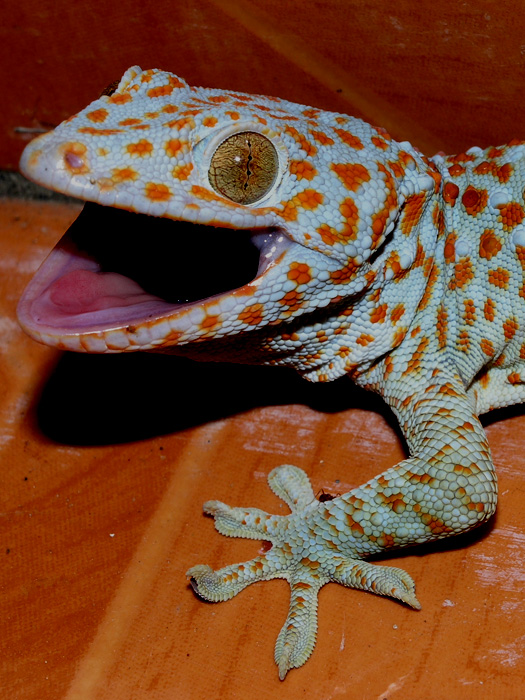
Geckos · Difficulty: Intermediate
Key facts and care guidance for Tokay gecko (Gekko gecko) (origin: South and South-East Asia (rain and monsoon forest, also on buildings)). Adult size around up to ~35 cm total length (SVL ~18 cm). Life expectancy 10–20 years (some over 25). The values below are carefully researched guidance.
Short answers
Tokay gecko: How big does the enclosure need to be?
From 110 × 110 × 150 cm for one animal or a pair (height is crucial); for a group more than 160 × 150 cm floor area and at least 180 cm height.
Tokay gecko: What temperature does it need?
Daytime 28–32 °C, basking spot 35–40 °C locally at a small spot (some sources mention up to 45 °C), at night 22–25 °C.
Tokay gecko: Does it need UVB lighting?
UVB: Recommended (weak UVB).
Tokay gecko: How long do they live?
Life expectancy: 10–20 years (some over 25).
Tokay gecko: Is it suitable for beginners?
Rather not – it is considered an intermediate species (difficulty: Intermediate).
Climate
- Daytime temperature
- 28–32 °C
- Night temperature
- 22–25 °C
- Basking spot
- 35–40 °C locally at a small spot (some sources mention up to 45 °C)
- Humidity
- 60–75 % during the day, 80–90 % at night
- UVB
- Recommended (weak UVB)
Enclosure
- Minimum size
- from 110 × 110 × 150 cm for one animal or a pair (height is crucial); for a group more than 160 × 150 cm floor area and at least 180 cm height
- Substrate
- Forest floor or coco, plenty of cork tubes, climbing branches, dense planting
Feeding
- Food
- Insects (crickets, locusts, roaches); large animals also take nestlings
- Feeding interval
- 2–3×/week
Key facts
- Adult size
- up to ~35 cm total length (SVL ~18 cm)
- Life expectancy
- 10–20 years (some over 25)
- Origin
- South and South-East Asia (rain and monsoon forest, also on buildings)
- Protection status
- CITES App. II (since 2019)
- Brumation
- None (possibly a slightly cooler, drier spell)
- Cohabitation
- Keeping it singly is the least stressful option; tokays do not need company. A pair (1.1) is possible in a sufficiently large terrarium and is common in captivity, but: fights can occur within a pair as well, so you must be able to separate them immediately. Males are strictly territorial and are never kept together; they fight over territory and basking spots until one is injured or permanently sits in a corner. Some keepers keep two females together, but: this can also end in fights, so only with separate basking and hiding spots for each animal.
Notes
Very defensive and quick to bite (a powerful bite) – not an animal for handling; loud calls. Robust in care, but CITES II-listed since 2019 (documentation required).
Do you keep this species?
Add your animal to Reptoria – Reptoria reminds you about feeding and shedding. Add your animal for free →
Related species
- Chinese gecko (Gekko chinensis) – Intermediate
- Rock gecko (Gekko petricolus) – Intermediate
- Golden gecko (Gekko badenii) – Beginner
- Grossmann's gecko (Gekko grossmanni) – Intermediate
- Horsfield's gecko (Gekko horsfieldii) – Intermediate
- Japanese gecko (Gekko japonicus) – Intermediate
- Kuhl's flying gecko (Gekko kuhli) – Intermediate
- Spotted house gecko (Gekko monarchus) – Beginner
What you need to start
To keep Tokay gecko (Gekko gecko) you typically need: a suitable enclosure (from 110 × 110 × 150 cm for one animal or a pair (height is crucial); for a group more than 160 × 150 cm floor area and at least 180 cm height), substrate (Forest floor or coco, plenty of cork tubes, climbing branches, dense planting), a heat source with a thermostat, UVB lighting, thermometer and hygrometer, a water dish and hides. You will find equipment in the Reptoria marketplace.
The complete, interactive care database is in the Reptoria app.
Last updated: 3 November 2026 · Editor: Reptoria editorial team · Sources include: cites.org, einrichtungsbeispiele.de, exotische-tierwelt.de, fws.gov, megazoo-nord.de
All values are non-binding guidance and do not replace expert advice. Research thoroughly from several sources before acquiring and keeping an animal, and observe the applicable law (species and animal protection in particular).