Variable bush viper (Atheris squamigera)
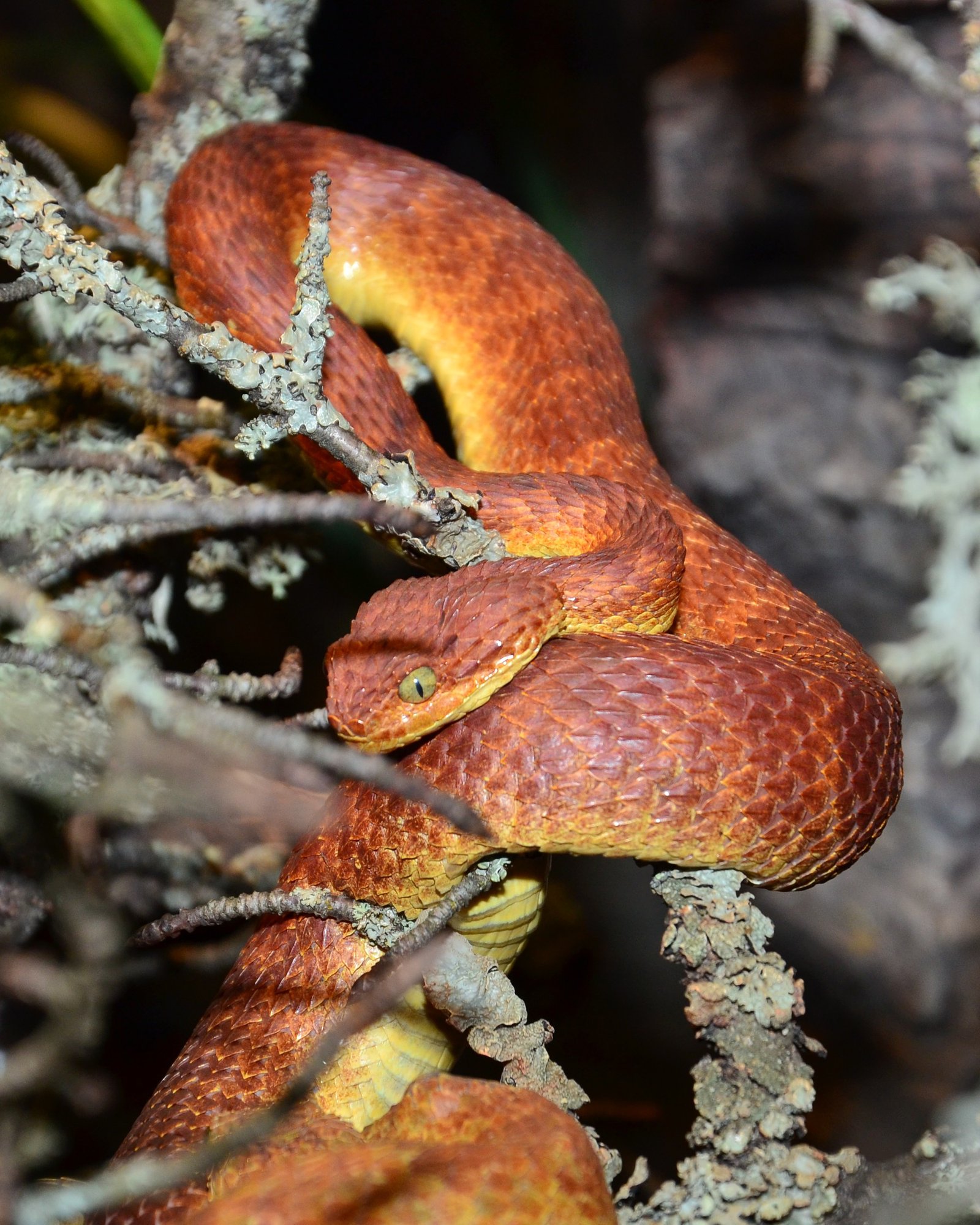
Snakes · Difficulty: Expert
Key facts and care guidance for Variable bush viper (Atheris squamigera) (origin: West and central Africa from Ghana through Nigeria, Cameroon and DR Congo to western Kenya and Tanzania, south to northern Angola and Bioko; tropical rainforest and montane rainforest, arboreal, up to about 1,800 m). Adult size around usually 45–60 cm, females up to about 70 cm, individual animals around 80 cm (females larger than males). Life expectancy 10–12 years. The values below are carefully researched guidance.
Short answers
Variable bush viper: How big does the enclosure need to be?
From 80×40×40 cm (minimum size per the 1997 expert report, bush vipers). Height matters; should be planted.
Variable bush viper: What temperature does it need?
Daytime 22–26 °C (max. 28 °C), at night 17–21 °C.
Variable bush viper: Does it need UVB lighting?
UVB: Optional (weak).
Variable bush viper: How long do they live?
Life expectancy: 10–12 years.
Variable bush viper: Is it suitable for beginners?
No – better suited to experienced keepers (difficulty: Expert).
Climate
- Daytime temperature
- 22–26 °C (max. 28 °C)
- Night temperature
- 17–21 °C
- Basking spot
- —
- Humidity
- 60–80 %
- UVB
- Optional (weak)
Enclosure
- Minimum size
- from 80×40×40 cm (minimum size per the 1997 expert report, bush vipers). Height matters; should be planted
- Substrate
- Coco humus or forest floor, dense planting, plenty of climbing branches
Feeding
- Food
- Mice or small rodents (frozen-thawed), sometimes frogs
- Feeding interval
- Juveniles every 7–14 days, small portions; adults every 3–8 weeks one appropriately sized mouse; feed deliberately sparingly.
Key facts
- Adult size
- usually 45–60 cm, females up to about 70 cm, individual animals around 80 cm (females larger than males)
- Life expectancy
- 10–12 years
- Origin
- West and central Africa from Ghana through Nigeria, Cameroon and DR Congo to western Kenya and Tanzania, south to northern Angola and Bioko; tropical rainforest and montane rainforest, arboreal, up to about 1,800 m
- Protection status
- A permit or notification is required (dangerous-animal regulations, varying by German state)
- Brumation
- None
- Cohabitation
- Single housing. Even animals kept together for years have bitten each other to death; always separate same-sex animals, only put together briefly for mating, and always feed individually.
Notes
VENOMOUS – a highly potent haemotoxic venom, NO specific antivenom, and bites can be fatal. Only for experts with a permit and a secure terrarium. Mist regularly; it often drinks from leaves.
Do you keep this species?
Add your animal to Reptoria – Reptoria reminds you about feeding and shedding. Add your animal for free →
Look for Variable bush viper (Atheris squamigera) in the marketplace →
Related species
- Usambara bush viper (Atheris ceratophora) – Expert
- Great Lakes bush viper (Atheris nitschei) – Expert
- Rough-scaled bush viper (Atheris hispida) – Expert
- West African bush viper (Atheris chlorechis) – Expert
- Savanna vine snake (Thelotornis capensis) – Expert
- Egyptian cobra (Naja haje) – Expert
- Egyptian saw-scaled viper (Echis pyramidum) – Expert
- Barnett's lancehead (Bothrops barnetti) – Expert
What you need to start
To keep Variable bush viper (Atheris squamigera) you typically need: a suitable enclosure (from 80×40×40 cm (minimum size per the 1997 expert report, bush vipers). Height matters; should be planted), substrate (Coco humus or forest floor, dense planting, plenty of climbing branches), a heat source with a thermostat, UVB lighting, thermometer and hygrometer, a water dish and hides. You will find equipment in the Reptoria marketplace.
The complete, interactive care database is in the Reptoria app.
Last updated: 9 October 2026 · Editor: Reptoria editorial team · Sources include: Wikipedia DE, Wikipedia EN, snakeparadise.ch, BMEL-Gutachten Reptilien 1997, EU-VO 338/97 (Anhang, Fassung 2026/1383)
All values are non-binding guidance and do not replace expert advice. Research thoroughly from several sources before acquiring and keeping an animal, and observe the applicable law (species and animal protection in particular).