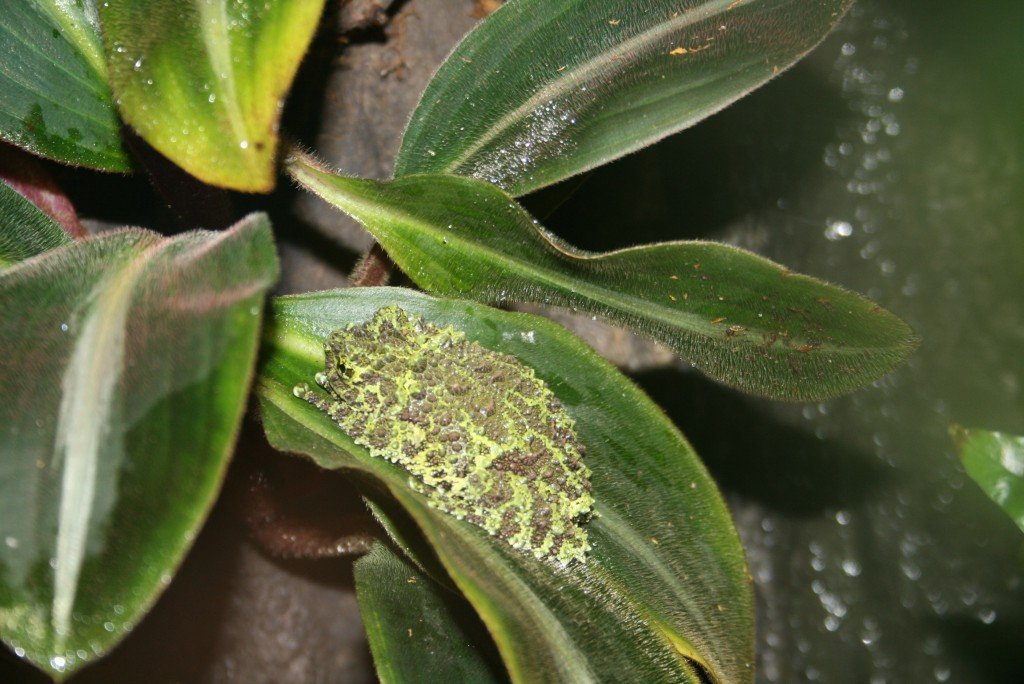
Vietnamese mossy frog (Theloderma corticale)
Amphibians · Difficulty: Intermediate
Key facts and care guidance for Vietnamese mossy frog (Theloderma corticale) (origin: The montane rainforests of northern and central Vietnam (470–1,500 m), adjoining southern China and Laos). Adult size around approx. 7–8 cm (females somewhat larger). Life expectancy approx. 10–15 years (long-lived). The values below are carefully researched guidance.
Short answers
Vietnamese mossy frog: How big does the enclosure need to be?
An aqua-terrarium or paludarium from approx. 60×45×60 cm for a pair or small group, with a water section (7–10 cm) and plenty of vertical hides (cork tubes).
Vietnamese mossy frog: What temperature does it need?
Daytime 20–24 °C (max. ~25 °C; sensitive to heat), at night 18–20 °C.
Vietnamese mossy frog: Does it need UVB lighting?
UVB: UVB not essential (crepuscular/nocturnal).
Vietnamese mossy frog: How long do they live?
Life expectancy: approx. 10–15 years (long-lived).
Vietnamese mossy frog: Is it suitable for beginners?
Rather not – it is considered an intermediate species (difficulty: Intermediate).
Climate
- Daytime temperature
- 20–24 °C (max. ~25 °C; sensitive to heat)
- Night temperature
- 18–20 °C
- Basking spot
- —
- Humidity
- 80–100 %
- UVB
- UVB not essential (crepuscular/nocturnal)
Enclosure
- Minimum size
- an aqua-terrarium or paludarium from approx. 60×45×60 cm for a pair or small group, with a water section (7–10 cm) and plenty of vertical hides (cork tubes)
- Substrate
- No substrate is needed (a large water section plus cork, moss and leaf litter); alternatively coco or moss on the land section
Feeding
- Food
- Crickets, house crickets, locusts (dusted with vitamin and mineral powder); the larvae feed in the water
- Feeding interval
- 2–3×/week
Key facts
- Adult size
- approx. 7–8 cm (females somewhat larger)
- Life expectancy
- approx. 10–15 years (long-lived)
- Origin
- The montane rainforests of northern and central Vietnam (470–1,500 m), adjoining southern China and Laos
- Protection status
- Not listed under CITES; captive-bred animals are freely tradable
- Brumation
- A slightly cooler rest period of ~2 months down to at least 18 °C (it encourages breeding); no real winter rest or frost
- Cohabitation
- Group. Two to four animals of the same species and equal size in a sufficiently large, structured tank with many hiding places and cork. This is the less stressful form; for breeding males and females can be put together, but after several months of continuous breeding the sexes should be separated again. Do not mix other species or clearly different sizes.
Notes
A master of camouflage. Critical: keep it cool (room temperature is often too warm in summer) and the water clean (it is sensitive to pollution). Fond of jumping – an opaque, well-covered terrarium. Minimise handling.
Do you keep this species?
Add your animal to Reptoria – Reptoria reminds you about feeding and shedding. Add your animal for free →
Look for Vietnamese mossy frog (Theloderma corticale) in the marketplace →
Related species
- Starry tree frog (Theloderma stellatum) – Intermediate
- Red-disked small treefrog (Theloderma rhododiscus) – Intermediate
- Hill garden bug-eyed frog (Theloderma asperum) – Beginner
- Bicoloured bug-eyed frog (Theloderma bicolor) – Intermediate
- File-eared tree frog (Polypedates otilophus) – Intermediate
- Chinese gliding frog (Zhangixalus dennysi) – Intermediate
- Common tree frog (Polypedates leucomystax) – Beginner
- Reinwardt's flying frog (Rhacophorus reinwardtii) – Intermediate to expert
What you need to start
To keep Vietnamese mossy frog (Theloderma corticale) you typically need: a suitable enclosure (an aqua-terrarium or paludarium from approx. 60×45×60 cm for a pair or small group, with a water section (7–10 cm) and plenty of vertical hides (cork tubes)), substrate (No substrate is needed (a large water section plus cork, moss and leaf litter); alternatively coco or moss on the land section), a heat source with a thermostat, UVB lighting, thermometer and hygrometer, a water dish and hides. You will find equipment in the Reptoria marketplace.
The complete, interactive care database is in the Reptoria app.
Last updated: 7 November 2026 · Editor: Reptoria editorial team · Sources include: https://en.wikipedia.org/wiki/Theloderma_corticale, https://reptilesmagazine.com/care-and-breeding-the-vietnamese-mossy-frog/, https://vetverified.com/articles/the-complete-guide-to-caring-for-a-vietnamese-mossy-frog
All values are non-binding guidance and do not replace expert advice. Research thoroughly from several sources before acquiring and keeping an animal, and observe the applicable law (species and animal protection in particular).