Yellow-crested Jackson's chameleon (Trioceros jacksonii xantholophus)
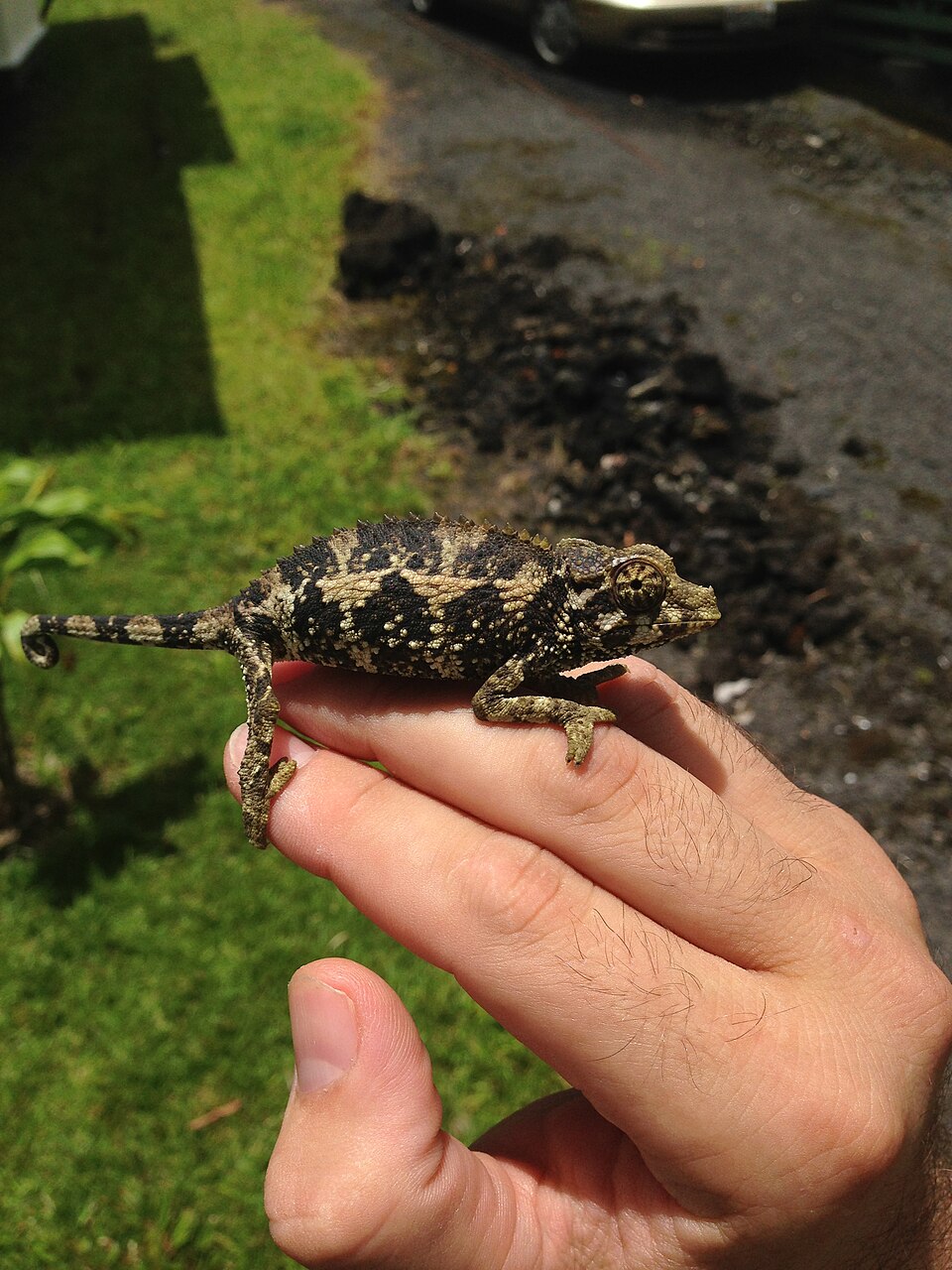
Chameleons · Difficulty: Intermediate
Key facts and care guidance for Yellow-crested Jackson's chameleon (Trioceros jacksonii xantholophus) (origin: Kenya: eastern slopes and foothills of Mount Kenya (from Chuka to Meru, Nyambene Hills, Maua), around 1500–1700 m; introduced to Hawaii (since 1972) as well as Florida and California). Adult size around Largest of the three subspecies; according to Au 2006 males 30–35 cm, females about 30 cm. Life expectancy up to 9 years. The values below are carefully researched guidance.
Short answers
Yellow-crested Jackson's chameleon: How big does the enclosure need to be?
100×60×100 cm (W×D×H) for 1 animal (Au 2006; Chameleon Academy: from 90×45×90 cm).
Yellow-crested Jackson's chameleon: What temperature does it need?
Daytime 20–24 °C, basking spot 28–30 °C, at night 10–15 °C.
Yellow-crested Jackson's chameleon: Does it need UVB lighting?
UVB: Essential.
Yellow-crested Jackson's chameleon: How long do they live?
Life expectancy: up to 9 years.
Yellow-crested Jackson's chameleon: Is it suitable for beginners?
Rather not – it is considered an intermediate species (difficulty: Intermediate).
Climate
- Daytime temperature
- 20–24 °C
- Night temperature
- 10–15 °C
- Basking spot
- 28–30 °C
- Humidity
- rather dry by day, 80–100 % at night
- UVB
- Essential
Enclosure
- Minimum size
- 100×60×100 cm (W×D×H) for 1 animal (Au 2006; Chameleon Academy: from 90×45×90 cm)
Feeding
- Food
- Live insects (e.g. crickets)
- Feeding interval
- Adults every other day, juveniles daily
Key facts
- Adult size
- Largest of the three subspecies; according to Au 2006 males 30–35 cm, females about 30 cm
- Life expectancy
- up to 9 years
- Origin
- Kenya: eastern slopes and foothills of Mount Kenya (from Chuka to Meru, Nyambene Hills, Maua), around 1500–1700 m; introduced to Hawaii (since 1972) as well as Florida and California
- Protection status
- CITES Appendix II / EU Annex B
- Brumation
- None
- Cohabitation
- Keep singly. Males fight with their horns and must never be kept together; even pairs rarely work out in the long run, and just seeing other chameleons causes stress. Only put them together briefly for mating.
Notes
Largest subspecies of Jackson's chameleon and for a long time the form most often kept. Females have no horns; needs cool, humid nights; live-bearing.
Do you keep this species?
Add your animal to Reptoria – Reptoria reminds you about feeding and shedding. Add your animal for free →
Yellow-crested Jackson's chameleon (Trioceros jacksonii xantholophus) currently offered
- Trioceros jacksonii xantholophus – Friedeburg · 200 €
Related species
- Affinis chameleon (Trioceros affinis) – Expert
- Bale two-horned chameleon (Trioceros balebicornutus) – Expert
- Usambara three-horned chameleon (Trioceros deremensis) – Intermediate to expert
- Elliot's chameleon (Trioceros ellioti) – Intermediate
- Fea's chameleon (Trioceros feae) – Expert
- Goetze's chameleon (Trioceros goetzei) – Expert
- Harenna chameleon (Trioceros harennae) – Expert
- Von Höhnel's chameleon (Trioceros hoehnelii) – Intermediate
What you need to start
To keep Yellow-crested Jackson's chameleon (Trioceros jacksonii xantholophus) you typically need: a suitable enclosure (100×60×100 cm (W×D×H) for 1 animal (Au 2006; Chameleon Academy: from 90×45×90 cm)), substrate, a heat source with a thermostat, UVB lighting, thermometer and hygrometer, a water dish and hides. You will find equipment in the Reptoria marketplace.
The complete, interactive care database is in the Reptoria app.
Last updated: 9 November 2026 · Editor: Reptoria editorial team · Sources include: Au 2006, Chamaeleo (Trioceros) jacksonii – ein beliebtes Hochlandchamäleon aus Ostafrika, Chamaeleo Nr. 32 (DGHT AG Chamäleons) – xantholophus ausdrücklich: Männchen 30–35 cm, Weibchen ca. 30 cm und hornlos, untere Höhenlagen, Hawaii seit 1972, bis max. 28 °C, Nachtabsenkung mind. 5 °C, toleranteste Unterart, Terrarium 100×60×100 cm, 25–45 Jungtiere, ein Wurf zum Jahresende; sonst Angaben für alle Unterarten (Einzelhaltung, Fütterung, Sprühen, Aufzucht) – https://www.agchamaeleons.de/wp-content/uploads/2022/07/Chamaeleo_0032-Manfred-Au-Trioceros-jacksonii.pdf, Chameleon Academy, Trioceros jacksonii: Natural History (Feldangaben P. Necas zu xantholophus) – 1500–1700 m, Busch, aktiv morgens/spätnachmittags, Minimum ~10 °C, Maximum 25–28 °C, nachts 100 % Feuchte, Haltung tags 20–23 °C mit Sonnenplatz 28–32 °C, nachts unter 15 °C, bis 8 Jahre, Fehler: trockene/warme Nächte, warm+feucht -> Infektionen – https://chameleonacademy.com/jacksons-chameleon-natural-history/, Wikipedia EN: Jackson's chameleon – T. j. xantholophus (yellow-crested) größte Unterart, Mt.-Kenya-Region, Hawaii seit 1972, Florida – https://en.wikipedia.org/wiki/Jackson%27s_chameleon, Chameleon Academy, Jackson's Chameleon Care (Yellow-crested und Machakos, gleiche Pflege) – Tag 70er °F, Hitzestress in den 80ern, Spot Mitte 80er °F, Nachtabsenkung 10–20 °F, nachts 90–100 %, tags 50 %, UVI 3, 2×2×4 ft, Adulte jeden 2. Tag, getrennt halten, Ödeme/Übergewicht/Verbrennungen/Fußwunden/Schläfendrüsen, Anfassen nur wenn nötig – https://chameleonacademy.com/jacksons-chameleon-care/, Chameleon Academy, Care Summary Trioceros jacksonii xantholophus 2022 – Tag 22–24 °C, nachts 10–18 °C, Spot 26–29 °C (bis 30 °C), tags 40–50 %, nachts 80–100 %, UVI 3, mind. 2×2×4 ft bzw. 36×18×36 in, ein Tier je Käfig, Adulte jeden 2. Tag, Trächtige täglich, Reife 10–12 Monate, lebendgebärend, 8–50 Junge, Tragzeit 6–9 Monate, Geburt ab dem Morgen, Spermaspeicherung, Hitzestress ab Mitte 80er °F, Ödeme, Anfassen = Stress – https://chameleonacademy.com/wp-content/uploads/2022/11/Care-Summary-Trioceros-jacksonii-xantholophus-2022B.pdf
All values are non-binding guidance and do not replace expert advice. Research thoroughly from several sources before acquiring and keeping an animal, and observe the applicable law (species and animal protection in particular).