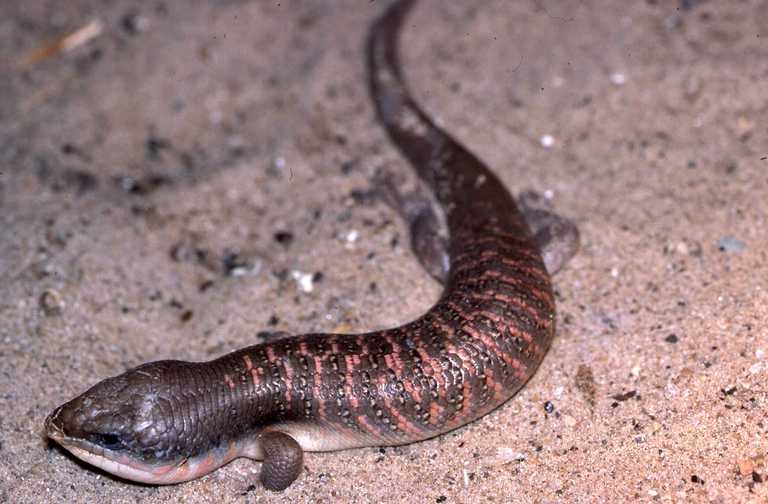
Algerian skink (Eumeces algeriensis)
Skinks · Difficulty: Intermediate
Key facts and care guidance for Algerian skink (Eumeces algeriensis) (origin: Morocco, Algeria, Tunisia). Adult size around 30–45 cm total length; the tail is only slightly longer than the body. Life expectancy 15–20 years, individual animals over 22 years. The values below are carefully researched guidance.
Short answers
Algerian skink: How big does the enclosure need to be?
150×100×60 cm for a pair.
Algerian skink: What temperature does it need?
Daytime 26–32 °C, basking spot 40–45 °C, at night 16–20 °C.
Algerian skink: Does it need UVB lighting?
UVB: Essential (UVB 6–10 %).
Algerian skink: How long do they live?
Life expectancy: 15–20 years, individual animals over 22 years.
Algerian skink: Is it suitable for beginners?
Rather not – it is considered an intermediate species (difficulty: Intermediate).
Climate
- Daytime temperature
- 26–32 °C
- Night temperature
- 16–20 °C
- Basking spot
- 40–45 °C
- Humidity
- 40–55 %
- UVB
- Essential (UVB 6–10 %)
Enclosure
- Minimum size
- 150×100×60 cm for a pair
- Substrate
- Deep, diggable sand-clay mix, flat and collapse-proof rock structures set directly on the enclosure floor, roots and cork bark; one corner kept permanently damp
Feeding
- Food
- Crickets, house crickets, roaches, earthworms, superworms, plus snails; few mealworms, occasional fruit and rarely a newborn mouse
- Feeding interval
- adults 3×/week
Key facts
- Adult size
- 30–45 cm total length; the tail is only slightly longer than the body
- Life expectancy
- 15–20 years, individual animals over 22 years
- Origin
- Morocco, Algeria, Tunisia
- Protection status
- Not listed under CITES
- Brumation
- A winter rest of 8–12 weeks at 12–15 °C
- Cohabitation
- Keep singly or as a pair (1.1). Two males do not go together — they fight over territory and the basking spot until one is seriously injured or permanently sits in a corner. Two females work if necessary; one male with several females is sometimes kept for breeding, downside: more squabbling and a greater space requirement, as this species is less social than its relatives. Several basking spots and hides are important so the subordinate animal can move away, and feed separately as soon as the animals differ in size.
Notes
A robust, burrowing skink with orange-red spots. It needs deep, firm ground for building its tunnels.
Do you keep this species?
Add your animal to Reptoria – Reptoria reminds you about feeding and shedding. Add your animal for free →
Look for Algerian skink (Eumeces algeriensis) in the marketplace →
Related species
- Berber skink (Eumeces schneideri) – Beginner to intermediate
- African five-lined skink (Trachylepis quinquetaeniata) – Intermediate
- Berdmore's water skink (Tropidophorus berdmorei) – Beginner with some knowledge
- Mountain skink (Plestiodon callicephalus) – Beginner with some knowledge
- Pacific blue-tailed skink (Emoia caeruleocauda) – Beginner with some knowledge
- Blue-tongued water skink (Tropidophorus cocincinensis) – Beginner with some knowledge
- Bouton's snake-eyed skink (Cryptoblepharus boutonii) – Beginner with some knowledge
- Bowring's supple skink (Lygosoma bowringii) – Beginner with some knowledge
What you need to start
To keep Algerian skink (Eumeces algeriensis) you typically need: a suitable enclosure (150×100×60 cm for a pair), substrate (Deep, diggable sand-clay mix, flat and collapse-proof rock structures set directly on the enclosure floor, roots and cork bark; one corner kept permanently damp), a heat source with a thermostat, UVB lighting, thermometer and hygrometer, a water dish and hides. You will find equipment in the Reptoria marketplace.
The complete, interactive care database is in the Reptoria app.
Last updated: 2 November 2026 · Editor: Reptoria editorial team · Sources include: einrichtungsbeispiele.de, monaconatureencyclopedia.com, EUR-Lex VO (EU) 2026/1383, Wikipedia DE, Wikipedia EN
All values are non-binding guidance and do not replace expert advice. Research thoroughly from several sources before acquiring and keeping an animal, and observe the applicable law (species and animal protection in particular).