Amazon milk frog (Trachycephalus resinifictrix)
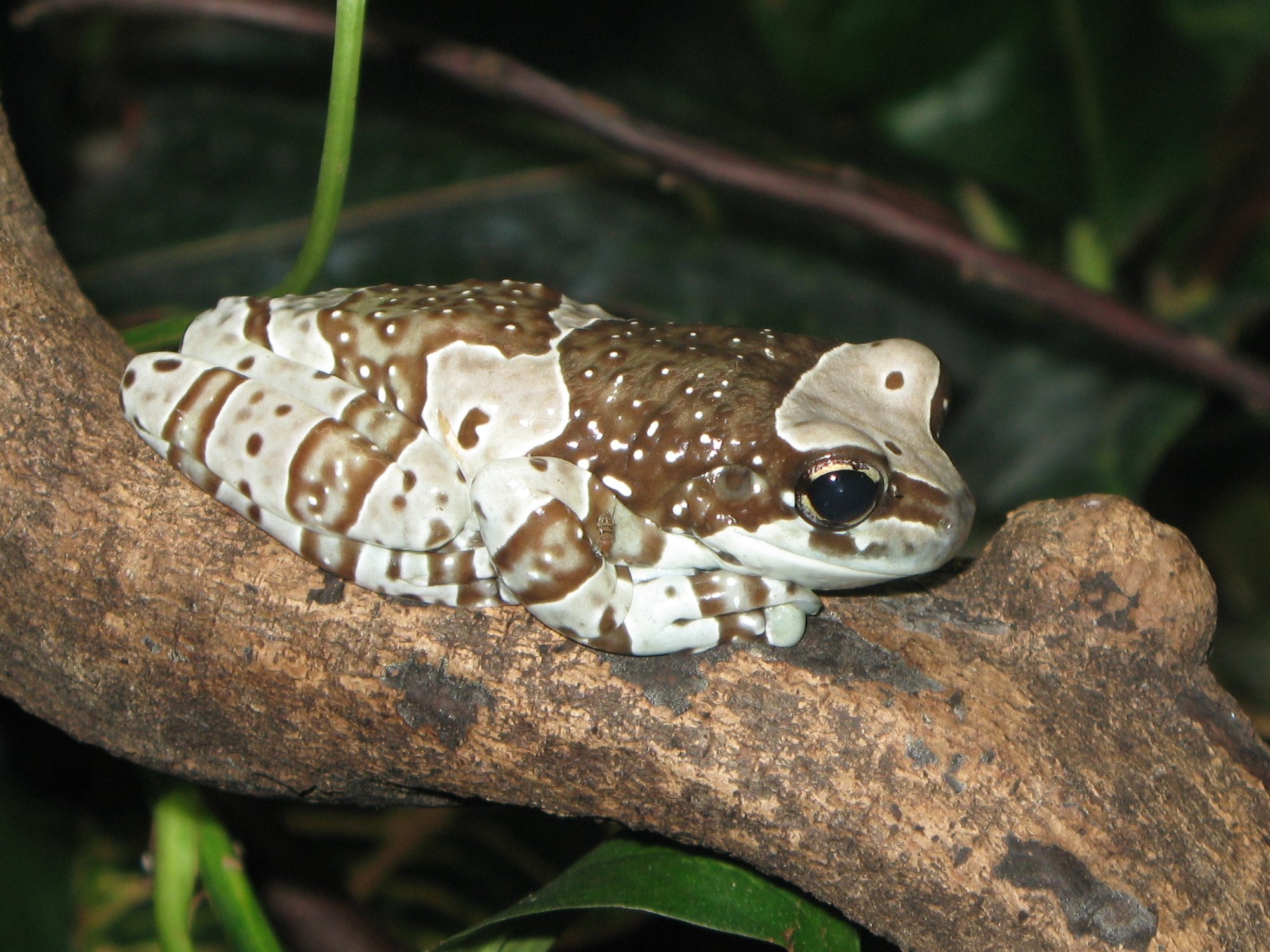
Amphibians · Difficulty: Beginner
Key facts and care guidance for Amazon milk frog (Trachycephalus resinifictrix) (origin: The Amazon basin (Brazil, Peru, Ecuador, Colombia, Venezuela, the Guianas)). Adult size around 6–8 cm (females up to ~8 cm, males up to ~7.5 cm). Life expectancy approx. 8–12 years (up to ~15). The values below are carefully researched guidance.
Short answers
Amazon milk frog: How big does the enclosure need to be?
Arboreal and tall: from approx. 60×45×60 cm for one animal; ~80×50×100 cm for a group of 3–4; with climbing branches and a water-filled tree hollow or bromeliad as a spawning site.
Amazon milk frog: What temperature does it need?
Daytime 24–28 °C, at night 22–24 °C (slight drop).
Amazon milk frog: Does it need UVB lighting?
UVB: UVB not essential (nocturnal); weak UVB optional.
Amazon milk frog: How long do they live?
Life expectancy: approx. 8–12 years (up to ~15).
Amazon milk frog: Is it suitable for beginners?
Yes – it is considered suitable for beginners (difficulty: Beginner).
Climate
- Daytime temperature
- 24–28 °C
- Night temperature
- 22–24 °C (slight drop)
- Basking spot
- —
- Humidity
- 70–90 %
- UVB
- UVB not essential (nocturnal); weak UVB optional
Enclosure
- Minimum size
- arboreal and tall: from approx. 60×45×60 cm for one animal; ~80×50×100 cm for a group of 3–4; with climbing branches and a water-filled tree hollow or bromeliad as a spawning site
- Substrate
- Coco humus or forest floor with moss, dense planting, climbing branches, a water dish
Feeding
- Food
- Crickets, locusts, roaches, worms; adults occasionally take a pinkie
- Feeding interval
- adults 2–3×/week, juveniles daily to every other day
Key facts
- Adult size
- 6–8 cm (females up to ~8 cm, males up to ~7.5 cm)
- Life expectancy
- approx. 8–12 years (up to ~15)
- Origin
- The Amazon basin (Brazil, Peru, Ecuador, Colombia, Venezuela, the Guianas)
- Protection status
- No CITES protection; captive-bred animals are freely tradable
- Brumation
- No real winter rest; possibly simulate a dry or rainy season to stimulate breeding
- Cohabitation
- Group keeping is possible and recommended – a sociable species, ideally a group of three or four (or a pair); keeping them singly is possible as well. Only similarly sized animals of the same species; avoid size differences (large frogs eat smaller ones).
Notes
The "milk frog": under stress it releases a milky, sticky, skin-irritating secretion – wash your hands after contact and minimise handling. Loud callers. A tree-hole breeder (spawn in water-filled cavities). Robust and easy to care for.
Do you keep this species?
Add your animal to Reptoria – Reptoria reminds you about feeding and shedding. Add your animal for free →
Look for Amazon milk frog (Trachycephalus resinifictrix) in the marketplace →
Related species
- Red-eyed tree frog (Litoria chloris) – Intermediate
- European tree frog (Hyla arborea) – Beginner to intermediate
- Fringed leaf frog (Cruziohyla craspedopus) – Expert
- Splendid leaf frog (Cruziohyla calcarifer) – Expert
- Gliding leaf frog (Agalychnis spurrelli) – Intermediate
- White's tree frog (Litoria caerulea) – Beginner
- Cuban tree frog (Osteopilus septentrionalis) – Beginner
- Lemur leaf frog (Agalychnis lemur) – Expert
What you need to start
To keep Amazon milk frog (Trachycephalus resinifictrix) you typically need: a suitable enclosure (arboreal and tall: from approx. 60×45×60 cm for one animal; ~80×50×100 cm for a group of 3–4; with climbing branches and a water-filled tree hollow or bromeliad as a spawning site), substrate (Coco humus or forest floor with moss, dense planting, climbing branches, a water dish), a heat source with a thermostat, UVB lighting, thermometer and hygrometer, a water dish and hides. You will find equipment in the Reptoria marketplace.
The complete, interactive care database is in the Reptoria app.
Last updated: 9 October 2026 · Editor: Reptoria editorial team · Sources include: https://de.wikipedia.org/wiki/Baumh%C3%B6hlen-Kr%C3%B6tenlaubfrosch, https://en.wikipedia.org/wiki/Trachycephalus_resinifictrix
All values are non-binding guidance and do not replace expert advice. Research thoroughly from several sources before acquiring and keeping an animal, and observe the applicable law (species and animal protection in particular).