American green tree frog (Hyla cinerea)
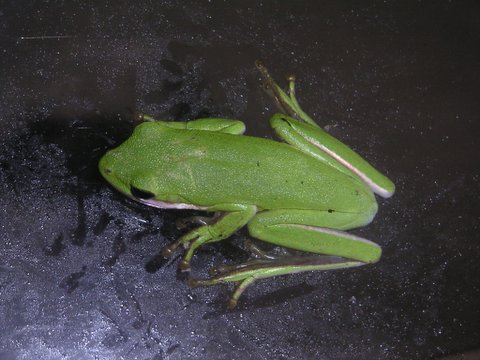
Amphibians · Difficulty: Beginner
Key facts and care guidance for American green tree frog (Hyla cinerea) (origin: The south-east of the USA). Adult size around approx. 3.2–6.4 cm (females noticeably larger than males). Life expectancy approx. 6–10 years. The values below are carefully researched guidance.
Short answers
American green tree frog: How big does the enclosure need to be?
45×45×60 cm for a single animal; at least 80×40×100 cm for a group of four to five animals (tall, with a water section).
American green tree frog: What temperature does it need?
Daytime 22–27 °C, basking spot Local warm spot 29–30 °C, readily used but not essential, at night 18–20 °C.
American green tree frog: Does it need UVB lighting?
UVB: UVB recommended (2–5 %).
American green tree frog: How long do they live?
Life expectancy: approx. 6–10 years.
American green tree frog: Is it suitable for beginners?
Yes – it is considered suitable for beginners (difficulty: Beginner).
Climate
- Daytime temperature
- 22–27 °C
- Night temperature
- 18–20 °C
- Basking spot
- Local warm spot 29–30 °C, readily used but not essential
- Humidity
- 60–80 %
- UVB
- UVB recommended (2–5 %)
Enclosure
- Minimum size
- 45×45×60 cm for a single animal; at least 80×40×100 cm for a group of four to five animals (tall, with a water section)
- Substrate
- Coco humus or pine bark, damp; a large water section, plenty of planting to climb
Feeding
- Food
- Crickets, house crickets, roaches, wax moths; dust with calcium and vitamins
- Feeding interval
- adults 2–3× a week, juveniles daily
Key facts
- Adult size
- approx. 3.2–6.4 cm (females noticeably larger than males)
- Life expectancy
- approx. 6–10 years
- Origin
- The south-east of the USA
- Protection status
- Not protected (not listed under CITES or German nature conservation law)
- Brumation
- Not necessary; for breeding stimulation, a few weeks to two months at around 15–18 °C with shortened lighting (8–10 instead of 12–14 hours)
- Cohabitation
- Keeping similarly sized animals in a group is straightforward. Avoid clearly different sizes — large tree frogs eat smaller ones.
Notes
A robust, long-lived beginner's frog. The males call loudly and persistently in the evening; you should have heard that before buying if the enclosure is going in the bedroom. Do not pick it up — the skin is permeable and sensitive to skin oils and soap residues.
Do you keep this species?
Add your animal to Reptoria – Reptoria reminds you about feeding and shedding. Add your animal for free →
Look for American green tree frog (Hyla cinerea) in the marketplace →
Related species
- European tree frog (Hyla arborea) – Beginner to intermediate
- Mediterranean tree frog (Hyla meridionalis) – Intermediate
- Red-eyed tree frog (Litoria chloris) – Intermediate
- Fringed leaf frog (Cruziohyla craspedopus) – Expert
- Splendid leaf frog (Cruziohyla calcarifer) – Expert
- Gliding leaf frog (Agalychnis spurrelli) – Intermediate
- White's tree frog (Litoria caerulea) – Beginner
- Cuban tree frog (Osteopilus septentrionalis) – Beginner
What you need to start
To keep American green tree frog (Hyla cinerea) you typically need: a suitable enclosure (45×45×60 cm for a single animal; at least 80×40×100 cm for a group of four to five animals (tall, with a water section)), substrate (Coco humus or pine bark, damp; a large water section, plenty of planting to climb), a heat source with a thermostat, UVB lighting, thermometer and hygrometer, a water dish and hides. You will find equipment in the Reptoria marketplace.
The complete, interactive care database is in the Reptoria app.
Last updated: 9 October 2026 · Editor: Reptoria editorial team · Sources include: Wikipedia EN, amphibiancare.com, aqualog.de, dubiaroaches.com, tropic-shop.de
All values are non-binding guidance and do not replace expert advice. Research thoroughly from several sources before acquiring and keeping an animal, and observe the applicable law (species and animal protection in particular).