Argentine black and white tegu (Salvator merianae)
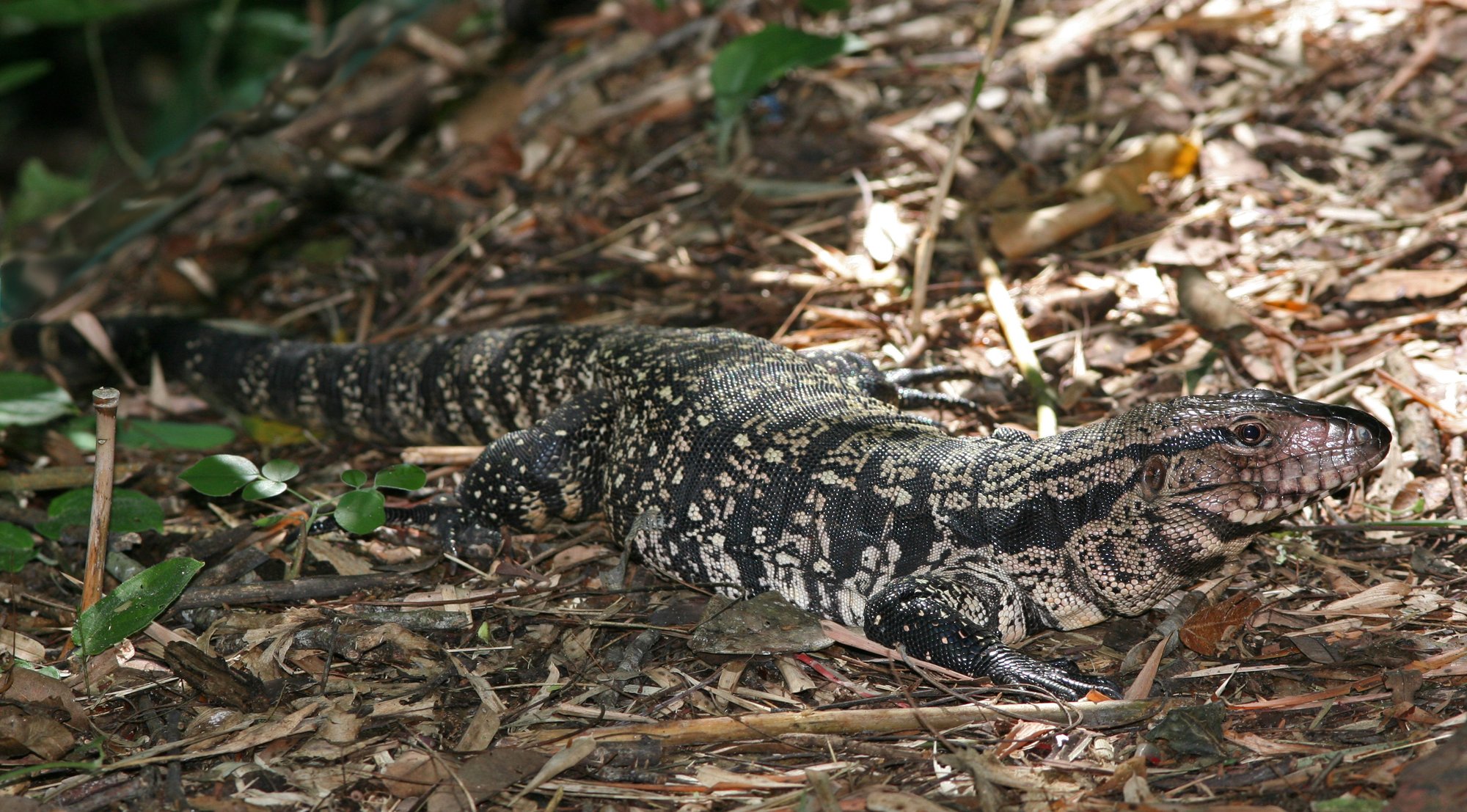
Monitors & tegus · Difficulty: Intermediate
Key facts and care guidance for Argentine black and white tegu (Salvator merianae) (origin: South America (Argentina, Uruguay, Paraguay, southern Brazil)). Adult size around 120–170 cm. Life expectancy 15–20 years. The values below are carefully researched guidance.
Short answers
Argentine black and white tegu: How big does the enclosure need to be?
300 x 180 x 160 cm (adult), at least 35 cm of digging substrate.
Argentine black and white tegu: What temperature does it need?
Daytime 28–32 °C, basking spot 45–50 °C (local basking spot), at night 20–22 °C.
Argentine black and white tegu: Does it need UVB lighting?
UVB: Essential (UVB 10–12%, UV index 3–4 at the basking spot).
Argentine black and white tegu: How long do they live?
Life expectancy: 15–20 years.
Argentine black and white tegu: Is it suitable for beginners?
Rather not – it is considered an intermediate species (difficulty: Intermediate).
Climate
- Daytime temperature
- 28–32 °C
- Night temperature
- 20–22 °C
- Basking spot
- 45–50 °C (local basking spot)
- Humidity
- 60–80 % during the day, rising to 80–90 % at night
- UVB
- Essential (UVB 10–12%, UV index 3–4 at the basking spot)
Enclosure
- Minimum size
- 300 x 180 x 160 cm (adult), at least 35 cm of digging substrate
- Substrate
- A deep soil and sand mix they can dig in (at least 35 cm) plus a large bath
Feeding
- Food
- Omnivorous: insects, rodents, chicks, fish, eggs, fruit
- Feeding interval
- juveniles daily, adults 2–3×/week, with variety
Key facts
- Adult size
- 120–170 cm
- Life expectancy
- 15–20 years
- Origin
- South America (Argentina, Uruguay, Paraguay, southern Brazil)
- Protection status
- CITES Appendix II, EU Annex B, registration required
- Brumation
- Winter dormancy 4–6 months at 12–15 °C (necessary for health and breeding)
- Cohabitation
- Keeping a single animal is the safe route; a permanent male–female pair is not recommended, because the male harasses the female outside the breeding season too, which causes constant stress. Two males are the riskiest combination: they often fight over territory and the basking spot until one is injured or sits permanently in a corner; some keepers still house them together in an enclosure twice the size, but only with the option to separate them. Two females usually get along, but each needs her own basking and hiding spots and a correspondingly larger enclosure; feed separately if they differ in size. Animals are only put together under supervision and temporarily for breeding.
Notes
A very large, intelligent omnivore with an enormous space and digging requirement. The winter rest of several months is essential for its hormones and health.
Do you keep this species?
Add your animal to Reptoria – Reptoria reminds you about feeding and shedding. Add your animal for free →
Look for Argentine black and white tegu (Salvator merianae) in the marketplace →
Related species
- Yellow tegu (Salvator dracaena) – Intermediate
- Red tegu (Salvator rufescens) – Intermediate
- Red tegu (Salvator duseni) – Intermediate
- Chilean dwarf tegu (Callopistes maculatus) – Intermediate
- Golden tegu (Tupinambis cryptus) – Intermediate
- Golden tegu (Tupinambis teguixin) – Intermediate
- Caiman lizard (Dracaena guianensis) – Expert
- Crocodile tegu (Crocodilurus amazonicus) – Expert
What you need to start
To keep Argentine black and white tegu (Salvator merianae) you typically need: a suitable enclosure (300 x 180 x 160 cm (adult), at least 35 cm of digging substrate), substrate (A deep soil and sand mix they can dig in (at least 35 cm) plus a large bath), a heat source with a thermostat, UVB lighting, thermometer and hygrometer, a water dish and hides. You will find equipment in the Reptoria marketplace.
The complete, interactive care database is in the Reptoria app.
Last updated: 9 October 2026 · Editor: Reptoria editorial team · Sources include: einrichtungsbeispiele.de, gutachten.txt (BML 1997), terraristikshop.net, drta-archiv.de, berlin.de
All values are non-binding guidance and do not replace expert advice. Research thoroughly from several sources before acquiring and keeping an animal, and observe the applicable law (species and animal protection in particular).