Red tegu (Salvator rufescens)
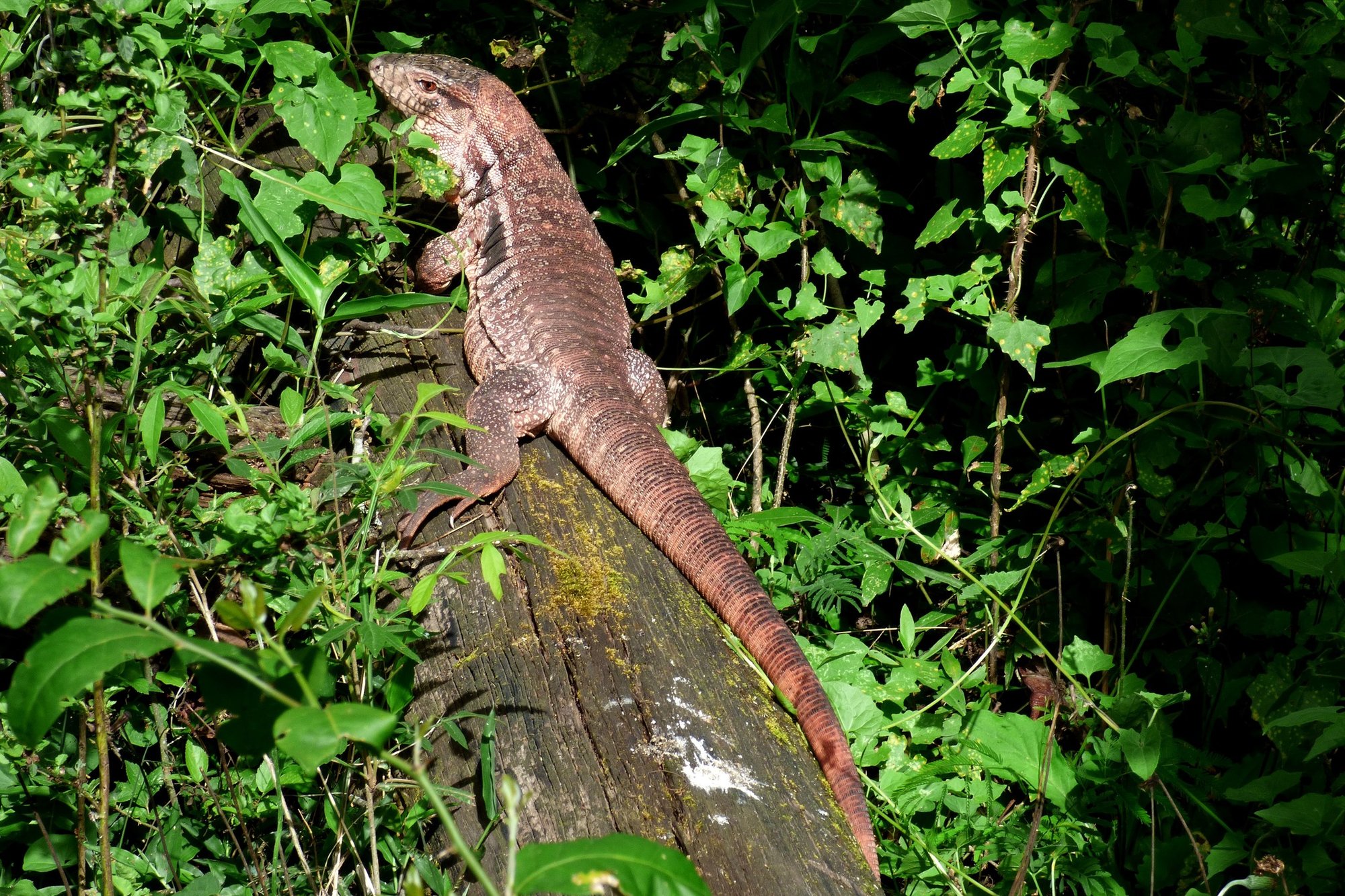
Monitors & tegus · Difficulty: Intermediate
Key facts and care guidance for Red tegu (Salvator rufescens) (origin: Argentina, Paraguay, Bolivia (the arid Chaco region)). Adult size around 90–130 cm total length (tail included). Life expectancy 15–20 years. The values below are carefully researched guidance.
Short answers
Red tegu: How big does the enclosure need to be?
At least 250×120×100 cm for one adult animal (a walk-in facility or room is better).
Red tegu: What temperature does it need?
Daytime 26–30 °C, basking spot 40–50 °C, at night 20–24 °C.
Red tegu: Does it need UVB lighting?
UVB: UVB needed (Ferguson zone 2–3, UV index 3–5).
Red tegu: How long do they live?
Life expectancy: 15–20 years.
Red tegu: Is it suitable for beginners?
Rather not – it is considered an intermediate species (difficulty: Intermediate).
Climate
- Daytime temperature
- 26–30 °C
- Night temperature
- 20–24 °C
- Basking spot
- 40–50 °C
- Humidity
- 60–80 %
- UVB
- UVB needed (Ferguson zone 2–3, UV index 3–5)
Enclosure
- Minimum size
- at least 250×120×100 cm for one adult animal (a walk-in facility or room is better)
- Substrate
- A deep, diggable mix of soil, sand and bark mulch (at least 20–30 cm, for a burrow)
Feeding
- Food
- Carnivorous to omnivorous: insects, rodents, chicks, fish, eggs, a little fruit; juveniles take mostly insects
- Feeding interval
- adults 2–3×/week, juveniles (almost) daily
Key facts
- Adult size
- 90–130 cm total length (tail included)
- Life expectancy
- 15–20 years
- Origin
- Argentina, Paraguay, Bolivia (the arid Chaco region)
- Protection status
- CITES Appendix II / EU Annex B → registration with the nature conservation authority, proof of origin required
- Brumation
- A winter rest or brumation is recommended, about 2–3 months at ~15–18 °C (a natural rhythm that encourages reproduction)
- Cohabitation
- Keep them singly; territorial, and the males do not get on. Keep them as a pair only temporarily for breeding, in a very large facility with visual barriers and constant supervision.
Notes
A large, intelligent, powerful lizard; it can become tame, but has a strong bite and claws. The males develop jowls. Common mistakes: a terrarium that is too small or too cold, no winter rest, and obesity from food that is too fatty. Sometimes listed as Salvator/Tupinambis rufescens or as a subspecies.
Do you keep this species?
Add your animal to Reptoria – Reptoria reminds you about feeding and shedding. Add your animal for free →
Related species
- Argentine black and white tegu (Salvator merianae) – Intermediate
- Yellow tegu (Salvator dracaena) – Intermediate
- Red tegu (Salvator duseni) – Intermediate
- Chilean dwarf tegu (Callopistes maculatus) – Intermediate
- Golden tegu (Tupinambis cryptus) – Intermediate
- Golden tegu (Tupinambis teguixin) – Intermediate
- Caiman lizard (Dracaena guianensis) – Expert
- Crocodile tegu (Crocodilurus amazonicus) – Expert
What you need to start
To keep Red tegu (Salvator rufescens) you typically need: a suitable enclosure (at least 250×120×100 cm for one adult animal (a walk-in facility or room is better)), substrate (A deep, diggable mix of soil, sand and bark mulch (at least 20–30 cm, for a burrow)), a heat source with a thermostat, UVB lighting, thermometer and hygrometer, a water dish and hides. You will find equipment in the Reptoria marketplace.
The complete, interactive care database is in the Reptoria app.
Last updated: 30 October 2026 · Editor: Reptoria editorial team · Sources include: https://en.wikipedia.org/wiki/Salvator_(lizard), https://reptile-database.reptarium.cz/species?genus=Salvator&species=rufescens
All values are non-binding guidance and do not replace expert advice. Research thoroughly from several sources before acquiring and keeping an animal, and observe the applicable law (species and animal protection in particular).