Armoured leaf chameleon (Brookesia perarmata)
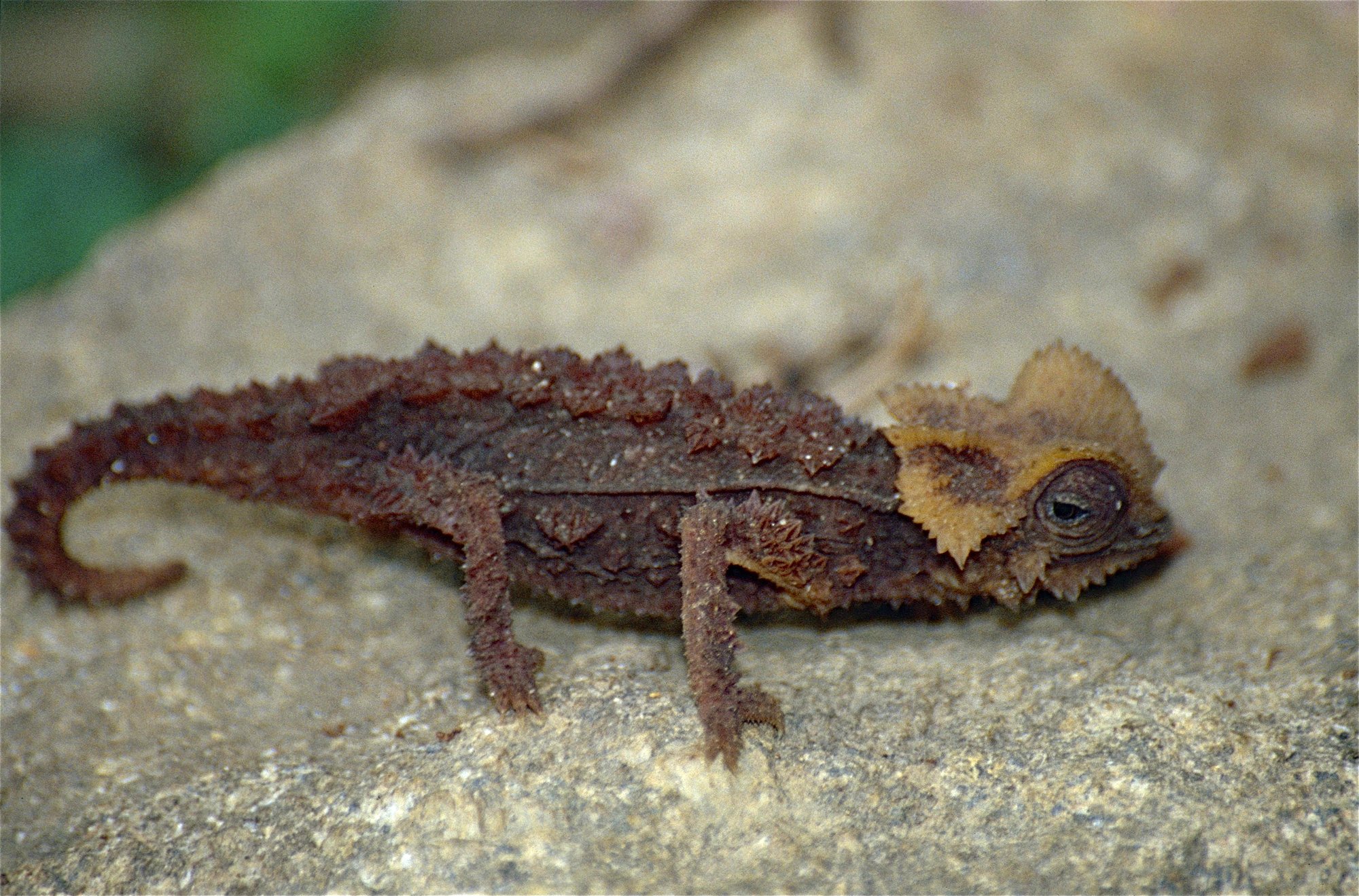
Chameleons · Difficulty: Expert
Key facts and care guidance for Armoured leaf chameleon (Brookesia perarmata) (origin: Tsingy de Bemaraha, Madagascar). Adult size around 8–11 cm. Life expectancy 3–5 years. The values below are carefully researched guidance.
Short answers
Armoured leaf chameleon: How big does the enclosure need to be?
40×40×40 cm for a pair — floor area matters, not height.
Armoured leaf chameleon: What temperature does it need?
Daytime 20–25 °C, basking spot No basking spot — these species avoid direct sun, at night 16–19 °C.
Armoured leaf chameleon: Does it need UVB lighting?
UVB: Weak UVB is enough (UVB 2.0–5.0), a ground-dweller living in shade.
Armoured leaf chameleon: How long do they live?
Life expectancy: 3–5 years.
Armoured leaf chameleon: Is it suitable for beginners?
No – better suited to experienced keepers (difficulty: Expert).
Climate
- Daytime temperature
- 20–25 °C
- Night temperature
- 16–19 °C
- Basking spot
- No basking spot — these species avoid direct sun
- Humidity
- 75–95 %, mist daily
- UVB
- Weak UVB is enough (UVB 2.0–5.0), a ground-dweller living in shade
Enclosure
- Minimum size
- 40×40×40 cm for a pair — floor area matters, not height
- Substrate
- A deep layer of leaf litter on damp forest floor, plus moss and low twigs
Feeding
- Food
- Small insects such as fruit flies, firebrats and micro crickets, dusted regularly with calcium and vitamins
- Feeding interval
- adults daily to every other day
Key facts
- Adult size
- 8–11 cm
- Life expectancy
- 3–5 years
- Origin
- Tsingy de Bemaraha, Madagascar
- Protection status
- CITES Appendix I — strictly protected, trade is effectively ruled out
- Brumation
- No winter rest
- Cohabitation
- Keep them singly – this is the least stressful option. A pair (one male, one female) works only in a sufficiently large, densely structured enclosure with many hiding places so the animals can avoid each other; never keep males together. No husbandry reports on the compatibility of this species exist; the information comes from the genus. There are reports of Brookesia kept together in trios, but permanent contact can cause stress.
Notes
Strikingly spined and at home only in the Tsingy massif. The only Appendix I member of the genus.
Do you keep this species?
Add your animal to Reptoria – Reptoria reminds you about feeding and shedding. Add your animal for free →
Look for Armoured leaf chameleon (Brookesia perarmata) in the marketplace →
Related species
- Betsch's leaf chameleon (Brookesia betschi) – Expert
- Brygoo's leaf chameleon (Brookesia brygooi) – Expert
- Decary's leaf chameleon (Brookesia decaryi) – Intermediate
- Ebenau's leaf chameleon (Brookesia ebenaui) – Expert
- Griveaud's leaf chameleon (Brookesia griveaudi) – Expert
- Karche's leaf chameleon (Brookesia karchei) – Expert
- Minute leaf chameleon (Brookesia minima) – Expert
- Brown leaf chameleon (Brookesia superciliaris) – Intermediate
What you need to start
To keep Armoured leaf chameleon (Brookesia perarmata) you typically need: a suitable enclosure (40×40×40 cm for a pair — floor area matters, not height), substrate (A deep layer of leaf litter on damp forest floor, plus moss and low twigs), a heat source with a thermostat, UVB lighting, thermometer and hygrometer, a water dish and hides. You will find equipment in the Reptoria marketplace.
The complete, interactive care database is in the Reptoria app.
Last updated: 7 November 2026 · Editor: Reptoria editorial team · Sources include: Wikipedia Brookesia stumpffi: Gelege 3-5 Eier, Schlupf nach 60-70 Tagen bei 23°C – https://en.wikipedia.org/wiki/Brookesia_stumpffi, IUCN/Wikipedia Brookesia perarmata: größere, gepanzerte Erdchamäleon-Art – https://en.wikipedia.org/wiki/Brookesia_perarmata, https://en.wikipedia.org/wiki/Antsingy_leaf_chameleon, https://en.wikipedia.org/wiki/Brookesia, https://reptile-database.reptarium.cz/species?genus=Brookesia&species=perarmata
All values are non-binding guidance and do not replace expert advice. Research thoroughly from several sources before acquiring and keeping an animal, and observe the applicable law (species and animal protection in particular).