Baracoa giant anole (Anolis baracoae)
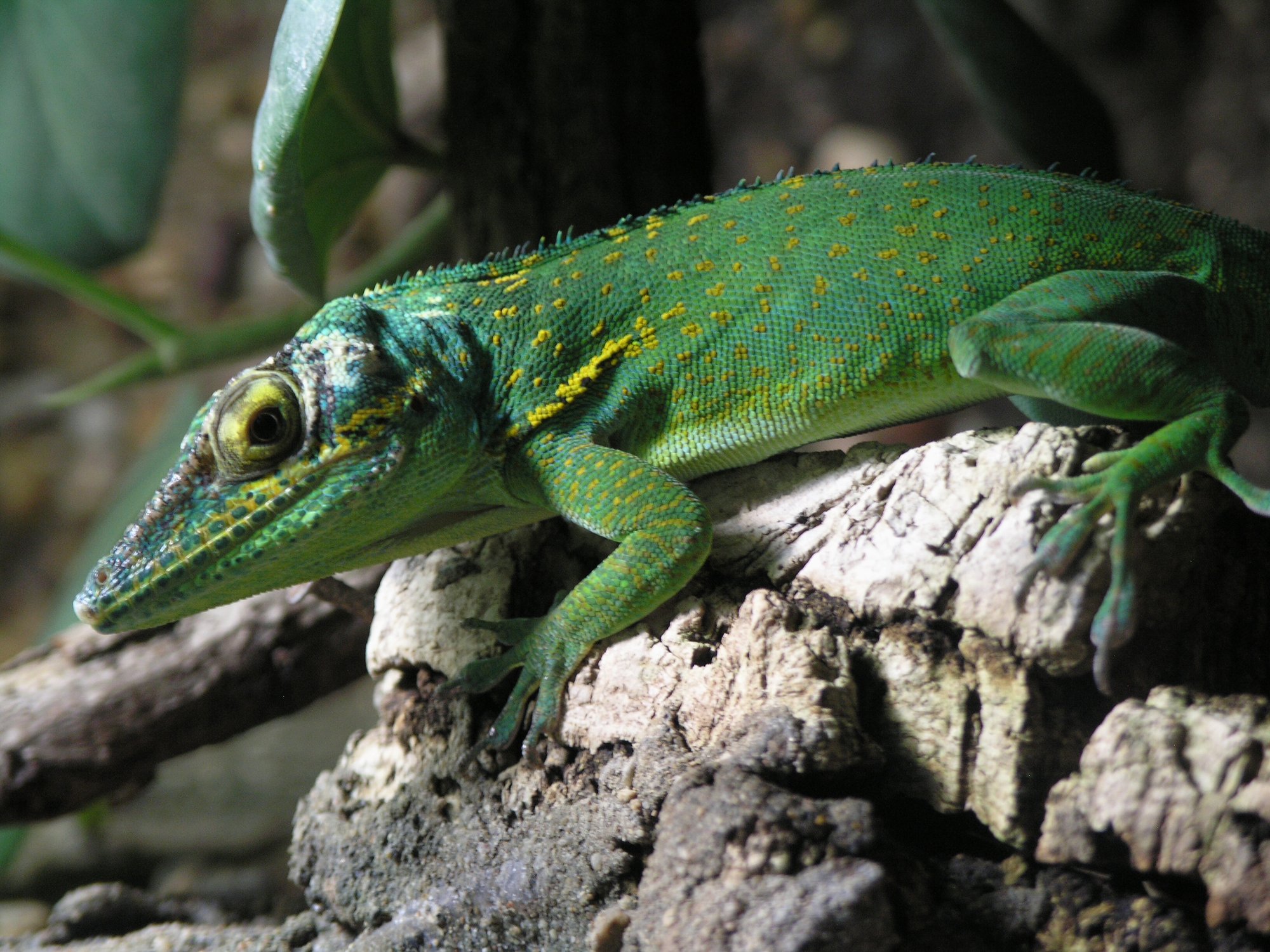
Iguanas · Difficulty: Intermediate
Key facts and care guidance for Baracoa giant anole (Anolis baracoae) (origin: Eastern Cuba (the Baracoa region)). Adult size around a giant anole, up to ~40–48 cm total length. Life expectancy ~8–10 years. The values below are carefully researched guidance.
Short answers
Baracoa giant anole: How big does the enclosure need to be?
A 1.1 pair from 90×80×130 cm (tall format), well ventilated, sturdy vertical and horizontal branches, real plants, a cork or rock background.
Baracoa giant anole: What temperature does it need?
Daytime 22–26 °C, basking spot Local warm spot ~30 °C, at night 18–22 °C.
Baracoa giant anole: Does it need UVB lighting?
UVB: Essential (UVB and strong lighting, plus a basking spot).
Baracoa giant anole: How long do they live?
Life expectancy: ~8–10 years.
Baracoa giant anole: Is it suitable for beginners?
Rather not – it is considered an intermediate species (difficulty: Intermediate).
Climate
- Daytime temperature
- 22–26 °C
- Night temperature
- 18–22 °C
- Basking spot
- Local warm spot ~30 °C
- Humidity
- ~80 % by day, higher at night
- UVB
- Essential (UVB and strong lighting, plus a basking spot)
Enclosure
- Minimum size
- a 1.1 pair from 90×80×130 cm (tall format), well ventilated, sturdy vertical and horizontal branches, real plants, a cork or rock background
- Substrate
- Forest floor with leaf litter, densely planted, plenty of vertical branches
Feeding
- Food
- Large insects: crickets, grasshoppers, roaches, beetles, snails; plus some fruit and occasionally a smaller lizard; dusted regularly with calcium and vitamins
- Feeding interval
- 2–3×/week
Key facts
- Adult size
- a giant anole, up to ~40–48 cm total length
- Life expectancy
- ~8–10 years
- Origin
- Eastern Cuba (the Baracoa region)
- Protection status
- —
- Brumation
- A slight drop is possible
- Cohabitation
- Pair; males incompatible. The reason: several males fight over territory and basking spot until one is injured or permanently confined to a corner. Two females do not get along long-term either: one occupies the basking spot, the other sits in the corner and loses condition — usually without a single visible bite wound.
Notes
Do not keep it too warm (max. about 26 °C, otherwise stress). It belongs to the giant anole group, with a powerful bite.
Do you keep this species?
Add your animal to Reptoria – Reptoria reminds you about feeding and shedding. Add your animal for free →
Baracoa giant anole (Anolis baracoae) currently offered
- Anolis baracoae – high gold · Fredersdorf-Vogelsdorf · 900 €
Related species
- Ghost anole (Anolis lemurinus) – Intermediate
- Ahl's anole (Anolis ahli) – Intermediate
- Aliniger anole (Anolis aliniger) – Beginner with some knowledge
- Allogus anole (Anolis allogus) – Beginner with some knowledge
- Bahaman green anole (Anolis smaragdinus) – Beginner
- Bahoruco anole (Anolis bahorucoensis) – Beginner with some knowledge
- Baleatus giant anole (Anolis baleatus) – Intermediate
- Barahona giant anole (Anolis barahonae) – Intermediate
What you need to start
To keep Baracoa giant anole (Anolis baracoae) you typically need: a suitable enclosure (a 1.1 pair from 90×80×130 cm (tall format), well ventilated, sturdy vertical and horizontal branches, real plants, a cork or rock background), substrate (Forest floor with leaf litter, densely planted, plenty of vertical branches), a heat source with a thermostat, UVB lighting, thermometer and hygrometer, a water dish and hides. You will find equipment in the Reptoria marketplace.
The complete, interactive care database is in the Reptoria app.
Last updated: 9 October 2026 · Editor: Reptoria editorial team · Sources include: royal-anolis.com, tropic-shop.de, anoleannals.org (Losos, Lizards in an Evolutionary Tree, Kap. 3), en.wikipedia.org (Knight anole), EUR-Lex VO (EU) 2026/1383
All values are non-binding guidance and do not replace expert advice. Research thoroughly from several sources before acquiring and keeping an animal, and observe the applicable law (species and animal protection in particular).