Ghost anole (Anolis lemurinus)
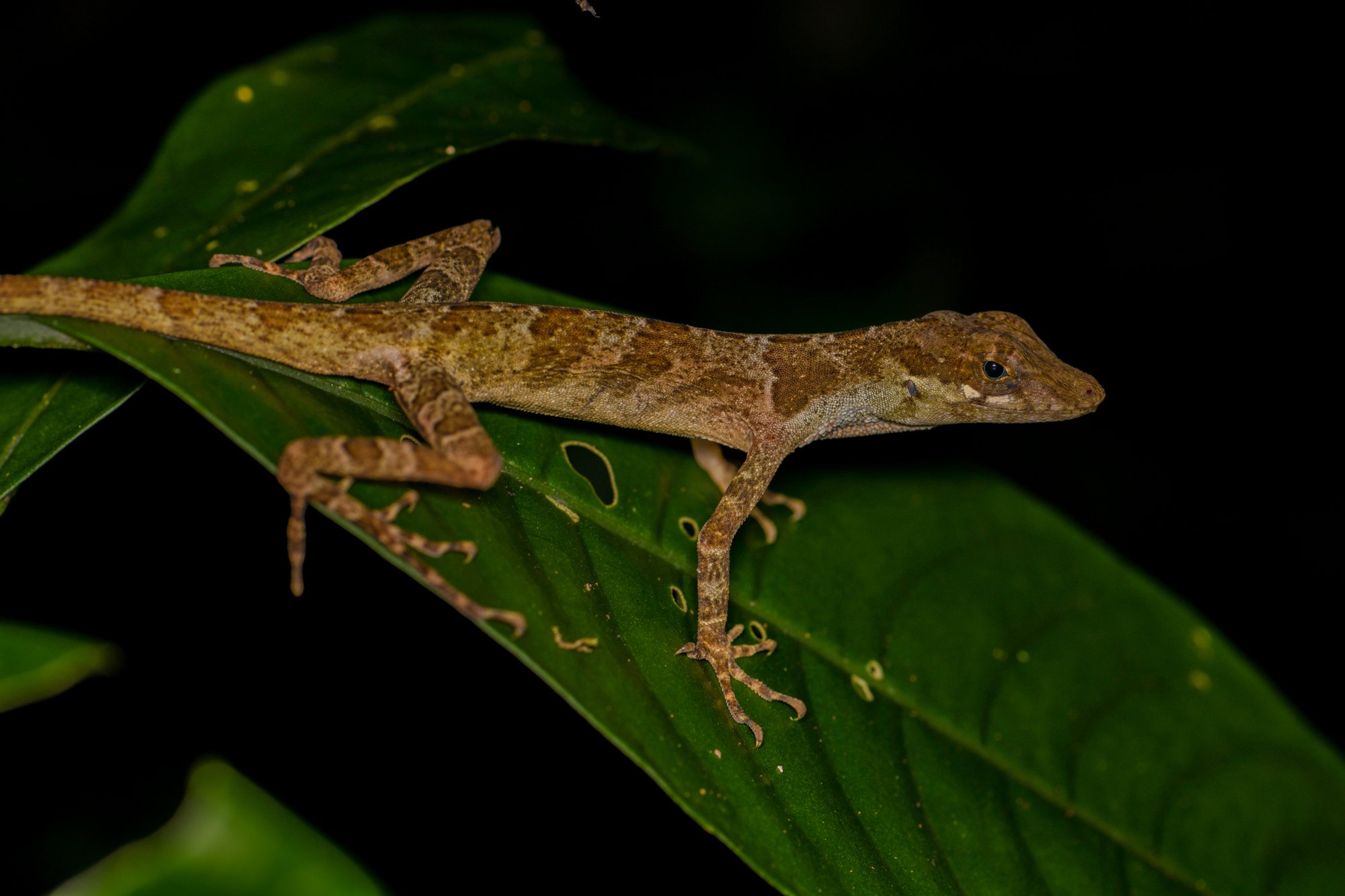
Iguanas · Difficulty: Intermediate
Key facts and care guidance for Ghost anole (Anolis lemurinus) (origin: Central America from Veracruz (Mexico) through Guatemala, Belize, El Salvador, Honduras, Nicaragua and Costa Rica to Panama and Colombia; humid and dry lowland forests as well as premontane wet forest, around 80–880 m, occasionally up to 960 m altitude). Adult size around ~15–18 cm total length (SVL 5–7 cm). Life expectancy ~4–6 years. The values below are carefully researched guidance.
Short answers
Ghost anole: How big does the enclosure need to be?
A pair ~50×50×80 cm (tall format).
Ghost anole: What temperature does it need?
Daytime 24–28 °C, basking spot Small warm spot ~30 °C, at night 20–23 °C.
Ghost anole: Does it need UVB lighting?
UVB: Needed (low to medium UVB, e.g. 5.0). This species lives in the shade and doesn't need a glaring lamp, but without UVB, rickets develops.
Ghost anole: How long do they live?
Life expectancy: ~4–6 years.
Ghost anole: Is it suitable for beginners?
Rather not – it is considered an intermediate species (difficulty: Intermediate).
Climate
- Daytime temperature
- 24–28 °C
- Night temperature
- 20–23 °C
- Basking spot
- Small warm spot ~30 °C
- Humidity
- 70–85 %
- UVB
- Needed (low to medium UVB, e.g. 5.0). This species lives in the shade and doesn't need a glaring lamp, but without UVB, rickets develops.
Enclosure
- Minimum size
- a pair ~50×50×80 cm (tall format)
- Substrate
- Damp forest floor with leaf litter, densely planted
Feeding
- Food
- Insects (soft-bodied prey preferred: caterpillars, spiders, small crickets)
- Feeding interval
- Several times a week
Key facts
- Adult size
- ~15–18 cm total length (SVL 5–7 cm)
- Life expectancy
- ~4–6 years
- Origin
- Central America from Veracruz (Mexico) through Guatemala, Belize, El Salvador, Honduras, Nicaragua and Costa Rica to Panama and Colombia; humid and dry lowland forests as well as premontane wet forest, around 80–880 m, occasionally up to 960 m altitude
- Protection status
- —
- Brumation
- None (a slight drop is possible)
- Cohabitation
- In pairs; males are territorial. The reason: several males fight over territory and basking spot until one is injured or ends up permanently sitting in a corner. Two females do not work together long-term either: one occupies the basking spot, the other sits in the corner and loses weight — usually without a single visible bite wound.
Notes
A shade-loving forest anole, rarely kept. There are no specific care sheets — the figures are derived from general anole husbandry and its home climate.
Do you keep this species?
Add your animal to Reptoria – Reptoria reminds you about feeding and shedding. Add your animal for free →
Look for Ghost anole (Anolis lemurinus) in the marketplace →
Related species
- Ahl's anole (Anolis ahli) – Intermediate
- Aliniger anole (Anolis aliniger) – Beginner with some knowledge
- Allogus anole (Anolis allogus) – Beginner with some knowledge
- Bahaman green anole (Anolis smaragdinus) – Beginner
- Bahoruco anole (Anolis bahorucoensis) – Beginner with some knowledge
- Baleatus giant anole (Anolis baleatus) – Intermediate
- Baracoa giant anole (Anolis baracoae) – Intermediate
- Barahona giant anole (Anolis barahonae) – Intermediate
What you need to start
To keep Ghost anole (Anolis lemurinus) you typically need: a suitable enclosure (a pair ~50×50×80 cm (tall format)), substrate (Damp forest floor with leaf litter, densely planted), a heat source with a thermostat, UVB lighting, thermometer and hygrometer, a water dish and hides. You will find equipment in the Reptoria marketplace.
The complete, interactive care database is in the Reptoria app.
Last updated: 9 October 2026 · Editor: Reptoria editorial team · Sources include: karibische-anolis.de, anolesatoz.weebly.com, reptile-database.reptarium.cz, Wikipedia EN, EUR-Lex VO (EU) 2026/1383
All values are non-binding guidance and do not replace expert advice. Research thoroughly from several sources before acquiring and keeping an animal, and observe the applicable law (species and animal protection in particular).