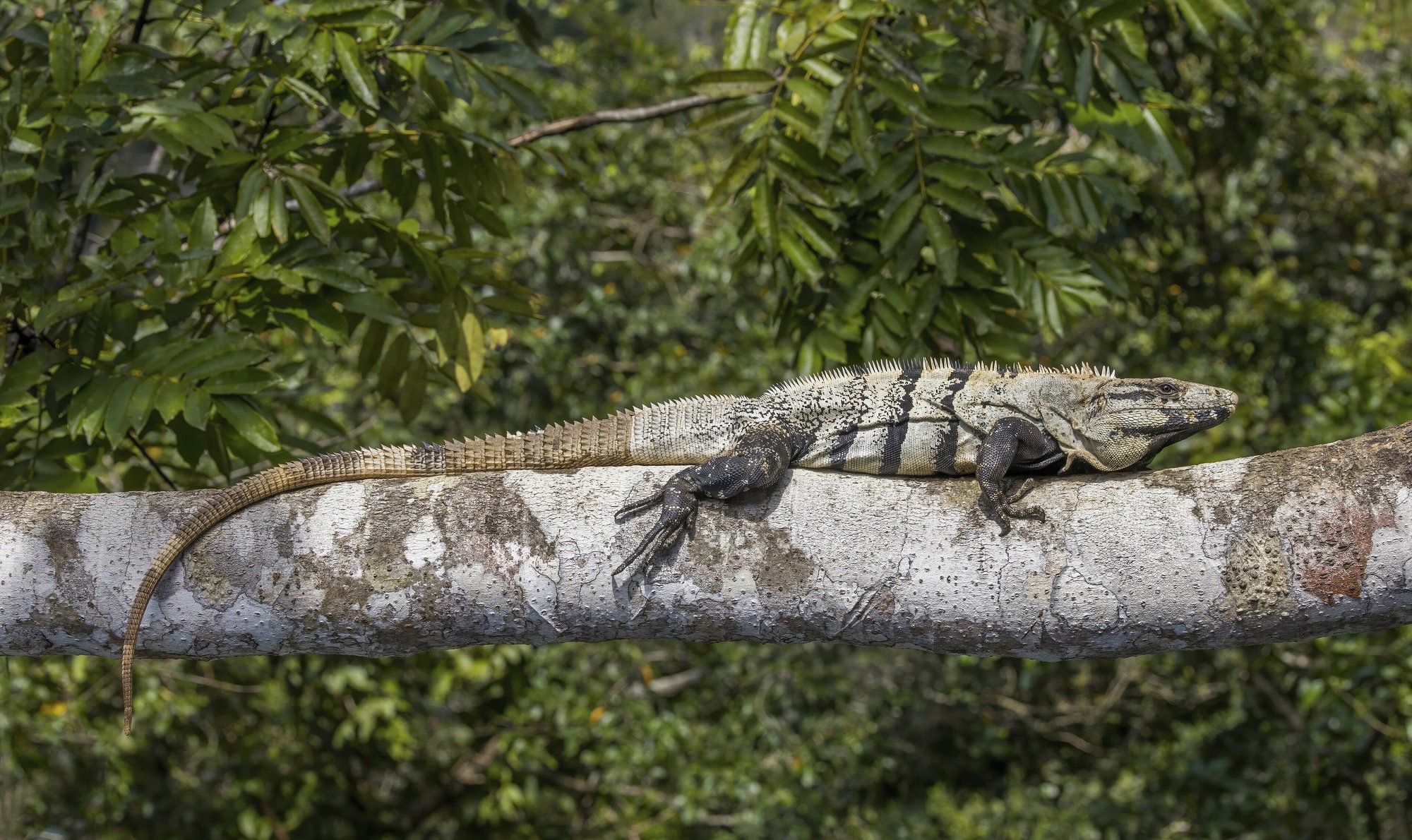
Black spiny-tailed iguana (Ctenosaura similis)
Iguanas · Difficulty: Intermediate
Key facts and care guidance for Black spiny-tailed iguana (Ctenosaura similis) (origin: Southern Mexico to Panama; invasive in Florida). Adult size around 100–150 cm total length including the tail (SVL 50–55 cm); males considerably larger. Life expectancy up to ~20–25 years. The values below are carefully researched guidance.
Short answers
Black spiny-tailed iguana: How big does the enclosure need to be?
Very large; at least ~200×100×150 cm for one adult animal, a room enclosure is better; a pair or group from ~300×250×180 cm.
Black spiny-tailed iguana: What temperature does it need?
Daytime 28–35 °C, basking spot 40–45 °C, at night 20–22 °C.
Black spiny-tailed iguana: Does it need UVB lighting?
UVB: UVB essential, high (an open-country sun species, Ferguson zone 3–4).
Black spiny-tailed iguana: How long do they live?
Life expectancy: up to ~20–25 years.
Black spiny-tailed iguana: Is it suitable for beginners?
Rather not – it is considered an intermediate species (difficulty: Intermediate).
Climate
- Daytime temperature
- 28–35 °C
- Night temperature
- 20–22 °C
- Basking spot
- 40–45 °C
- Humidity
- approx. 50 % by day, 80–90 % at night
- UVB
- UVB essential, high (an open-country sun species, Ferguson zone 3–4)
Enclosure
- Minimum size
- Very large; at least ~200×100×150 cm for one adult animal, a room enclosure is better; a pair or group from ~300×250×180 cm
- Substrate
- A sand, soil and loam mix they can dig in, with stones, places to climb and a bathing basin
Feeding
- Food
- Adults are mostly plant-eating (80–90 %: leaves, flowers, herbs, vegetables) with little animal food; juveniles take more insects and animal food
- Feeding interval
- adults plant food daily to every other day, animal food rarely; juveniles daily
Key facts
- Adult size
- 100–150 cm total length including the tail (SVL 50–55 cm); males considerably larger
- Life expectancy
- up to ~20–25 years
- Origin
- Southern Mexico to Panama; invasive in Florida
- Protection status
- Not listed under CITES (IUCN "Least Concern"); no registration duty
- Brumation
- A slight rest period of about 4 weeks at ~18 °C is possible
- Cohabitation
- Keep singly, as a pair, or as a harem with one male and several females in a very large enclosure. Never house males together - fights over territory and the basking spot often end in serious injury.
Notes
It grows very large, powerful and fast, can bite hard and lash with its tail. An enormous space requirement → a room or outdoor terrarium, and nothing for a small flat. Adults are mainly plant-eating (too much animal food → gout and kidney problems).
Do you keep this species?
Add your animal to Reptoria – Reptoria reminds you about feeding and shedding. Add your animal for free →
Look for Black spiny-tailed iguana (Ctenosaura similis) in the marketplace →
Related species
- Cape spiny-tailed iguana (Ctenosaura hemilopha) – Intermediate
- Guatemalan spiny-tailed iguana (Ctenosaura palearis) – Expert
- Northeastern spiny-tailed iguana (Ctenosaura acanthura) – Expert
- Mexican spiny-tailed iguana (Ctenosaura pectinata) – Intermediate
- Club-tailed iguana (Ctenosaura quinquecarinata) – Expert
- Oaxaca spiny-tailed iguana (Ctenosaura oaxacana) – Expert
- Roatán spiny-tailed iguana (Ctenosaura oedirhina) – Expert
- Black-chested spiny-tailed iguana (Ctenosaura melanosterna) – Expert
What you need to start
To keep Black spiny-tailed iguana (Ctenosaura similis) you typically need: a suitable enclosure (Very large; at least ~200×100×150 cm for one adult animal, a room enclosure is better; a pair or group from ~300×250×180 cm), substrate (A sand, soil and loam mix they can dig in, with stones, places to climb and a bathing basin), a heat source with a thermostat, UVB lighting, thermometer and hygrometer, a water dish and hides. You will find equipment in the Reptoria marketplace.
The complete, interactive care database is in the Reptoria app.
Last updated: 9 October 2026 · Editor: Reptoria editorial team · Sources include: https://de.wikipedia.org/wiki/Gemeiner_Schwarzleguan, https://en.wikipedia.org/wiki/Ctenosaura, https://reptilesmagazine.com/spiny-tailed-iguana-care-sheet/, https://www.zoonewengland.org/stone-zoo/animals/reptiles-amphibians/spiny-tailed-iguana/
All values are non-binding guidance and do not replace expert advice. Research thoroughly from several sources before acquiring and keeping an animal, and observe the applicable law (species and animal protection in particular).