Bromeliad arboreal alligator lizard (Abronia taeniata)
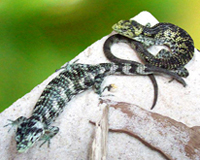
Lizards · Difficulty: Expert
Key facts and care guidance for Bromeliad arboreal alligator lizard (Abronia taeniata) (origin: Eastern Mexico (Tamaulipas, San Luis Potosí, Hidalgo, northern Puebla, Querétaro, Veracruz, Guanajuato); cloud and pine-oak forest; IUCN Vulnerable). Adult size around total length ~25–30 cm (the banded, somewhat larger species). Life expectancy approx. 10–15 years. The values below are carefully researched guidance.
Short answers
Bromeliad arboreal alligator lizard: How big does the enclosure need to be?
80×60×80 cm (arboreal, height matters; for 1–2 animals).
Bromeliad arboreal alligator lizard: What temperature does it need?
Daytime 20–26 °C, basking spot 28–30 °C (cool basking spot; above 32 °C heat build-up becomes life-threatening), at night 14–18 °C.
Bromeliad arboreal alligator lizard: Does it need UVB lighting?
UVB: UVB needed (low to moderate, Ferguson zone 1–2, UV index 1–3).
Bromeliad arboreal alligator lizard: How long do they live?
Life expectancy: approx. 10–15 years.
Bromeliad arboreal alligator lizard: Is it suitable for beginners?
No – better suited to experienced keepers (difficulty: Expert).
Climate
- Daytime temperature
- 20–26 °C
- Night temperature
- 14–18 °C
- Basking spot
- 28–30 °C (cool basking spot; above 32 °C heat build-up becomes life-threatening)
- Humidity
- 70–90 % (well ventilated, let it dry out at times)
- UVB
- UVB needed (low to moderate, Ferguson zone 1–2, UV index 1–3)
Enclosure
- Minimum size
- 80×60×80 cm (arboreal, height matters; for 1–2 animals)
- Substrate
- Sphagnum moss with coco humus or chips, damp but airy
Feeding
- Food
- Insects (crickets, house crickets, roaches, snails, caterpillars), low in protein and well supplemented with vitamins
- Feeding interval
- adults 2–3×/week, juveniles approx. 3×/week
Key facts
- Adult size
- total length ~25–30 cm (the banded, somewhat larger species)
- Life expectancy
- approx. 10–15 years
- Origin
- Eastern Mexico (Tamaulipas, San Luis Potosí, Hidalgo, northern Puebla, Querétaro, Veracruz, Guanajuato); cloud and pine-oak forest; IUCN Vulnerable
- Protection status
- CITES Appendix II / EU Regulation Annex B; proof of origin plus registration required, captive-bred animals only
- Brumation
- No real winter rest; a slight winter cooling to stimulate breeding
- Cohabitation
- Keep them singly or as a pair (1.1); NEVER keep males together (territorial fights); live-bearing (ovoviviparous)
Notes
A more widespread, bromeliad-dwelling species (the banded or bromeliad arboreal alligator lizard). Cool cloud-forest conditions; avoid overheating and waterlogging. The care is typical of the genus and well documented; species-specific captive data are limited.
Do you keep this species?
Add your animal to Reptoria – Reptoria reminds you about feeding and shedding. Add your animal for free →
Look for Bromeliad arboreal alligator lizard (Abronia taeniata) in the marketplace →
Related species
- Anzueto's arboreal alligator lizard (Abronia anzuetoi) – Expert
- Aurita arboreal alligator lizard (Abronia aurita) – Intermediate to expert
- Bogert's arboreal alligator lizard (Abronia bogerti) – Expert
- Campbell's alligator lizard (Abronia campbelli) – Expert
- Campbell's arboreal alligator lizard (Abronia lythrochila campbelli) – Intermediate to expert
- Chiszar's arboreal alligator lizard (Abronia chiszari) – Expert
- Cuetzpali arboreal alligator lizard (Abronia cuetzpali) – Expert
- Deppe's arboreal alligator lizard (Abronia deppii) – Expert
What you need to start
To keep Bromeliad arboreal alligator lizard (Abronia taeniata) you typically need: a suitable enclosure (80×60×80 cm (arboreal, height matters; for 1–2 animals)), substrate (Sphagnum moss with coco humus or chips, damp but airy), a heat source with a thermostat, UVB lighting, thermometer and hygrometer, a water dish and hides. You will find equipment in the Reptoria marketplace.
The complete, interactive care database is in the Reptoria app.
Last updated: 30 October 2026 · Editor: Reptoria editorial team · Sources include: https://en.wikipedia.org/wiki/Abronia_(lizard), https://reptile-database.reptarium.cz/species?genus=Abronia&species=taeniata, https://www.thebiodude.com/blogs/lizard-caresheets/arboreal-alligator-lizard-caresheet-and-bioactive-habitat-maintenance
All values are non-binding guidance and do not replace expert advice. Research thoroughly from several sources before acquiring and keeping an animal, and observe the applicable law (species and animal protection in particular).