Brown pricklenape (Acanthosaura lepidogaster)
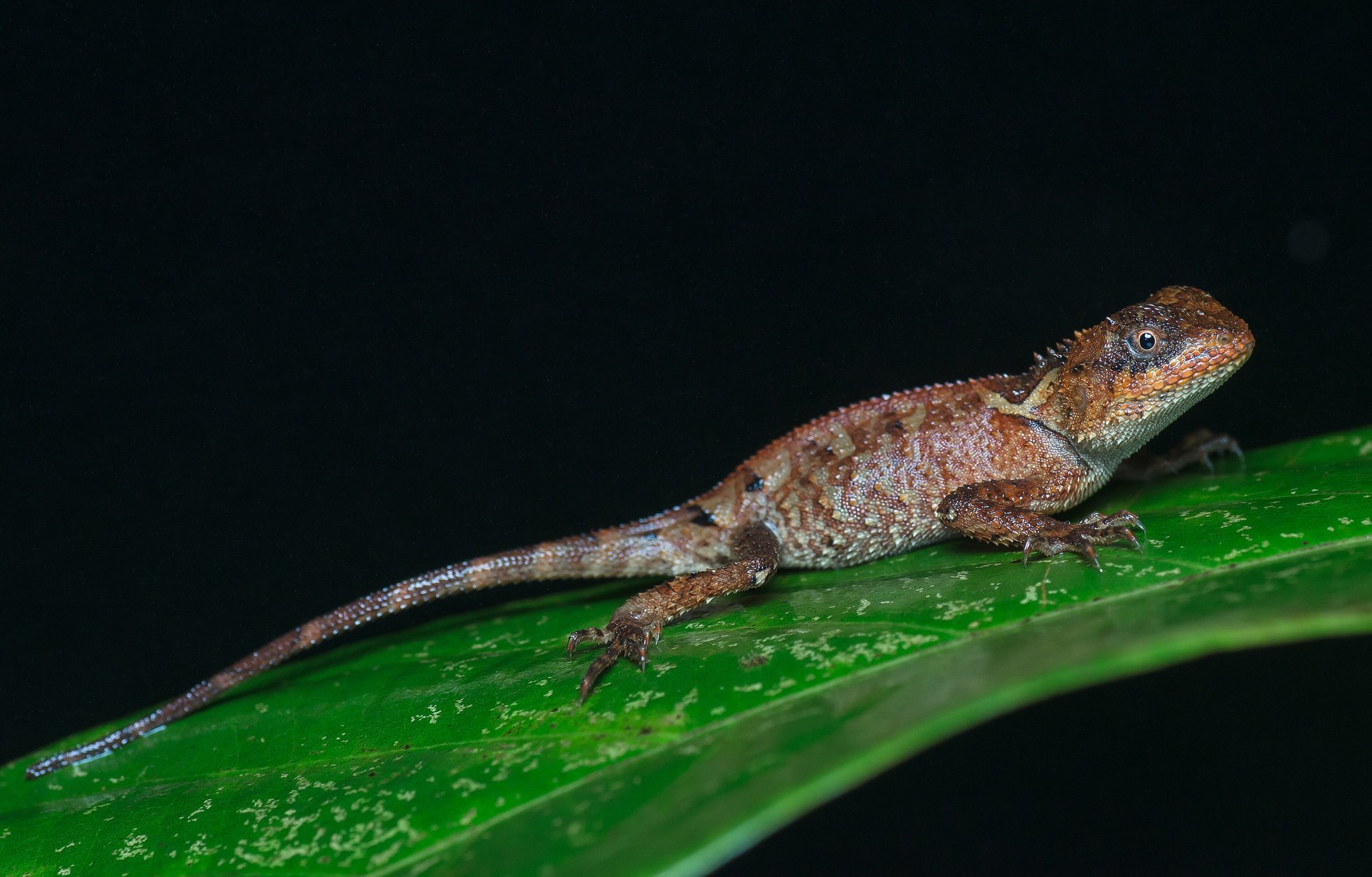
Agamas · Difficulty: Intermediate
Key facts and care guidance for Brown pricklenape (Acanthosaura lepidogaster) (origin: Southern China (Yunnan, Guangxi, Hainan), Vietnam, Laos, Thailand, Myanmar, north-eastern India; montane forest to ~1,500 m). Adult size around approx. 20–28 cm total length (with the tail), females smaller; the smallest species in the genus. Life expectancy approx. 6–10 years. The values below are carefully researched guidance.
Short answers
Brown pricklenape: How big does the enclosure need to be?
80×50×100 cm for 1 adult animal, better 100×60×120 cm (height matters more than floor space — a trunk dweller).
Brown pricklenape: What temperature does it need?
Daytime 24–28 °C, basking spot local warm spot up to 30 °C (never keep the enclosure above 30 °C for long – sensitive to heat), at night 18–20 °C.
Brown pricklenape: Does it need UVB lighting?
UVB: UVB recommended (a forest and shade dweller, Ferguson zone 1–2, UV index 1–3; a 6 % T5 tube).
Brown pricklenape: How long do they live?
Life expectancy: approx. 6–10 years.
Brown pricklenape: Is it suitable for beginners?
Rather not – it is considered an intermediate species (difficulty: Intermediate).
Climate
- Daytime temperature
- 24–28 °C
- Night temperature
- 18–20 °C
- Basking spot
- local warm spot up to 30 °C (never keep the enclosure above 30 °C for long – sensitive to heat)
- Humidity
- 70–80 % by day, up to 90–100 % at night
- UVB
- UVB recommended (a forest and shade dweller, Ferguson zone 1–2, UV index 1–3; a 6 % T5 tube)
Enclosure
- Minimum size
- 80×50×100 cm for 1 adult animal, better 100×60×120 cm (height matters more than floor space — a trunk dweller)
- Substrate
- Humid woodland substrate: coco humus or terrarium soil with leaf litter and moss, a drainage layer against waterlogging
Feeding
- Food
- Insectivorous: crickets, house crickets, roaches, earthworms (preferred), wax or silkworms; dusted with calcium and vitamin D3
- Feeding interval
- adults 2–3×/week, juveniles daily to every other day
Key facts
- Adult size
- approx. 20–28 cm total length (with the tail), females smaller; the smallest species in the genus
- Life expectancy
- approx. 6–10 years
- Origin
- Southern China (Yunnan, Guangxi, Hainan), Vietnam, Laos, Thailand, Myanmar, north-eastern India; montane forest to ~1,500 m
- Protection status
- Not listed under CITES, no German registration duty (as far as research shows); often wild-caught – look for captive breeding and proof of origin
- Brumation
- A cooler rest period of 6–8 weeks is recommended (day ~18–20 °C, night ~15 °C, with a shorter photoperiod and reduced feeding) – it benefits health and breeding
- Cohabitation
- Territorial. Keeping them singly is the standard. A harem of one male plus several females is possible only in a large, heavily structured tall enclosure with visual barriers; NEVER two males (territorial fights)
Notes
No heat build-up – the commonest keeping mistake is too high a temperature and too dry air (dehydration, shedding and kidney problems). A large, clean water section and daily misting; it often drinks only moving or dripping water. Also known as the "green / Siamese forest dragon"; it changes colour with its mood.
Do you keep this species?
Add your animal to Reptoria – Reptoria reminds you about feeding and shedding. Add your animal for free →
Look for Brown pricklenape (Acanthosaura lepidogaster) in the marketplace →
Related species
- Bintang mountain horned lizard (Acanthosaura bintangensis) – Intermediate
- Short-legged horned lizard (Acanthosaura brachypoda) – Intermediate
- Cardamom mountain horned lizard (Acanthosaura cardamomensis) – Intermediate
- Crowned pricklenape (Acanthosaura coronata) – Intermediate
- Golden pricklenape (Acanthosaura capra) – Intermediate
- Masked spiny lizard (Acanthosaura crucigera) – Intermediate
- Natalia's pricklenape (Acanthosaura nataliae) – Intermediate
- Phong Dien pricklenape (Acanthosaura phongdienensis) – Intermediate
What you need to start
To keep Brown pricklenape (Acanthosaura lepidogaster) you typically need: a suitable enclosure (80×50×100 cm for 1 adult animal, better 100×60×120 cm (height matters more than floor space — a trunk dweller)), substrate (Humid woodland substrate: coco humus or terrarium soil with leaf litter and moss, a drainage layer against waterlogging), a heat source with a thermostat, UVB lighting, thermometer and hygrometer, a water dish and hides. You will find equipment in the Reptoria marketplace.
The complete, interactive care database is in the Reptoria app.
Last updated: 9 October 2026 · Editor: Reptoria editorial team · Sources include: einrichtungsbeispiele.de, eur-lex.europa.eu, kaleidoskop-der-naturnahe.jimdoweb.com, kingsnake.com, nahf.org
All values are non-binding guidance and do not replace expert advice. Research thoroughly from several sources before acquiring and keeping an animal, and observe the applicable law (species and animal protection in particular).