Golden pricklenape (Acanthosaura capra)
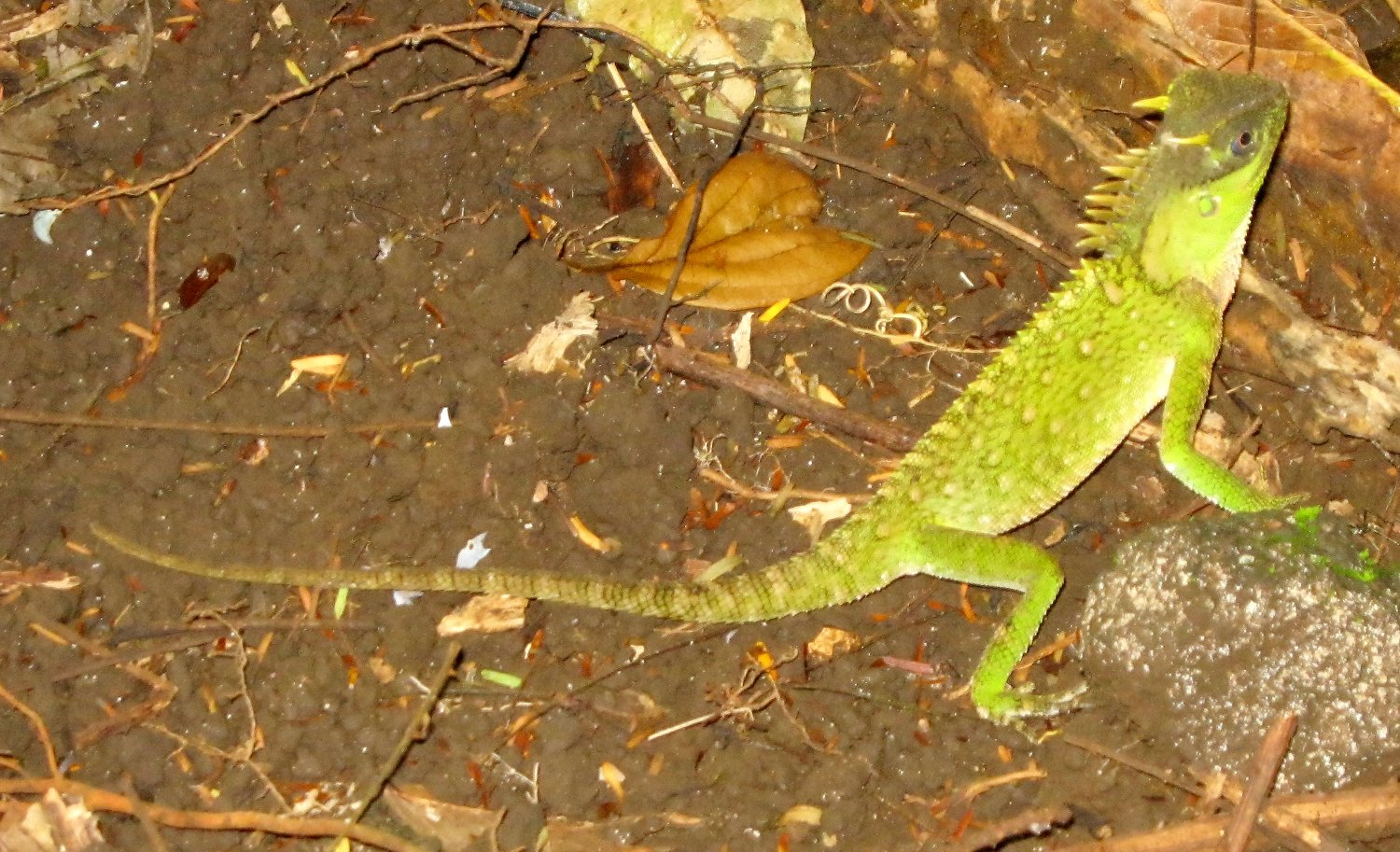
Agamas · Difficulty: Intermediate
Key facts and care guidance for Golden pricklenape (Acanthosaura capra) (origin: Southern Vietnam (Đồng Nai, Khánh Hòa, Lâm Đồng) and eastern Cambodia (Mondolkiri); shaded montane and lowland rainforest, usually near water). Adult size around up to ~32 cm total length (with the tail). Life expectancy approx. 10 years. The values below are carefully researched guidance.
Short answers
Golden pricklenape: How big does the enclosure need to be?
At least 120×70×150 cm for a single animal, 140×70×170 cm for a pair; large water section (about 1/4 of the floor area) with moving water.
Golden pricklenape: What temperature does it need?
Daytime 22–27 °C (preferred temperature ~25 °C), basking spot local warm spot max. ~30 °C (shade-seeker – never overheat the enclosure), at night 18–20 °C.
Golden pricklenape: Does it need UVB lighting?
UVB: UVB needed (a forest dweller, Ferguson zone 1–2, UV index 1–3; position it at the basking spot).
Golden pricklenape: How long do they live?
Life expectancy: approx. 10 years.
Golden pricklenape: Is it suitable for beginners?
Rather not – it is considered an intermediate species (difficulty: Intermediate).
Climate
- Daytime temperature
- 22–27 °C (preferred temperature ~25 °C)
- Night temperature
- 18–20 °C
- Basking spot
- local warm spot max. ~30 °C (shade-seeker – never overheat the enclosure)
- Humidity
- 70–80 % by day, 90–100 % at night
- UVB
- UVB needed (a forest dweller, Ferguson zone 1–2, UV index 1–3; position it at the basking spot)
Enclosure
- Minimum size
- at least 120×70×150 cm for a single animal, 140×70×170 cm for a pair; large water section (about 1/4 of the floor area) with moving water
- Substrate
- Terrarium soil or coco humus with moss and leaf litter; a LECA drainage layer with a fleece against waterlogging
Feeding
- Food
- Insectivorous: earthworms, crickets, roaches, larvae; large animals rarely take smelt or a nestling mouse; calcium and D3
- Feeding interval
- adults 2–3×/week, juveniles daily
Key facts
- Adult size
- up to ~32 cm total length (with the tail)
- Life expectancy
- approx. 10 years
- Origin
- Southern Vietnam (Đồng Nai, Khánh Hòa, Lâm Đồng) and eastern Cambodia (Mondolkiri); shaded montane and lowland rainforest, usually near water
- Protection status
- Not listed under CITES (as far as research shows); often wild-caught – prefer captive breeding and proof of origin
- Brumation
- A winter rest of about 2 months: reduce the heat by 4–5 °C and shorten the lighting hours, and stop feeding
- Cohabitation
- Territorial. Keeping them singly is the standard; a pair or harem (one male plus females) only in a large, well-structured tall enclosure with visual barriers; NEVER two males (fights)
Notes
The "green / golden forest dragon", diurnal but shade-seeking – do not make the lighting too intense. The main mistakes: too warm or too dry. It needs a large water section and high humidity with good ventilation (a risk of mould).
Do you keep this species?
Add your animal to Reptoria – Reptoria reminds you about feeding and shedding. Add your animal for free →
Look for Golden pricklenape (Acanthosaura capra) in the marketplace →
Related species
- Bintang mountain horned lizard (Acanthosaura bintangensis) – Intermediate
- Short-legged horned lizard (Acanthosaura brachypoda) – Intermediate
- Brown pricklenape (Acanthosaura lepidogaster) – Intermediate
- Cardamom mountain horned lizard (Acanthosaura cardamomensis) – Intermediate
- Crowned pricklenape (Acanthosaura coronata) – Intermediate
- Masked spiny lizard (Acanthosaura crucigera) – Intermediate
- Natalia's pricklenape (Acanthosaura nataliae) – Intermediate
- Phong Dien pricklenape (Acanthosaura phongdienensis) – Intermediate
What you need to start
To keep Golden pricklenape (Acanthosaura capra) you typically need: a suitable enclosure (at least 120×70×150 cm for a single animal, 140×70×170 cm for a pair; large water section (about 1/4 of the floor area) with moving water), substrate (Terrarium soil or coco humus with moss and leaf litter; a LECA drainage layer with a fleece against waterlogging), a heat source with a thermostat, UVB lighting, thermometer and hygrometer, a water dish and hides. You will find equipment in the Reptoria marketplace.
The complete, interactive care database is in the Reptoria app.
Last updated: 9 October 2026 · Editor: Reptoria editorial team · Sources include: reptile-database.reptarium.cz, Wikipedia EN, einrichtungsbeispiele.de, eur-lex.europa.eu, kaleidoskop-der-naturnahe.jimdoweb.com
All values are non-binding guidance and do not replace expert advice. Research thoroughly from several sources before acquiring and keeping an animal, and observe the applicable law (species and animal protection in particular).