Chameleon angle-headed lizard (Gonocephalus chamaeleontinus)
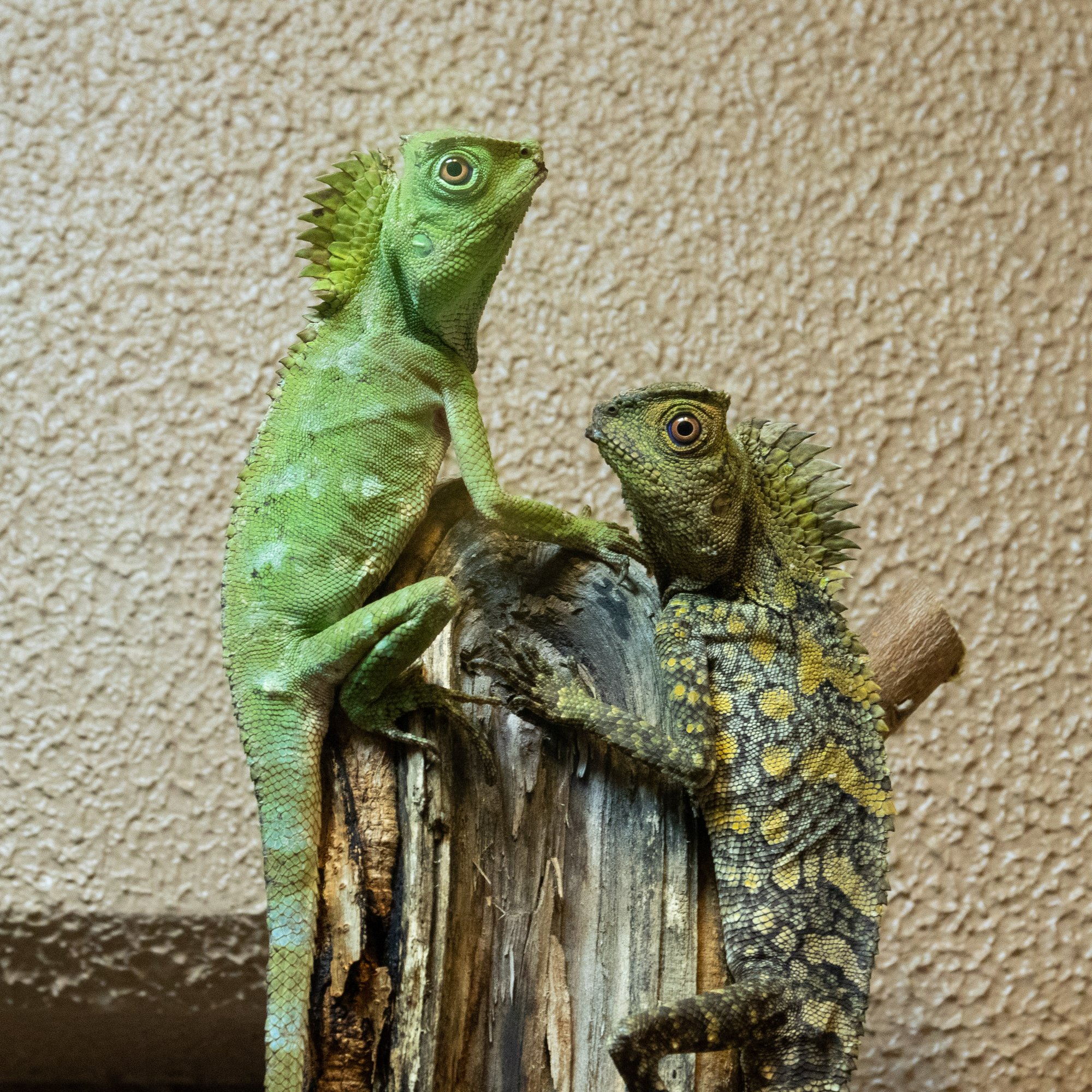
Agamas · Difficulty: Expert
Key facts and care guidance for Chameleon angle-headed lizard (Gonocephalus chamaeleontinus) (origin: Sumatra, Java, Nias, the Mentawai, Banyak and Natuna Islands as well as the Malay Peninsula (Pahang, Pulau Tioman); humid montane forest). Adult size around males up to approx. 32 cm, females up to approx. 27 cm total length. Life expectancy approx. 8–10 years. The values below are carefully researched guidance.
Short answers
Chameleon angle-headed lizard: How big does the enclosure need to be?
At least 100 × 60 × 120 cm for a pair, 160 × 90 × 180 cm recommended (height and vertical trunks matter more than floor space), plus a large water basin.
Chameleon angle-headed lizard: What temperature does it need?
Daytime 24–28 °C, basking spot 28–30 °C (small spot, not too hot), at night 20–22 °C.
Chameleon angle-headed lizard: Does it need UVB lighting?
UVB: UVB needed (5–6 %, Ferguson zone 1–2).
Chameleon angle-headed lizard: How long do they live?
Life expectancy: approx. 8–10 years.
Chameleon angle-headed lizard: Is it suitable for beginners?
No – better suited to experienced keepers (difficulty: Expert).
Climate
- Daytime temperature
- 24–28 °C
- Night temperature
- 20–22 °C
- Basking spot
- 28–30 °C (small spot, not too hot)
- Humidity
- 70–80 % during the day, up to nearly 100 % at night
- UVB
- UVB needed (5–6 %, Ferguson zone 1–2)
Enclosure
- Minimum size
- at least 100 × 60 × 120 cm for a pair, 160 × 90 × 180 cm recommended (height and vertical trunks matter more than floor space), plus a large water basin
- Substrate
- A forest-floor mix of coco humus and leaf litter, permanently damp but not wet
Feeding
- Food
- Crickets, house crickets, roaches, wax moths, occasionally snails; dust with calcium and vitamins
- Feeding interval
- adults 2–3× a week, juveniles daily; mist several times a day
Key facts
- Adult size
- males up to approx. 32 cm, females up to approx. 27 cm total length
- Life expectancy
- approx. 8–10 years
- Origin
- Sumatra, Java, Nias, the Mentawai, Banyak and Natuna Islands as well as the Malay Peninsula (Pahang, Pulau Tioman); humid montane forest
- Protection status
- Not listed under CITES; wild-caught animals in the trade — please buy captive-bred animals specifically
- Brumation
- None
- Cohabitation
- In pairs (1.1), with a lot of space also 1.2. Males are strictly territorial and will not tolerate each other, not even in large enclosures. Plan visual barriers and several climbing levels so that subordinate animals can get out of the way.
Notes
It drinks almost only falling droplets — a rain or fog system is essential, and a water bowl alone is not enough. Wild-caught animals are often heavily wormed and hard to settle in; captive-bred animals are markedly more robust.
Do you keep this species?
Add your animal to Reptoria – Reptoria reminds you about feeding and shedding. Add your animal for free →
Look for Chameleon angle-headed lizard (Gonocephalus chamaeleontinus) in the marketplace →
Related species
- Bell's angle-headed dragon (Gonocephalus bellii) – Intermediate to expert
- Borneo angle-headed lizard (Gonocephalus bornensis) – Expert
- Doria's angle-headed lizard (Gonocephalus doriae) – Intermediate
- Great angle-headed lizard (Gonocephalus grandis) – Expert
- Kuhl's angle-headed lizard (Gonocephalus kuhlii) – Expert
- Blue-eyed angle-headed lizard (Gonocephalus liogaster) – Intermediate
- Large-scaled angle-headed lizard (Gonocephalus megalepis) – Expert
- Mjöberg's angle-headed lizard (Gonocephalus mjobergi) – Expert
What you need to start
To keep Chameleon angle-headed lizard (Gonocephalus chamaeleontinus) you typically need: a suitable enclosure (at least 100 × 60 × 120 cm for a pair, 160 × 90 × 180 cm recommended (height and vertical trunks matter more than floor space), plus a large water basin), substrate (A forest-floor mix of coco humus and leaf litter, permanently damp but not wet), a heat source with a thermostat, UVB lighting, thermometer and hygrometer, a water dish and hides. You will find equipment in the Reptoria marketplace.
The complete, interactive care database is in the Reptoria app.
Last updated: 9 October 2026 · Editor: Reptoria editorial team · Sources include: reptile-database.reptarium.cz, reptile-care.de, einrichtungsbeispiele.de, Wikipedia EN, bmleh.de (Gutachten Reptilien 1997)
All values are non-binding guidance and do not replace expert advice. Research thoroughly from several sources before acquiring and keeping an animal, and observe the applicable law (species and animal protection in particular).