Doria's angle-headed lizard (Gonocephalus doriae)
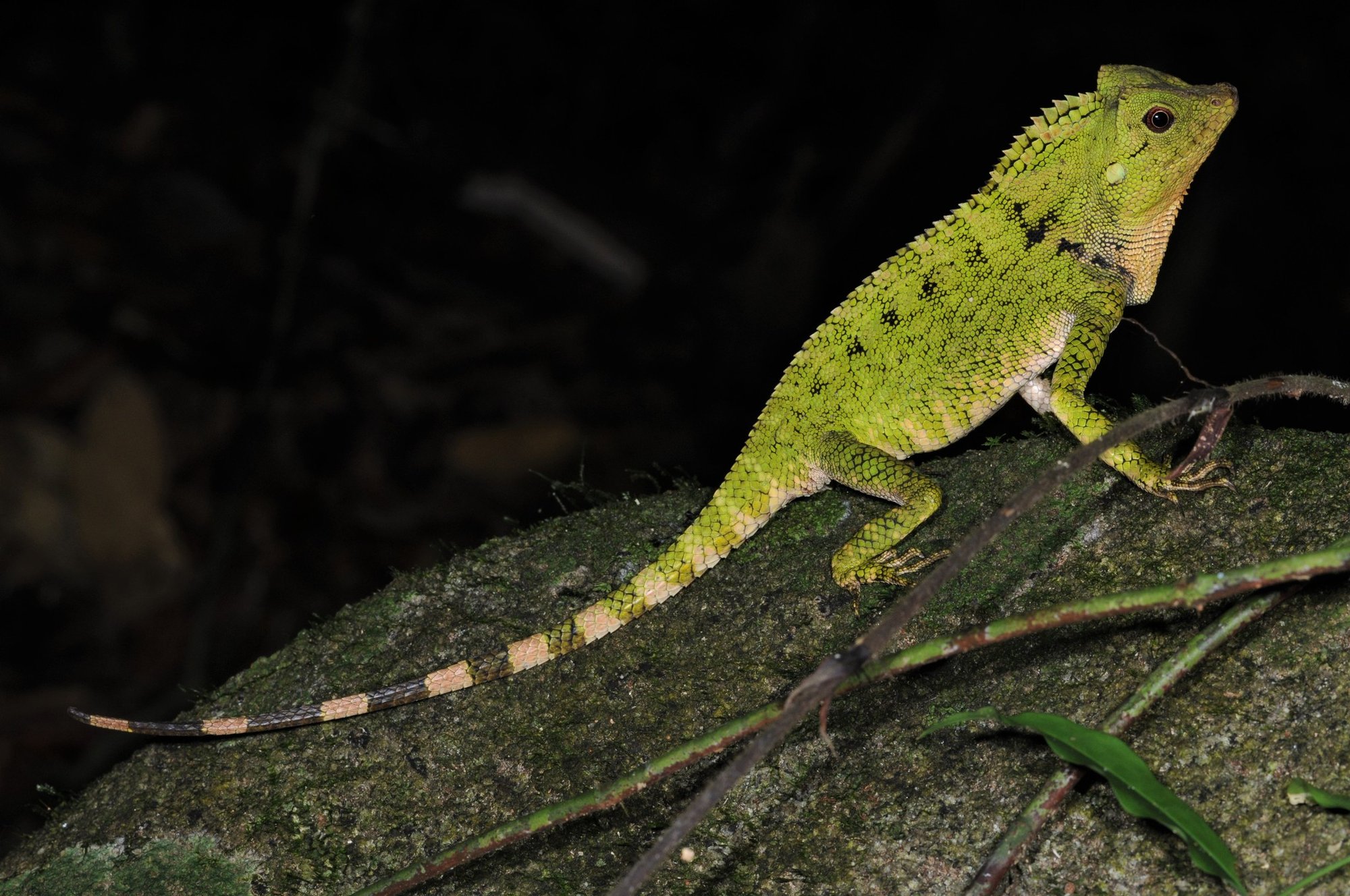
Agamas · Difficulty: Intermediate
Key facts and care guidance for Doria's angle-headed lizard (Gonocephalus doriae) (origin: Borneo (Kalimantan, Sarawak, Sabah), lowland and hill rainforest; since 2023 the forms from the Malay Peninsula and southern Thailand (subspecies abbotti) as well as Sumatra (subspecies brevis) have again been placed within this species. Belongs to the chamaeleontinus subgroup.). Adult size around males up to approx. 37 cm, females up to approx. 32 cm (total length). Life expectancy approx. 10 years in captivity. The values below are carefully researched guidance.
Short answers
Doria's angle-headed lizard: How big does the enclosure need to be?
120×70×120 cm for one animal (larger for a pair), tall and vertical with upright trunks.
Doria's angle-headed lizard: What temperature does it need?
Daytime 27–29 °C, basking spot 30–32 °C (local basking spot), at night 23–24 °C.
Doria's angle-headed lizard: Does it need UVB lighting?
UVB: UVB needed (Ferguson zone 1–2, UV index 2–3; ~5–10 % UVB).
Doria's angle-headed lizard: How long do they live?
Life expectancy: approx. 10 years in captivity.
Doria's angle-headed lizard: Is it suitable for beginners?
Rather not – it is considered an intermediate species (difficulty: Intermediate).
Climate
- Daytime temperature
- 27–29 °C
- Night temperature
- 23–24 °C
- Basking spot
- 30–32 °C (local basking spot)
- Humidity
- 70–90 % (70–80 % by day, higher at night)
- UVB
- UVB needed (Ferguson zone 1–2, UV index 2–3; ~5–10 % UVB)
Enclosure
- Minimum size
- 120×70×120 cm for one animal (larger for a pair), tall and vertical with upright trunks
- Substrate
- Coco humus or forest floor with sphagnum moss and leaf litter, moisture-retaining
Feeding
- Food
- Insects: house crickets, roaches, crickets, locusts, worms; with calcium and vitamins
- Feeding interval
- adults 2–3×/week, juveniles (almost) daily
Key facts
- Adult size
- males up to approx. 37 cm, females up to approx. 32 cm (total length)
- Life expectancy
- approx. 10 years in captivity
- Origin
- Borneo (Kalimantan, Sarawak, Sabah), lowland and hill rainforest; since 2023 the forms from the Malay Peninsula and southern Thailand (subspecies abbotti) as well as Sumatra (subspecies brevis) have again been placed within this species. Belongs to the chamaeleontinus subgroup.
- Protection status
- Not listed under CITES, no special protection under German nature conservation law; proof of origin is advisable for wild-caught animals
- Brumation
- None (a tropical species)
- Cohabitation
- Singly or in pairs (1.1); NEVER keep males together (territorial). House them together only with plenty of space, structure and supervision
Notes
It typically runs sideways around trunks (hiding from the observer). Very prone to stress, and slow to settle in. It needs running or dripping water and somewhere to bathe.
Do you keep this species?
Add your animal to Reptoria – Reptoria reminds you about feeding and shedding. Add your animal for free →
Look for Doria's angle-headed lizard (Gonocephalus doriae) in the marketplace →
Related species
- Bell's angle-headed dragon (Gonocephalus bellii) – Intermediate to expert
- Borneo angle-headed lizard (Gonocephalus bornensis) – Expert
- Chameleon angle-headed lizard (Gonocephalus chamaeleontinus) – Expert
- Great angle-headed lizard (Gonocephalus grandis) – Expert
- Kuhl's angle-headed lizard (Gonocephalus kuhlii) – Expert
- Blue-eyed angle-headed lizard (Gonocephalus liogaster) – Intermediate
- Large-scaled angle-headed lizard (Gonocephalus megalepis) – Expert
- Mjöberg's angle-headed lizard (Gonocephalus mjobergi) – Expert
What you need to start
To keep Doria's angle-headed lizard (Gonocephalus doriae) you typically need: a suitable enclosure (120×70×120 cm for one animal (larger for a pair), tall and vertical with upright trunks), substrate (Coco humus or forest floor with sphagnum moss and leaf litter, moisture-retaining), a heat source with a thermostat, UVB lighting, thermometer and hygrometer, a water dish and hides. You will find equipment in the Reptoria marketplace.
The complete, interactive care database is in the Reptoria app.
Last updated: 9 October 2026 · Editor: Reptoria editorial team · Sources include: reptile-database.reptarium.cz, Wikipedia EN, reptile-care.de, bmleh.de (Gutachten Reptilien 1997), de.wikipedia.org
All values are non-binding guidance and do not replace expert advice. Research thoroughly from several sources before acquiring and keeping an animal, and observe the applicable law (species and animal protection in particular).