Coast horned lizard (Phrynosoma coronatum)
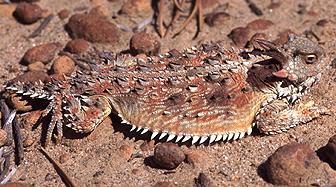
Iguanas · Difficulty: Beginner with some knowledge
Key facts and care guidance for Coast horned lizard (Phrynosoma coronatum) (origin: California and Baja California). Adult size around 8–12 cm. Life expectancy 5–10 years. The values below are carefully researched guidance.
Short answers
Coast horned lizard: How big does the enclosure need to be?
120×60×60 cm for a group.
Coast horned lizard: What temperature does it need?
Daytime 27–33 °C, basking spot Basking spot 42–48 °C, at night 15–20 °C.
Coast horned lizard: Does it need UVB lighting?
UVB: Essential (UVB 10.0–12.0).
Coast horned lizard: How long do they live?
Life expectancy: 5–10 years.
Coast horned lizard: Is it suitable for beginners?
Partly – manageable with some prior knowledge (difficulty: Beginner with some knowledge).
Climate
- Daytime temperature
- 27–33 °C
- Night temperature
- 15–20 °C
- Basking spot
- Basking spot 42–48 °C
- Humidity
- 30–50 %
- UVB
- Essential (UVB 10.0–12.0)
Enclosure
- Minimum size
- 120×60×60 cm for a group
- Substrate
- A sand-loam mix they can dig in, with stone slabs, roots and a few twigs
Feeding
- Food
- Crickets, house crickets, roaches and locusts, dusted regularly with calcium and vitamins
- Feeding interval
- adults daily to every other day in small portions
Key facts
- Adult size
- 8–12 cm
- Life expectancy
- 5–10 years
- Origin
- California and Baja California
- Protection status
- Protected under California state law — check the origin
- Brumation
- A cooler rest of 8–12 weeks at 10–15 °C
- Cohabitation
- Keeping them singly is least stressful. Horned lizards are sedentary loners; there is little evidence of fighting between males of this species. For breeding, put one male with one or two females temporarily and separate them again at signs of stress.
Notes
Populations are falling sharply, partly because of introduced Argentine ants that displace the ants it feeds on.
Do you keep this species?
Add your animal to Reptoria – Reptoria reminds you about feeding and shedding. Add your animal for free →
Look for Coast horned lizard (Phrynosoma coronatum) in the marketplace →
Related species
- Mountain horned lizard (Phrynosoma orbiculare) – Expert
- Regal horned lizard (Phrynosoma solare) – Beginner with some knowledge
- Greater short-horned lizard (Phrynosoma hernandesi) – Beginner with some knowledge
- Giant horned lizard (Phrynosoma asio) – Beginner with some knowledge
- Round-tailed horned lizard (Phrynosoma modestum) – Beginner with some knowledge
- Texas horned lizard (Phrynosoma cornutum) – Expert
- Desert horned lizard (Phrynosoma platyrhinos) – Beginner with some knowledge
- Aliniger anole (Anolis aliniger) – Beginner with some knowledge
What you need to start
To keep Coast horned lizard (Phrynosoma coronatum) you typically need: a suitable enclosure (120×60×60 cm for a group), substrate (A sand-loam mix they can dig in, with stone slabs, roots and a few twigs), a heat source with a thermostat, UVB lighting, thermometer and hygrometer, a water dish and hides. You will find equipment in the Reptoria marketplace.
The complete, interactive care database is in the Reptoria app.
Last updated: 30 October 2026 · Editor: Reptoria editorial team · Sources include: https://en.wikipedia.org/wiki/Coast_horned_lizard, https://reptile-database.reptarium.cz/species?genus=Phrynosoma&species=coronatum
All values are non-binding guidance and do not replace expert advice. Research thoroughly from several sources before acquiring and keeping an animal, and observe the applicable law (species and animal protection in particular).