Common chameleon (Chamaeleo chamaeleon)
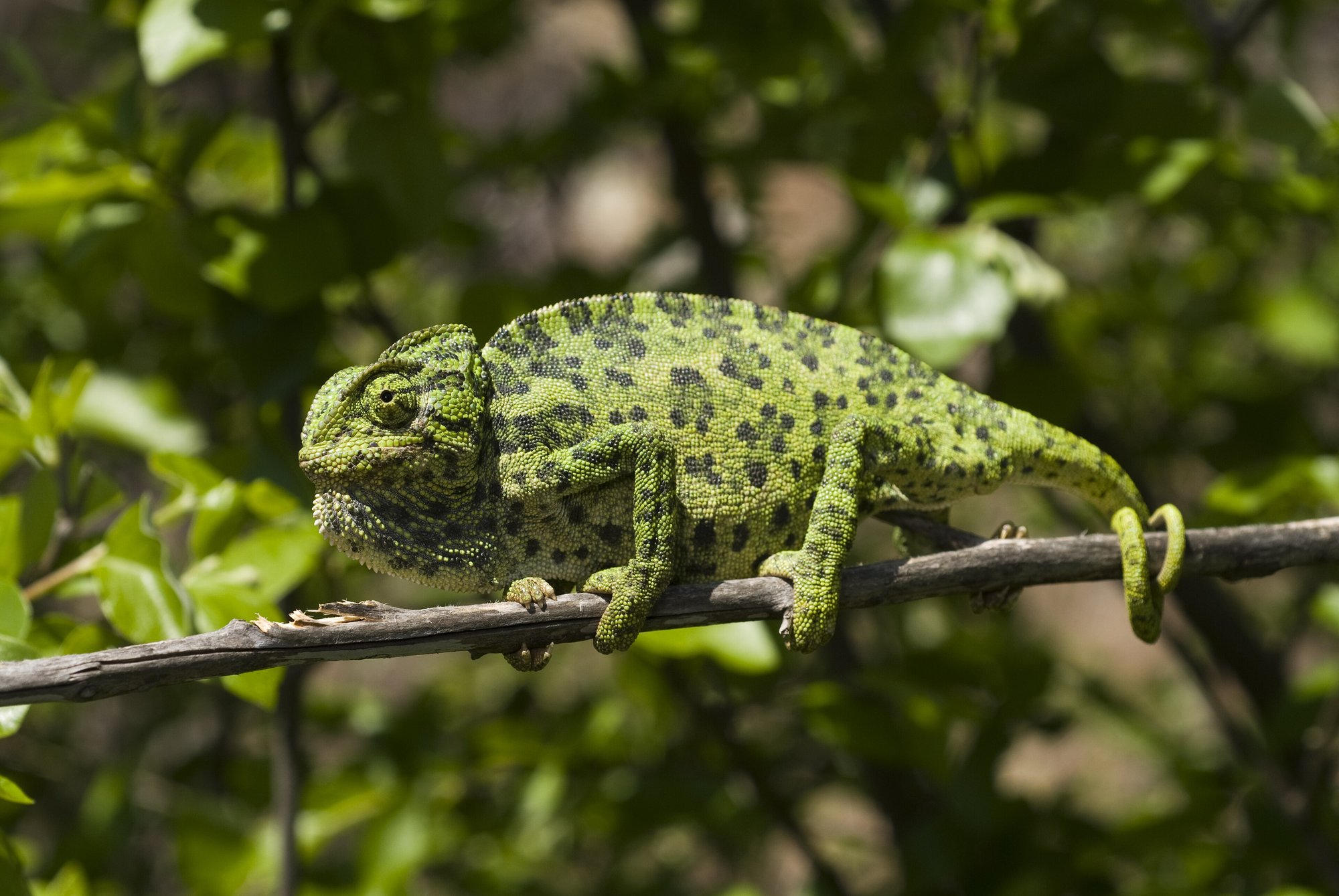
Chameleons · Difficulty: Intermediate
Key facts and care guidance for Common chameleon (Chamaeleo chamaeleon) (origin: The Mediterranean, North Africa and the Near East (Mediterranean, arboreal)). Adult size around 20–40 cm (females larger). Life expectancy ~4–8 years. The values below are carefully researched guidance.
Short answers
Common chameleon: How big does the enclosure need to be?
100×75×150 cm (H).
Common chameleon: What temperature does it need?
Daytime 26–30 °C, basking spot 35 °C, at night 16–20 °C (cooler in winter).
Common chameleon: Does it need UVB lighting?
UVB: Essential.
Common chameleon: How long do they live?
Life expectancy: ~4–8 years.
Common chameleon: Is it suitable for beginners?
Rather not – it is considered an intermediate species (difficulty: Intermediate).
Climate
- Daytime temperature
- 26–30 °C
- Night temperature
- 16–20 °C (cooler in winter)
- Basking spot
- 35 °C
- Humidity
- 50–70 %
- UVB
- Essential
Enclosure
- Minimum size
- 100×75×150 cm (H)
- Substrate
- A soil and sand mix, an egg-laying site
Feeding
- Food
- Locusts, crickets, flies, beetles
- Feeding interval
- adults 2–3×/week, juveniles daily
Key facts
- Adult size
- 20–40 cm (females larger)
- Life expectancy
- ~4–8 years
- Origin
- The Mediterranean, North Africa and the Near East (Mediterranean, arboreal)
- Protection status
- CITES Appendix II / EU Annex A — strictly protected, an EC certificate plus photo documentation and marking are required
- Brumation
- A winter rest of ~2 months, ~16–20 °C by day and cooler at night
- Cohabitation
- Keep them singly. Chameleons are pronounced loners, and even the mere sight of another of their kind means constant stress — you can see it in dark colouring, refusal to feed and weakened defences. Males fight in earnest, and females are harassed by males. So screen neighbouring enclosures from each other as well. For breeding, introduce the female briefly, stay with them and separate them again afterwards.
Notes
A Mediterranean species with an obligatory winter rest. More strictly protected in the EU (Annex A) — keep it only with valid papers or captive-bred animals.
Do you keep this species?
Add your animal to Reptoria – Reptoria reminds you about feeding and shedding. Add your animal for free →
Look for Common chameleon (Chamaeleo chamaeleon) in the marketplace →
Related species
- African chameleon (Chamaeleo africanus) – Intermediate
- Anchieta's chameleon (Chamaeleo anchietae) – Intermediate
- Arabian chameleon (Chamaeleo arabicus) – Intermediate
- Graceful chameleon (Chamaeleo gracilis) – Intermediate
- Smooth chameleon (Chamaeleo laevigatus) – Intermediate
- Indian chameleon (Chamaeleo zeylanicus) – Intermediate
- Veiled chameleon (Chamaeleo calyptratus) – Intermediate
- Flap-necked chameleon (Chamaeleo dilepis) – Intermediate
What you need to start
To keep Common chameleon (Chamaeleo chamaeleon) you typically need: a suitable enclosure (100×75×150 cm (H)), substrate (A soil and sand mix, an egg-laying site), a heat source with a thermostat, UVB lighting, thermometer and hygrometer, a water dish and hides. You will find equipment in the Reptoria marketplace.
The complete, interactive care database is in the Reptoria app.
Last updated: 9 October 2026 · Editor: Reptoria editorial team · Sources include: https://en.wikipedia.org/wiki/Chamaeleo, https://en.wikipedia.org/wiki/Common_chameleon, https://reptile-database.reptarium.cz/species?genus=Chamaeleo&species=chamaeleon
All values are non-binding guidance and do not replace expert advice. Research thoroughly from several sources before acquiring and keeping an animal, and observe the applicable law (species and animal protection in particular).