Dalmatian wall lizard (Podarcis melisellensis)
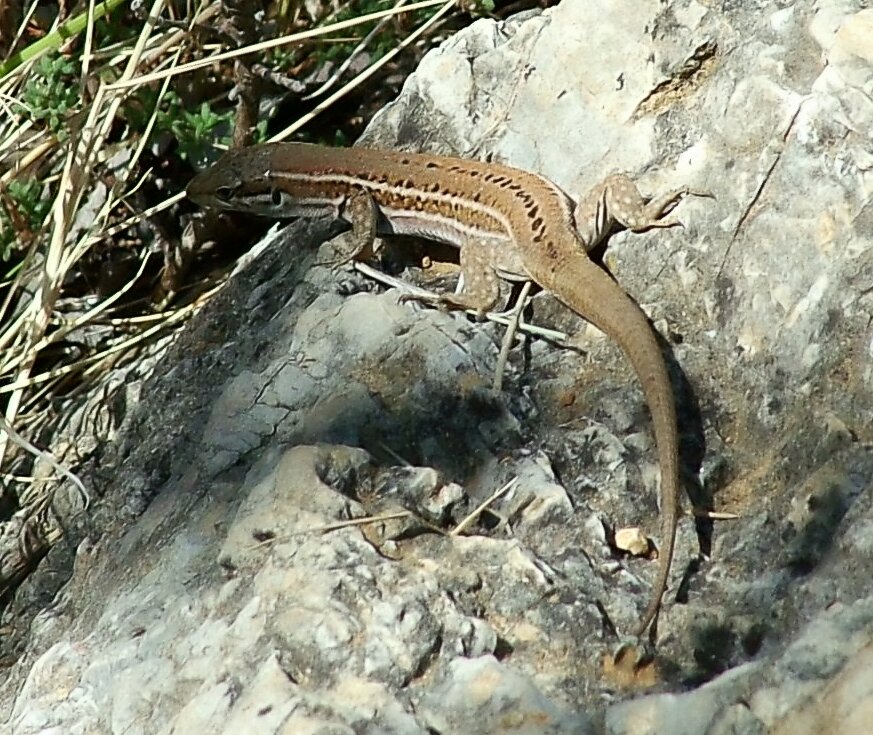
Lizards · Difficulty: Intermediate
Key facts and care guidance for Dalmatian wall lizard (Podarcis melisellensis) (origin: The eastern Adriatic: Croatia / Dalmatia with its islands, to Montenegro and Albania (a karst runner)). Adult size around approx. 18–20 cm total length (SVL 5–6.5 cm, the tail twice as long). Life expectancy approx. 6–10 years. The values below are carefully researched guidance.
Short answers
Dalmatian wall lizard: How big does the enclosure need to be?
80×40×50 cm for one animal; larger and heavily structured for a pair or trio.
Dalmatian wall lizard: What temperature does it need?
Daytime 25–30 °C, basking spot 35–40 °C, at night 15–18 °C.
Dalmatian wall lizard: Does it need UVB lighting?
UVB: UVB is essential (Ferguson zone 3, UV index 3–4 at the basking spot).
Dalmatian wall lizard: How long do they live?
Life expectancy: approx. 6–10 years.
Dalmatian wall lizard: Is it suitable for beginners?
Rather not – it is considered an intermediate species (difficulty: Intermediate).
Climate
- Daytime temperature
- 25–30 °C
- Night temperature
- 15–18 °C
- Basking spot
- 35–40 °C
- Humidity
- 40–60 %
- UVB
- UVB is essential (Ferguson zone 3, UV index 3–4 at the basking spot)
Enclosure
- Minimum size
- 80×40×50 cm for one animal; larger and heavily structured for a pair or trio
- Substrate
- A sand-loam mix with climbing stones, dry-stone walls, bark and rock structures
Feeding
- Food
- A variety of insects (house crickets, crickets, small locusts, flies), spiders; occasionally a little plant food
- Feeding interval
- adults 2–3×/week, juveniles (almost) daily
Key facts
- Adult size
- approx. 18–20 cm total length (SVL 5–6.5 cm, the tail twice as long)
- Life expectancy
- approx. 6–10 years
- Origin
- The eastern Adriatic: Croatia / Dalmatia with its islands, to Montenegro and Albania (a karst runner)
- Protection status
- Bern Convention Appendix II; protected in the EU. Proof of origin or captive breeding is required; check regional registration duties.
- Brumation
- Yes: a winter rest of 2–3 months at about 8–10 °C
- Cohabitation
- Keeping it singly is, per the source data, unproblematic and the least stressful option for this territorial animal; one male with one or more females also works in a large, structured enclosure with sight barriers - but never two males together.
Notes
A small, sun-hungry karst species; it needs a pronounced basking spot and a dry, well-structured climbing landscape. The males do not get on with each other.
Do you keep this species?
Add your animal to Reptoria – Reptoria reminds you about feeding and shedding. Add your animal for free →
Look for Dalmatian wall lizard (Podarcis melisellensis) in the marketplace →
Related species
- Aeolian wall lizard (Podarcis raffonei) – Expert
- Erhard's wall lizard (Podarcis erhardii) – Beginner to intermediate
- Lilford's wall lizard (Podarcis lilfordi) – Expert
- Bocage's wall lizard (Podarcis bocagei) – Beginner with some knowledge
- Carbonell's wall lizard (Podarcis carbonelli) – Beginner with some knowledge
- Geniez's wall lizard (Podarcis virescens) – Beginner with some knowledge
- Guadarrama wall lizard (Podarcis guadarramae) – Beginner with some knowledge
- Ionian wall lizard (Podarcis ionicus) – Beginner with some knowledge
What you need to start
To keep Dalmatian wall lizard (Podarcis melisellensis) you typically need: a suitable enclosure (80×40×50 cm for one animal; larger and heavily structured for a pair or trio), substrate (A sand-loam mix with climbing stones, dry-stone walls, bark and rock structures), a heat source with a thermostat, UVB lighting, thermometer and hygrometer, a water dish and hides. You will find equipment in the Reptoria marketplace.
The complete, interactive care database is in the Reptoria app.
Last updated: 9 October 2026 · Editor: Reptoria editorial team · Sources include: https://en.wikipedia.org/wiki/Podarcis, https://reptile-database.reptarium.cz/species?genus=Podarcis&species=melisellensis
All values are non-binding guidance and do not replace expert advice. Research thoroughly from several sources before acquiring and keeping an animal, and observe the applicable law (species and animal protection in particular).