Dubia roach (Blaptica dubia)
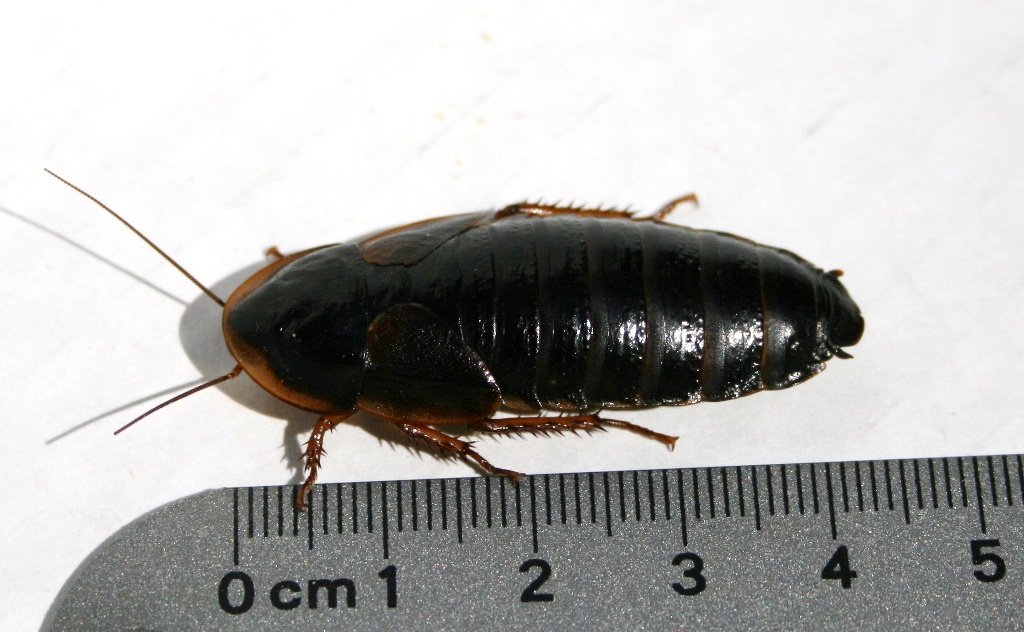
Invertebrates · Difficulty: Beginner
Key facts and care guidance for Dubia roach (Blaptica dubia) (origin: Paraguay, northern Argentina (South America)). Adult size around approx. 3.5–5 cm (females 4–5 cm, males 3.5–4.5 cm). Life expectancy approx. 1–2 years (about one year as an adult, preceded by 2–6 months as a nymph). The values below are carefully researched guidance.
Short answers
Dubia roach: How big does the enclosure need to be?
60×30×30 cm (a starter colony of around 30 females and 20 males; a plastic box with a tightly fitting, ventilated lid).
Dubia roach: What temperature does it need?
Daytime 25–30 °C, at night 20–24 °C.
Dubia roach: Does it need UVB lighting?
UVB: No UVB needed.
Dubia roach: How long do they live?
Life expectancy: approx. 1–2 years (about one year as an adult, preceded by 2–6 months as a nymph).
Dubia roach: Is it suitable for beginners?
Yes – it is considered suitable for beginners (difficulty: Beginner).
Climate
- Daytime temperature
- 25–30 °C
- Night temperature
- 20–24 °C
- Basking spot
- —
- Humidity
- 50–65 % (juveniles more humid, adults drier)
- UVB
- No UVB needed
Enclosure
- Minimum size
- 60×30×30 cm (a starter colony of around 30 females and 20 males; a plastic box with a tightly fitting, ventilated lid)
- Substrate
- Coco humus, oak leaves or kitchen paper; egg cartons or cork bark as hides
Feeding
- Food
- Dry food (oat flakes, bran, cereals), vegetables (carrot, pumpkin), fruit; a little protein to prevent cannibalism
- Feeding interval
- always on offer; fresh food 2–3×/week, dry food always available
Key facts
- Adult size
- approx. 3.5–5 cm (females 4–5 cm, males 3.5–4.5 cm)
- Life expectancy
- approx. 1–2 years (about one year as an adult, preceded by 2–6 months as a nymph)
- Origin
- Paraguay, northern Argentina (South America)
- Protection status
- Not protected (no CITES or German nature conservation listing). Do not release it into the wild.
- Brumation
- None
- Cohabitation
- Colony or group keeping (sociable, with no cannibalism when there is enough food). A popular feeder animal; it does not climb smooth walls and barely flies.
Notes
A very easy feeder and breeding animal. Ovoviviparous. Watch the ventilation and avoid waterlogging; above 30–32 °C heat stress threatens. The males are winged but do not fly.
Do you keep this species?
Add your animal to Reptoria – Reptoria reminds you about feeding and shedding. Add your animal for free →
Related species
- Domino cockroach (Therea bernhardti) – Beginner
- Peppered cockroach (Archimandrita tesselata) – Beginner
- Green banana cockroach (Panchlora nivea) – Beginner
- Halloween hissing cockroach (Elliptorhina javanica) – Beginner
- Domino cockroach (Therea petiveriana) – Beginner
- Glowspot cockroach (Lucihormetica subcincta) – Intermediate
- Madagascar hissing cockroach (Gromphadorhina portentosa) – Beginner
- Orange-headed cockroach (Eublaberus posticus) – Beginner
What you need to start
To keep Dubia roach (Blaptica dubia) you typically need: a suitable enclosure (60×30×30 cm (a starter colony of around 30 females and 20 males; a plastic box with a tightly fitting, ventilated lid)), substrate (Coco humus, oak leaves or kitchen paper; egg cartons or cork bark as hides), a heat source with a thermostat, UVB lighting, thermometer and hygrometer, a water dish and hides. You will find equipment in the Reptoria marketplace.
The complete, interactive care database is in the Reptoria app.
Last updated: 9 October 2026 · Editor: Reptoria editorial team · Sources include: aqua-spider.de, das-maeuseasyl.de, eu_annex.txt (lokal, VO (EU) 2026/1383), jungle-exotica.de, terraristikshop.net
All values are non-binding guidance and do not replace expert advice. Research thoroughly from several sources before acquiring and keeping an animal, and observe the applicable law (species and animal protection in particular).