Madagascar hissing cockroach (Gromphadorhina portentosa)
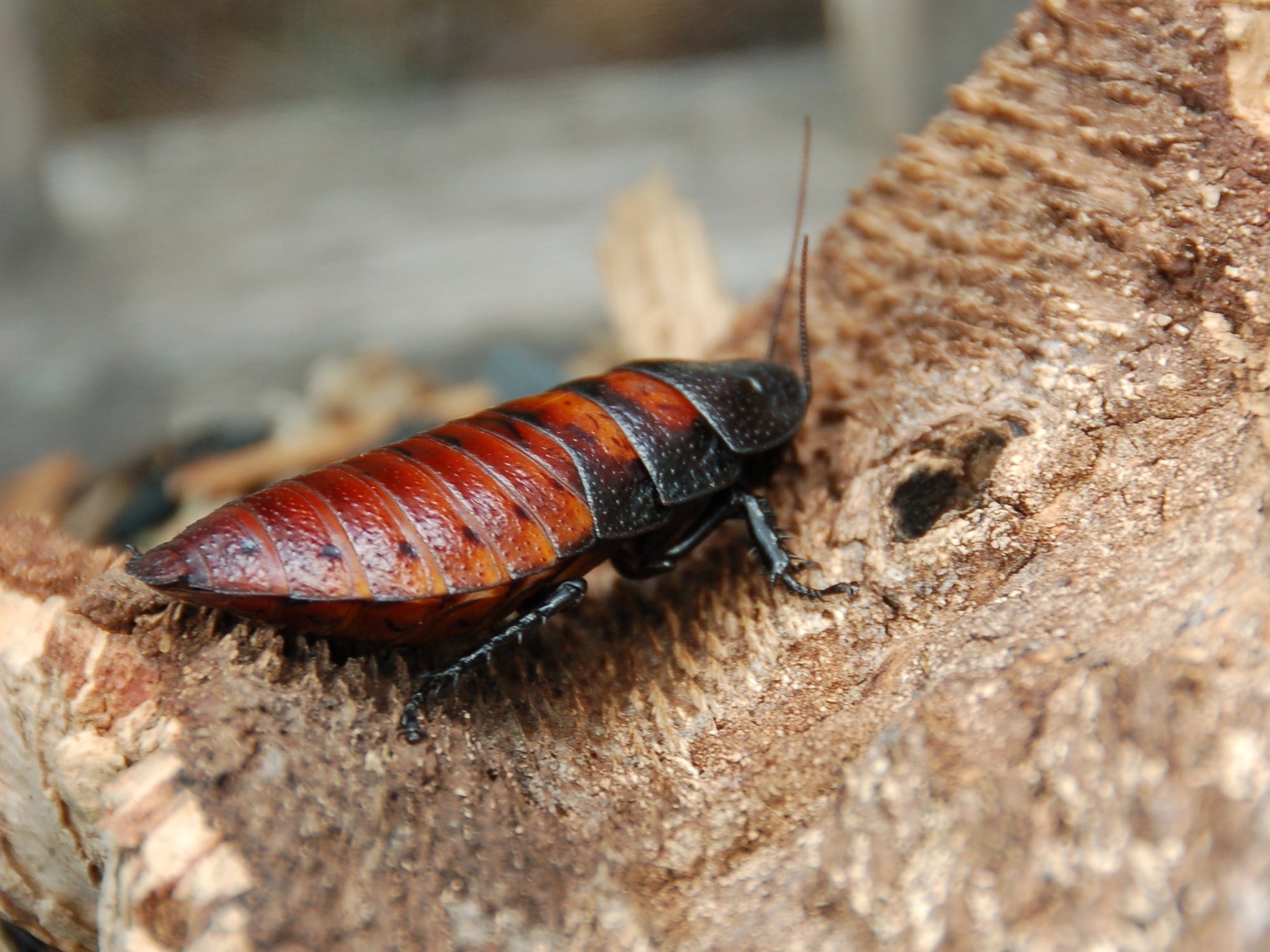
Invertebrates · Difficulty: Beginner
Key facts and care guidance for Madagascar hissing cockroach (Gromphadorhina portentosa) (origin: Madagascar; lives there on the ground of dry forests to semi-evergreen rainforests, under leaf litter, deadwood and bark). Adult size around females up to ~8 cm, males ~5 cm (males with tubercles). Life expectancy approx. 2–5 years, usually around 3 years. The values below are carefully researched guidance.
Short answers
Madagascar hissing cockroach: How big does the enclosure need to be?
Approx. 40×30×30 cm for a small group (smooth walls or a petroleum-jelly rim are needed, they climb well).
Madagascar hissing cockroach: What temperature does it need?
Daytime 25–30 °C, with a temperature gradient in the enclosure (heat mat on the side, not under the substrate), at night 20–24 °C.
Madagascar hissing cockroach: Does it need UVB lighting?
UVB: No UVB needed.
Madagascar hissing cockroach: How long do they live?
Life expectancy: approx. 2–5 years, usually around 3 years.
Madagascar hissing cockroach: Is it suitable for beginners?
Yes – it is considered suitable for beginners (difficulty: Beginner).
Climate
- Daytime temperature
- 25–30 °C, with a temperature gradient in the enclosure (heat mat on the side, not under the substrate)
- Night temperature
- 20–24 °C
- Basking spot
- —
- Humidity
- approx. 50–70 %; a humid corner is enough, permanently wet conditions promote mites and mold
- UVB
- No UVB needed
Enclosure
- Minimum size
- approx. 40×30×30 cm for a small group (smooth walls or a petroleum-jelly rim are needed, they climb well)
- Substrate
- Coco fibre or forest soil, at least 5 cm deep, with leaf litter and moss on top; cork bark and egg cartons as hides and climbing surfaces; a shallow water dish with kitchen paper, or a chick waterer, so none of them drown
Feeding
- Food
- Vegetables (carrot, pumpkin), fruit, dry food, fish flakes or cat food (a little protein)
- Feeding interval
- fresh food 2–3×/week, dry food always available
Key facts
- Adult size
- females up to ~8 cm, males ~5 cm (males with tubercles)
- Life expectancy
- approx. 2–5 years, usually around 3 years
- Origin
- Madagascar; lives there on the ground of dry forests to semi-evergreen rainforests, under leaf litter, deadwood and bark
- Protection status
- Not protected. Do not release it.
- Brumation
- None
- Cohabitation
- Sociable; group keeping (at least 5–10 animals) is recommended. The males settle territory with hissing and shoving without serious injuries – unproblematic given enough space and hides.
Notes
The best-known display cockroach; wingless, unable to fly but a good climber – escape protection (a smooth upper rim) is needed. It produces an audible hiss through its spiracles. Ovoviviparous, very robust and long-lived.
Do you keep this species?
Add your animal to Reptoria – Reptoria reminds you about feeding and shedding. Add your animal for free →
Look for Madagascar hissing cockroach (Gromphadorhina portentosa) in the marketplace →
Related species
- Dubia roach (Blaptica dubia) – Beginner
- Domino cockroach (Therea bernhardti) – Beginner
- Peppered cockroach (Archimandrita tesselata) – Beginner
- Green banana cockroach (Panchlora nivea) – Beginner
- Halloween hissing cockroach (Elliptorhina javanica) – Beginner
- Domino cockroach (Therea petiveriana) – Beginner
- Glowspot cockroach (Lucihormetica subcincta) – Intermediate
- Orange-headed cockroach (Eublaberus posticus) – Beginner
What you need to start
To keep Madagascar hissing cockroach (Gromphadorhina portentosa) you typically need: a suitable enclosure (approx. 40×30×30 cm for a small group (smooth walls or a petroleum-jelly rim are needed, they climb well)), substrate (Coco fibre or forest soil, at least 5 cm deep, with leaf litter and moss on top; cork bark and egg cartons as hides and climbing surfaces; a shallow water dish with kitchen paper, or a chick waterer, so none of them drown), a heat source with a thermostat, UVB lighting, thermometer and hygrometer, a water dish and hides. You will find equipment in the Reptoria marketplace.
The complete, interactive care database is in the Reptoria app.
Last updated: 30 October 2026 · Editor: Reptoria editorial team · Sources include: ph-heidelberg.de, Wikipedia DE, einrichtungsbeispiele.de, eur-lex.europa.eu, insektenliebe.com
All values are non-binding guidance and do not replace expert advice. Research thoroughly from several sources before acquiring and keeping an animal, and observe the applicable law (species and animal protection in particular).