Emerald mountain dragon (Diploderma splendidum)
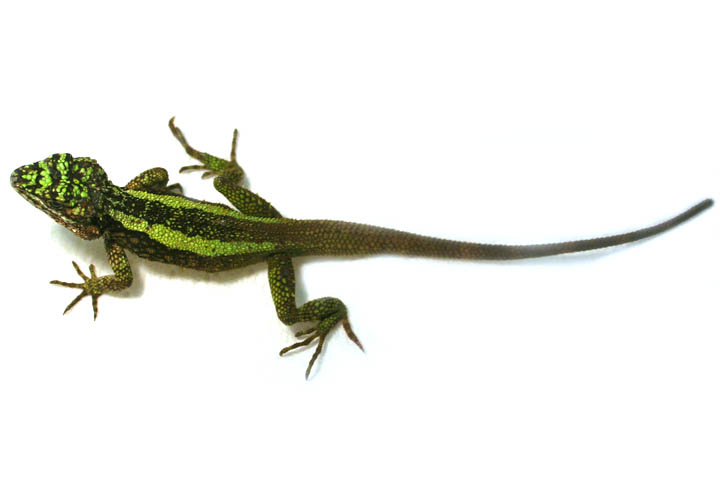
Agamas · Difficulty: Intermediate
Key facts and care guidance for Emerald mountain dragon (Diploderma splendidum) (origin: South-western China (the Yangtze basin); subtropical and montane forests). Adult size around approx. 20–30 cm total length (a long tail). Life expectancy approx. 8–10 years. The values below are carefully researched guidance.
Short answers
Emerald mountain dragon: How big does the enclosure need to be?
80×40×80 cm (arboreal, taller is better; the absolute minimum in care sheets is ~76×30×30 cm).
Emerald mountain dragon: What temperature does it need?
Daytime 24–28 °C, basking spot 29–32 °C, at night 18–20 °C.
Emerald mountain dragon: Does it need UVB lighting?
UVB: UVB needed (Ferguson zone 2–3, UV index 2–4).
Emerald mountain dragon: How long do they live?
Life expectancy: approx. 8–10 years.
Emerald mountain dragon: Is it suitable for beginners?
Rather not – it is considered an intermediate species (difficulty: Intermediate).
Climate
- Daytime temperature
- 24–28 °C
- Night temperature
- 18–20 °C
- Basking spot
- 29–32 °C
- Humidity
- 70–80 %
- UVB
- UVB needed (Ferguson zone 2–3, UV index 2–4)
Enclosure
- Minimum size
- 80×40×80 cm (arboreal, taller is better; the absolute minimum in care sheets is ~76×30×30 cm)
- Substrate
- A coco humus and peat-moss mix (moisture-retaining), leaf litter; dense planting and plenty of climbing wood
Feeding
- Food
- Insects (crickets, house crickets, roaches, small locusts); occasionally a little plant food
- Feeding interval
- adults every other day, juveniles daily
Key facts
- Adult size
- approx. 20–30 cm total length (a long tail)
- Life expectancy
- approx. 8–10 years
- Origin
- South-western China (the Yangtze basin); subtropical and montane forests
- Protection status
- Not listed under CITES; IUCN "Least Concern". Mostly wild-caught in the trade – prefer captive-bred animals.
- Brumation
- A slight winter cooling matching their subtropical native climate (a few weeks cooler at ~15–18 °C, with a shorter photoperiod), optional for breeding
- Cohabitation
- Keep singly, or one male with one to two females (a pair or small harem group) in a large, structured enclosure. Never house males together - territorial fights are to be expected. The species is easily stressed by being seen, so visual barriers and dense planting are essential.
Notes
A shy, agile arboreal species; it injures itself on the glass in a panic – dense planting and visual screening are needed. It prefers to drink mist or dew droplets (daily misting or sprinkling). Nomenclature: formerly Japalura splendida (neon tree dragon / green striped dragon). Often wild-caught (check for parasites).
Do you keep this species?
Add your animal to Reptoria – Reptoria reminds you about feeding and shedding. Add your animal for free →
Look for Emerald mountain dragon (Diploderma splendidum) in the marketplace →
Related species
- Banded mountain dragon (Diploderma fasciatum) – Expert
- Oriental garden lizard (Calotes versicolor) – Intermediate
- Spotted butterfly lizard (Leiolepis guttata) – Intermediate
- Painted dragon (Ctenophorus pictus) – Intermediate
- Common flying dragon (Draco volans) – Expert
- Green crested lizard (Bronchocela cristatella) – Intermediate
- Himalayan agama (Paralaudakia himalayana) – Intermediate
- Horsfield's salea (Salea horsfieldii) – Expert
What you need to start
To keep Emerald mountain dragon (Diploderma splendidum) you typically need: a suitable enclosure (80×40×80 cm (arboreal, taller is better; the absolute minimum in care sheets is ~76×30×30 cm)), substrate (A coco humus and peat-moss mix (moisture-retaining), leaf litter; dense planting and plenty of climbing wood), a heat source with a thermostat, UVB lighting, thermometer and hygrometer, a water dish and hides. You will find equipment in the Reptoria marketplace.
The complete, interactive care database is in the Reptoria app.
Last updated: 9 October 2026 · Editor: Reptoria editorial team · Sources include: https://en.wikipedia.org/wiki/Diploderma_splendidum, https://reptile-database.reptarium.cz/species?genus=Diploderma&species=splendidum
All values are non-binding guidance and do not replace expert advice. Research thoroughly from several sources before acquiring and keeping an animal, and observe the applicable law (species and animal protection in particular).