Emma Gray's forest lizard (Calotes emma)
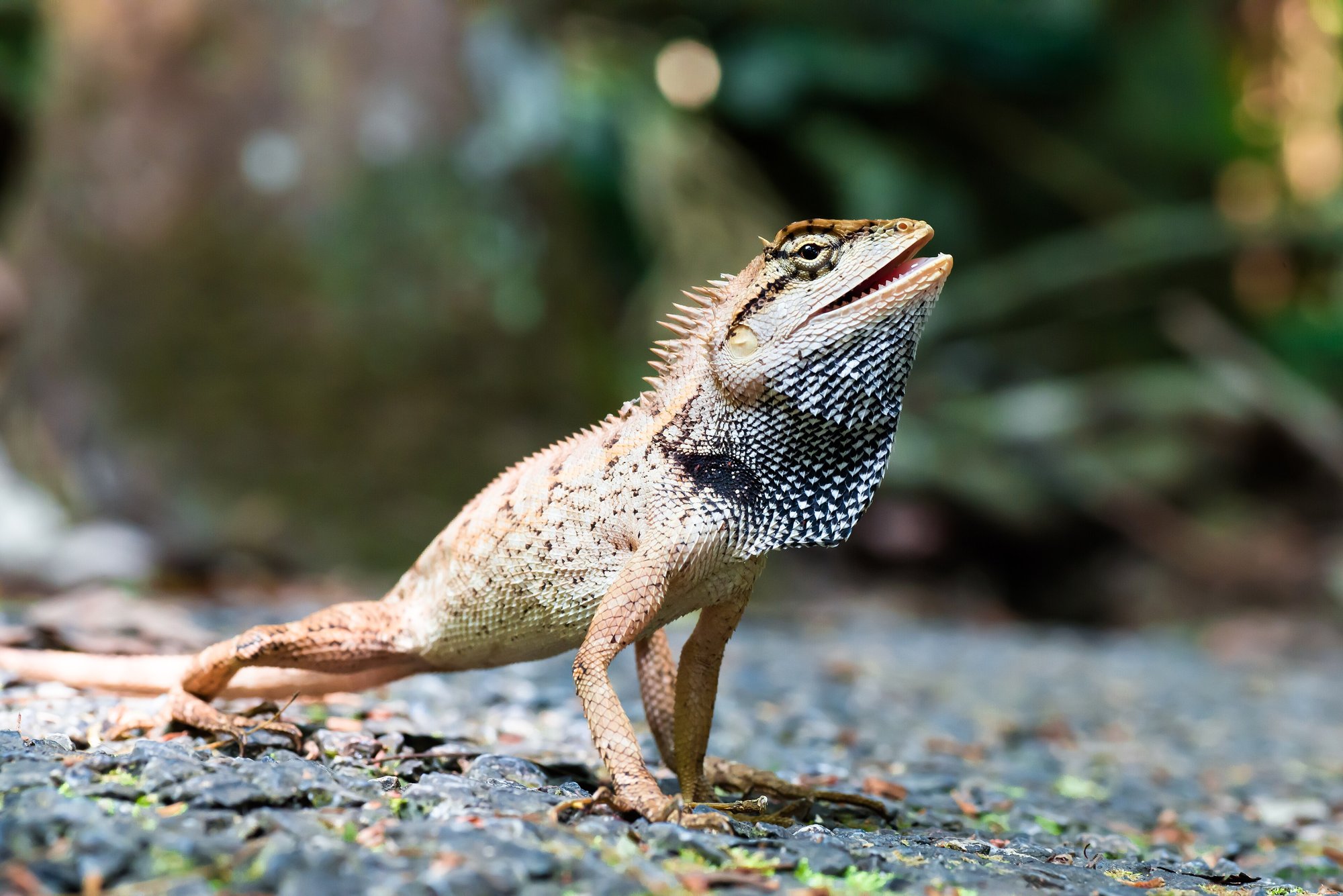
Agamas · Difficulty: Intermediate
Key facts and care guidance for Emma Gray's forest lizard (Calotes emma) (origin: South and South-East Asia (India / Assam, Bangladesh, Myanmar, southern China / Yunnan, Thailand, Laos, Cambodia, Vietnam, northern Malaysia); deciduous, humid and coastal forest). Adult size around up to ~38–40 cm total length (SVL ~10 cm, the tail approx. two thirds). Life expectancy over 10 years. The values below are carefully researched guidance.
Short answers
Emma Gray's forest lizard: How big does the enclosure need to be?
60×60×150 cm (W×D×H) for one animal (arboreal, tall).
Emma Gray's forest lizard: What temperature does it need?
Daytime 25–30 °C, basking spot up to 35 °C, at night 20–24 °C.
Emma Gray's forest lizard: Does it need UVB lighting?
UVB: UVB needed (Ferguson zone 2–3, UV index 3–4).
Emma Gray's forest lizard: How long do they live?
Life expectancy: over 10 years.
Emma Gray's forest lizard: Is it suitable for beginners?
Rather not – it is considered an intermediate species (difficulty: Intermediate).
Climate
- Daytime temperature
- 25–30 °C
- Night temperature
- 20–24 °C
- Basking spot
- up to 35 °C
- Humidity
- 60–80 %
- UVB
- UVB needed (Ferguson zone 2–3, UV index 3–4)
Enclosure
- Minimum size
- 60×60×150 cm (W×D×H) for one animal (arboreal, tall)
- Substrate
- Coco humus or forest floor with leaf litter; plenty of climbing wood and plants, somewhere to drink
Feeding
- Food
- Insects (termites, locusts, crickets, roaches, beetles, moths, insect larvae)
- Feeding interval
- adults 2–3×/week, juveniles daily
Key facts
- Adult size
- up to ~38–40 cm total length (SVL ~10 cm, the tail approx. two thirds)
- Life expectancy
- over 10 years
- Origin
- South and South-East Asia (India / Assam, Bangladesh, Myanmar, southern China / Yunnan, Thailand, Laos, Cambodia, Vietnam, northern Malaysia); deciduous, humid and coastal forest
- Protection status
- Not listed under CITES. Wild-caught animals are common in the trade – prefer captive-bred ones.
- Brumation
- No real winter rest; a slight seasonal dry spell is possible
- Cohabitation
- Keeping it singly is the default. A pair (1.1) or one male with several females is also possible in a large, structured, planted enclosure with visual barriers. Never house males together - territorial fights are documented.
Notes
An arboreal species (it prefers the lower trunk areas); the males darken in the mating season. It needs height and climbing opportunities, and to drink from mist or dew droplets. A clutch of 10–12 eggs (May–June), with an incubation of about 60–70 days. Often wild-caught (check for parasites). The figures are documented across German and English sources.
Do you keep this species?
Add your animal to Reptoria – Reptoria reminds you about feeding and shedding. Add your animal for free →
Look for Emma Gray's forest lizard (Calotes emma) in the marketplace →
Related species
- Oriental garden lizard (Calotes versicolor) – Intermediate
- Indo-Chinese forest lizard (Calotes mystaceus) – Intermediate
- Spotted butterfly lizard (Leiolepis guttata) – Intermediate
- Painted dragon (Ctenophorus pictus) – Intermediate
- Common flying dragon (Draco volans) – Expert
- Green crested lizard (Bronchocela cristatella) – Intermediate
- Himalayan agama (Paralaudakia himalayana) – Intermediate
- Horsfield's salea (Salea horsfieldii) – Expert
What you need to start
To keep Emma Gray's forest lizard (Calotes emma) you typically need: a suitable enclosure (60×60×150 cm (W×D×H) for one animal (arboreal, tall)), substrate (Coco humus or forest floor with leaf litter; plenty of climbing wood and plants, somewhere to drink), a heat source with a thermostat, UVB lighting, thermometer and hygrometer, a water dish and hides. You will find equipment in the Reptoria marketplace.
The complete, interactive care database is in the Reptoria app.
Last updated: 9 October 2026 · Editor: Reptoria editorial team · Sources include: https://en.wikipedia.org/wiki/Calotes_emma, https://reptile-database.reptarium.cz/species?genus=Calotes&species=emma
All values are non-binding guidance and do not replace expert advice. Research thoroughly from several sources before acquiring and keeping an animal, and observe the applicable law (species and animal protection in particular).