Florida cooter (Pseudemys floridana)
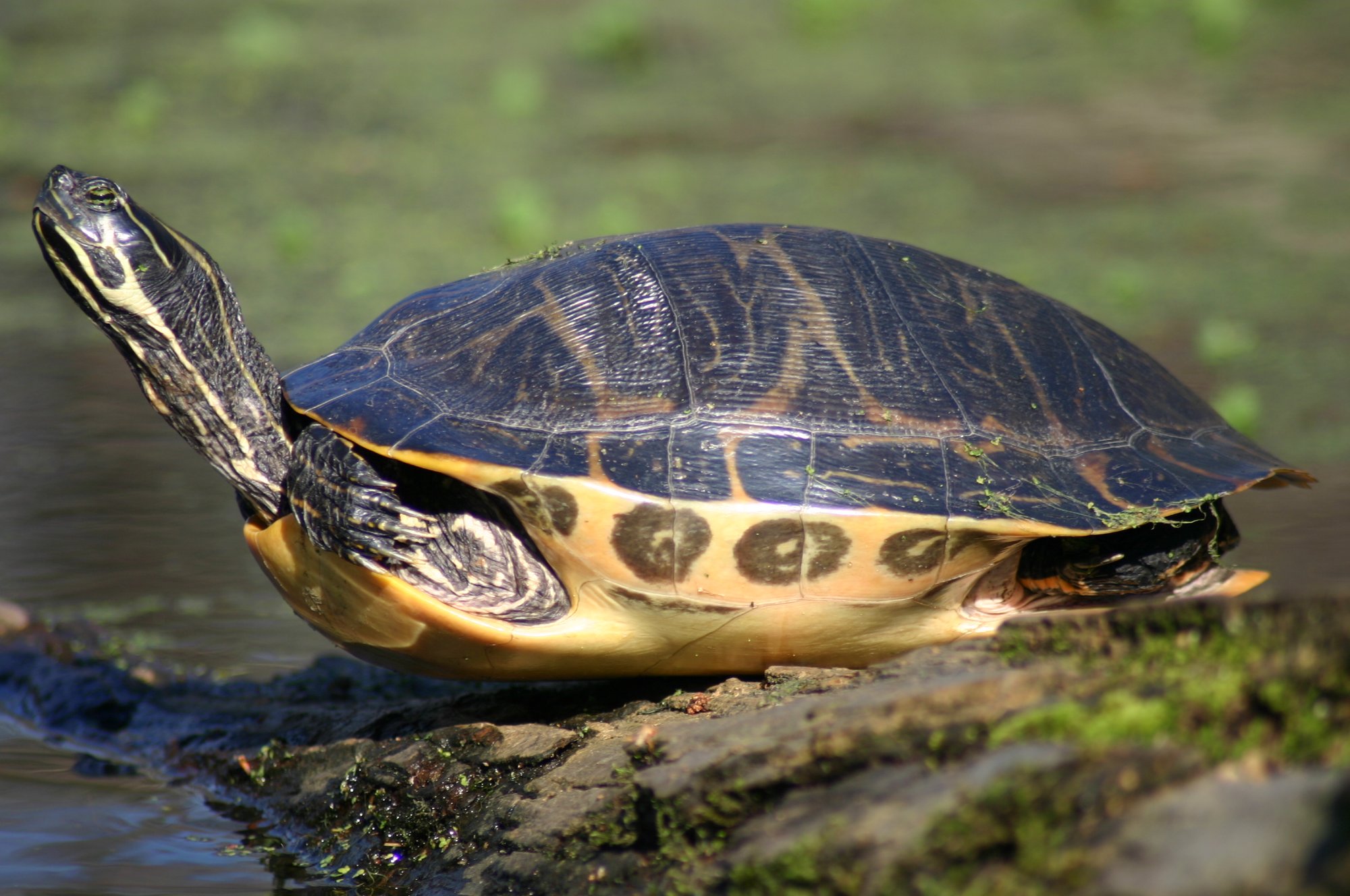
Turtles & tortoises · Difficulty: Intermediate
Key facts and care guidance for Florida cooter (Pseudemys floridana) (origin: The south-eastern USA, the Atlantic coastal plain (Florida north to Virginia and the Carolinas)). Adult size around females 30–40 cm, males ~25–30 cm; females weigh several kg. Life expectancy 30–50+ years. The values below are carefully researched guidance.
Short answers
Florida cooter: How big does the enclosure need to be?
An aqua-terrarium from ~200×100 cm or an outdoor pond of at least 1,000 l per animal (they grow very large); deep water.
Florida cooter: What temperature does it need?
Daytime water 24–28 °C (summer), 20–24 °C (spring/autumn), basking spot 38–42 °C (dry basking spot), at night 18–22 °C (air above the water).
Florida cooter: Does it need UVB lighting?
UVB: UVB needed (Ferguson zone 2–3, UV index 2–4); an HQI / UV metal-halide lamp is recommended.
Florida cooter: How long do they live?
Life expectancy: 30–50+ years.
Florida cooter: Is it suitable for beginners?
Rather not – it is considered an intermediate species (difficulty: Intermediate).
Climate
- Daytime temperature
- water 24–28 °C (summer), 20–24 °C (spring/autumn)
- Night temperature
- 18–22 °C (air above the water)
- Basking spot
- 38–42 °C (dry basking spot)
- Humidity
- Not critical (aquatic); the basking spot must stay dry
- UVB
- UVB needed (Ferguson zone 2–3, UV index 2–4); an HQI / UV metal-halide lamp is recommended
Enclosure
- Minimum size
- an aqua-terrarium from ~200×100 cm or an outdoor pond of at least 1,000 l per animal (they grow very large); deep water
- Substrate
- Fine sand or rounded gravel; robust or permanently available water plants; an egg-laying site for the females
Feeding
- Food
- Mostly herbivorous; adults eat mainly water plants (which must be permanently available), dandelion and lettuce; juveniles take more animal food (insects, snails, small fish)
- Feeding interval
- juveniles daily; adults plant food daily (aquatic plants ad libitum), animal food 1–2×/week
Key facts
- Adult size
- females 30–40 cm, males ~25–30 cm; females weigh several kg
- Life expectancy
- 30–50+ years
- Origin
- The south-eastern USA, the Atlantic coastal plain (Florida north to Virginia and the Carolinas)
- Protection status
- Not currently listed under CITES, freely tradable in the EU. Note: at CITES CoP20 (2025) a proposal to add it to Appendix II was considered – the status may change
- Brumation
- A mild rest period or drop in temperature (~15–20 °C) in winter; for animals of northern origin a slight winter rest is possible (depending on their origin)
- Cohabitation
- Keeping them singly is preferable. The males harass the females heavily during courtship and become aggressive towards each other – keep them singly; stable groups of females only with a great deal of space
Notes
Very large-growing – a considerable space requirement. Closely related to P. peninsularis (formerly treated as a subspecies); some husbandry data are derived from the Pseudemys concinna/floridana complex. The need for a winter rest is uncertain and depends on the source population.
Do you keep this species?
Add your animal to Reptoria – Reptoria reminds you about feeding and shedding. Add your animal for free →
Look for Florida cooter (Pseudemys floridana) in the marketplace →
Related species
- Florida red-bellied cooter (Pseudemys nelsoni) – Intermediate
- River cooter (Pseudemys concinna) – Intermediate
- Peninsula cooter (Pseudemys peninsularis) – Intermediate
- Red-bellied cooter (Pseudemys rubriventris) – Intermediate
- Alabama map turtle (Graptemys pulchra) – Intermediate
- Barbour's map turtle (Graptemys barbouri) – Intermediate
- Cumberland slider (Trachemys scripta troostii) – Intermediate
- D'Orbigny's slider (Trachemys dorbigni) – Intermediate
What you need to start
To keep Florida cooter (Pseudemys floridana) you typically need: a suitable enclosure (an aqua-terrarium from ~200×100 cm or an outdoor pond of at least 1,000 l per animal (they grow very large); deep water), substrate (Fine sand or rounded gravel; robust or permanently available water plants; an egg-laying site for the females), a heat source with a thermostat, UVB lighting, thermometer and hygrometer, a water dish and hides. You will find equipment in the Reptoria marketplace.
The complete, interactive care database is in the Reptoria app.
Last updated: 30 October 2026 · Editor: Reptoria editorial team · Sources include: https://en.wikipedia.org/wiki/River_cooter, https://reptile-database.reptarium.cz/species?genus=Pseudemys&species=floridana
All values are non-binding guidance and do not replace expert advice. Research thoroughly from several sources before acquiring and keeping an animal, and observe the applicable law (species and animal protection in particular).