Barbour's map turtle (Graptemys barbouri)
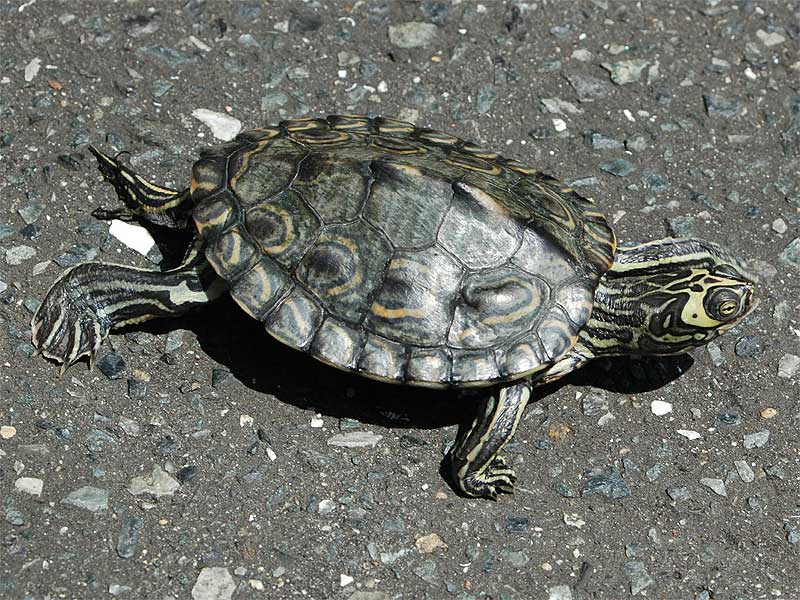
Turtles & tortoises · Difficulty: Intermediate
Key facts and care guidance for Barbour's map turtle (Graptemys barbouri) (origin: The Apalachicola river system (Florida, Georgia, Alabama)). Adult size around males 10–13.5 cm, females 28–33 cm carapace length. Life expectancy 25–35 years. The values below are carefully researched guidance.
Short answers
Barbour's map turtle: How big does the enclosure need to be?
200×80 cm aquarium.
Barbour's map turtle: What temperature does it need?
Daytime 22–28 °C, basking spot 40–45 °C at the basking spot, at night 18–22 °C.
Barbour's map turtle: Does it need UVB lighting?
UVB: Essential (UVB 10.0).
Barbour's map turtle: How long do they live?
Life expectancy: 25–35 years.
Barbour's map turtle: Is it suitable for beginners?
Rather not – it is considered an intermediate species (difficulty: Intermediate).
Climate
- Daytime temperature
- 22–28 °C
- Night temperature
- 18–22 °C
- Basking spot
- 40–45 °C at the basking spot
- Humidity
- Aquatic
- UVB
- Essential (UVB 10.0)
Enclosure
- Minimum size
- 200×80 cm aquarium
- Substrate
- Water 40–60 cm deep, sand, a current, a large basking spot
Feeding
- Food
- Females almost exclusively hard-shelled molluscs – snails and small mussels; males and juveniles mainly insects, insect larvae and crayfish, plus some aquatic plants
- Feeding interval
- 3×/week
Key facts
- Adult size
- males 10–13.5 cm, females 28–33 cm carapace length
- Life expectancy
- 25–35 years
- Origin
- The Apalachicola river system (Florida, Georgia, Alabama)
- Protection status
- Not listed under CITES; protected in the USA
- Brumation
- Winter dormancy 10–14 weeks at a water temperature of 8–12 °C
- Cohabitation
- Single housing is the least stressful. Group housing is possible and explicitly provided for map turtles in the official German husbandry guidelines, but it needs a large tank and observation, because large females can harass smaller animals and males. In that case one male with several females has proven successful, because courtship is spread out. With a single pair, the much smaller male can harass the female with constant courtship – then you must be able to remove him, so a second tank belongs in the plan. In any case you need enough basking spots for all animals to lie dry at the same time.
Notes
The females have very broad heads – strict mussel and snail eaters. Hard food matters for wearing down the beak; a pure pellet diet leads to deformities.
Do you keep this species?
Add your animal to Reptoria – Reptoria reminds you about feeding and shedding. Add your animal for free →
Look for Barbour's map turtle (Graptemys barbouri) in the marketplace →
Related species
- Alabama map turtle (Graptemys pulchra) – Intermediate
- False map turtle (Graptemys pseudogeographica) – Intermediate
- Yellow-blotched map turtle (Graptemys flavimaculata) – Intermediate
- Northern map turtle (Graptemys geographica) – Intermediate
- Mississippi map turtle (Graptemys pseudogeographica kohni) – Intermediate
- Ouachita map turtle (Graptemys ouachitensis) – Intermediate
- Black-knobbed map turtle (Graptemys nigrinoda) – Intermediate
- Cumberland slider (Trachemys scripta troostii) – Intermediate
What you need to start
To keep Barbour's map turtle (Graptemys barbouri) you typically need: a suitable enclosure (200×80 cm aquarium), substrate (Water 40–60 cm deep, sand, a current, a large basking spot), a heat source with a thermostat, UVB lighting, thermometer and hygrometer, a water dish and hides. You will find equipment in the Reptoria marketplace.
The complete, interactive care database is in the Reptoria app.
Last updated: 9 October 2026 · Editor: Reptoria editorial team · Sources include: theturtleroom.org, graptemys.de, zierschildkroete.de, Wikipedia EN, biologicaldiversity.org
All values are non-binding guidance and do not replace expert advice. Research thoroughly from several sources before acquiring and keeping an animal, and observe the applicable law (species and animal protection in particular).