Northern map turtle (Graptemys geographica)
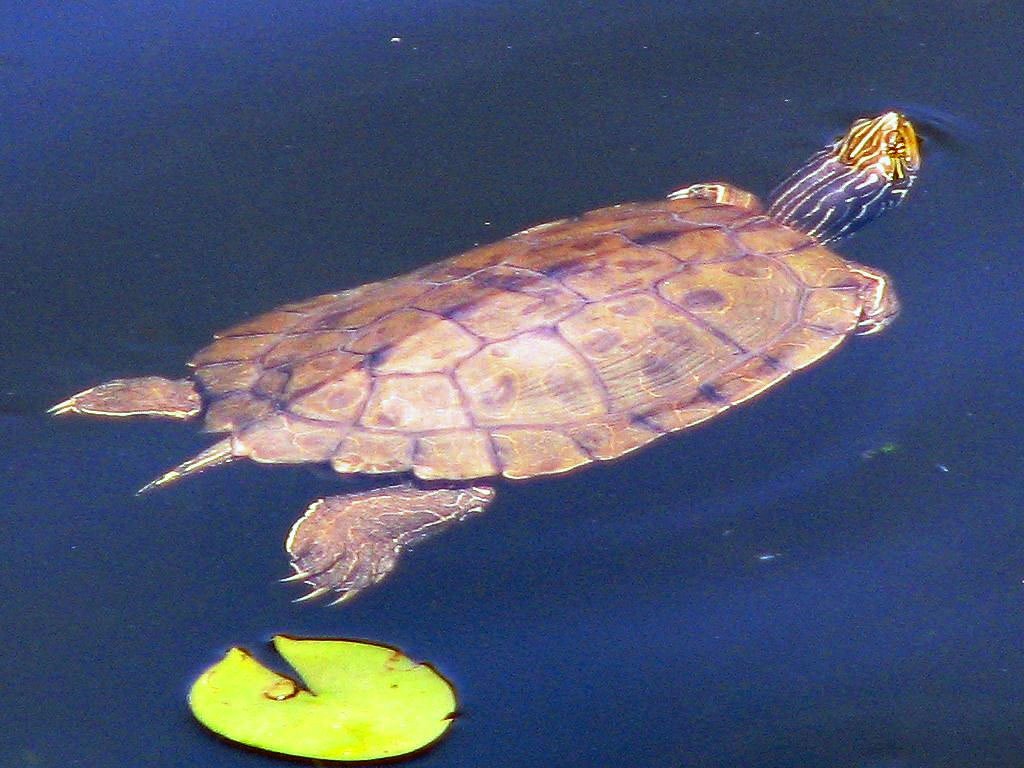
Turtles & tortoises · Difficulty: Intermediate
Key facts and care guidance for Northern map turtle (Graptemys geographica) (origin: The eastern and central USA and south-eastern Canada; the Mississippi, Ohio, Tennessee and Great Lakes systems). Adult size around females up to 26 cm (large-headed), males up to 15 cm. Life expectancy up to ~60 years. The values below are carefully researched guidance.
Short answers
Northern map turtle: How big does the enclosure need to be?
An aqua-terrarium from ~125×60×60 cm for one adult female (water at least twice the shell length); males from ~100×50 cm.
Northern map turtle: What temperature does it need?
Daytime water 22–28 °C (spring/autumn 20–23, midsummer 27–28), basking spot 35–42 °C (dry basking spot), at night 18–22 °C (air above the water).
Northern map turtle: Does it need UVB lighting?
UVB: UVB needed (Ferguson zone 2–3, UV index 2–4); an HQI / UV metal-halide lamp is recommended.
Northern map turtle: How long do they live?
Life expectancy: up to ~60 years.
Northern map turtle: Is it suitable for beginners?
Rather not – it is considered an intermediate species (difficulty: Intermediate).
Climate
- Daytime temperature
- water 22–28 °C (spring/autumn 20–23, midsummer 27–28)
- Night temperature
- 18–22 °C (air above the water)
- Basking spot
- 35–42 °C (dry basking spot)
- Humidity
- Not critical (aquatic); the basking spot must stay dry
- UVB
- UVB needed (Ferguson zone 2–3, UV index 2–4); an HQI / UV metal-halide lamp is recommended
Enclosure
- Minimum size
- an aqua-terrarium from ~125×60×60 cm for one adult female (water at least twice the shell length); males from ~100×50 cm
- Substrate
- Fine sand or rounded gravel; alternatively bare-bottomed for hygiene; an egg-laying site for the females
Feeding
- Food
- Durophagous and omnivorous: it eats mainly water snails and mussels (the broad-headed females), plus insects, crayfish and small fish; adults also take plant food and pellets, and a cuttlebone
- Feeding interval
- juveniles daily; adults animal food 2–3×/week, plant food available
Key facts
- Adult size
- females up to 26 cm (large-headed), males up to 15 cm
- Life expectancy
- up to ~60 years
- Origin
- The eastern and central USA and south-eastern Canada; the Mississippi, Ohio, Tennessee and Great Lakes systems
- Protection status
- CITES Appendix III (since 2006) = EU Annex C. Freely tradable within the EU, no registration duty; export and origin documents are needed for import
- Brumation
- A winter rest or brumation of about 3 months at 4–8 °C (a northern species)
- Cohabitation
- Keep them singly. A loner and territorial; never keep males together, and they harass the females. A group only with plenty of space, visual barriers and a surplus of females
Notes
A specialised snail and mussel eater (durophagous) – watch that there is enough hard-shelled prey and calcium. Very sensitive to water quality; strong filtration is needed. Considered one of the more demanding map turtles.
Do you keep this species?
Add your animal to Reptoria – Reptoria reminds you about feeding and shedding. Add your animal for free →
Look for Northern map turtle (Graptemys geographica) in the marketplace →
Related species
- Alabama map turtle (Graptemys pulchra) – Intermediate
- Barbour's map turtle (Graptemys barbouri) – Intermediate
- False map turtle (Graptemys pseudogeographica) – Intermediate
- Yellow-blotched map turtle (Graptemys flavimaculata) – Intermediate
- Mississippi map turtle (Graptemys pseudogeographica kohni) – Intermediate
- Ouachita map turtle (Graptemys ouachitensis) – Intermediate
- Black-knobbed map turtle (Graptemys nigrinoda) – Intermediate
- Cumberland slider (Trachemys scripta troostii) – Intermediate
What you need to start
To keep Northern map turtle (Graptemys geographica) you typically need: a suitable enclosure (an aqua-terrarium from ~125×60×60 cm for one adult female (water at least twice the shell length); males from ~100×50 cm), substrate (Fine sand or rounded gravel; alternatively bare-bottomed for hygiene; an egg-laying site for the females), a heat source with a thermostat, UVB lighting, thermometer and hygrometer, a water dish and hides. You will find equipment in the Reptoria marketplace.
The complete, interactive care database is in the Reptoria app.
Last updated: 30 October 2026 · Editor: Reptoria editorial team · Sources include: https://en.wikipedia.org/wiki/Northern_map_turtle, https://reptile-database.reptarium.cz/species?genus=Graptemys&species=geographica
All values are non-binding guidance and do not replace expert advice. Research thoroughly from several sources before acquiring and keeping an animal, and observe the applicable law (species and animal protection in particular).