False map turtle (Graptemys pseudogeographica)
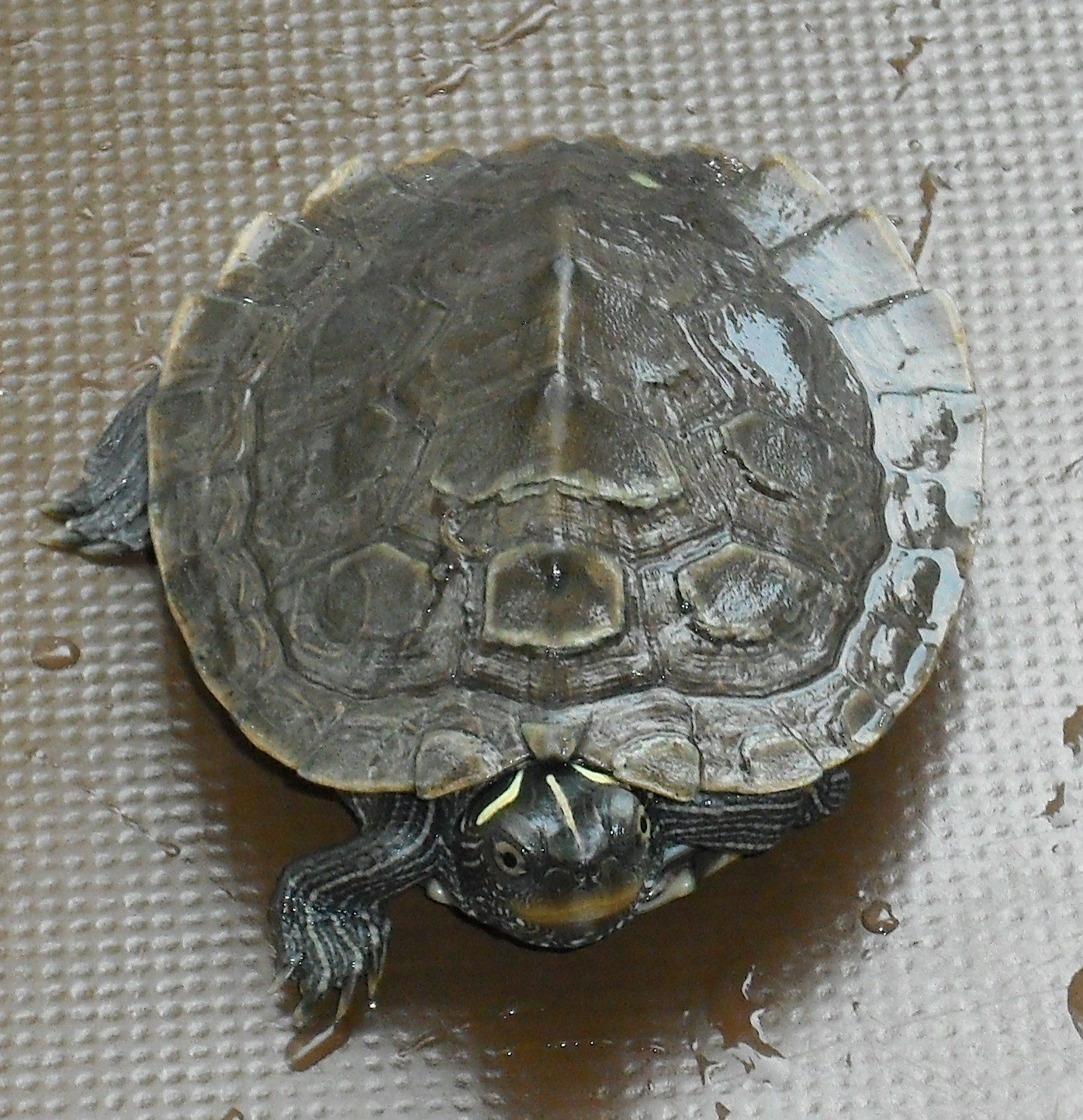
Turtles & tortoises · Difficulty: Intermediate
Key facts and care guidance for False map turtle (Graptemys pseudogeographica) (origin: The Mississippi river system, the central USA (Wisconsin to Louisiana, eastern Texas)). Adult size around females up to 27 cm, males 9–15 cm (a strong sexual dimorphism). Life expectancy 30–60 years. The values below are carefully researched guidance.
Short answers
False map turtle: How big does the enclosure need to be?
An aqua-terrarium from ~125×60×60 cm for one adult female (water at least twice the shell length); males from ~100×50 cm.
False map turtle: What temperature does it need?
Daytime water 22–28 °C (spring/autumn 20–23, midsummer 26–28), basking spot 35–42 °C (dry basking spot), at night 18–22 °C (air always above the water temperature).
False map turtle: Does it need UVB lighting?
UVB: UVB needed (Ferguson zone 2–3, UV index 2–4 at the basking spot); an HQI / UV metal-halide lamp is recommended.
False map turtle: How long do they live?
Life expectancy: 30–60 years.
False map turtle: Is it suitable for beginners?
Rather not – it is considered an intermediate species (difficulty: Intermediate).
Climate
- Daytime temperature
- water 22–28 °C (spring/autumn 20–23, midsummer 26–28)
- Night temperature
- 18–22 °C (air always above the water temperature)
- Basking spot
- 35–42 °C (dry basking spot)
- Humidity
- Not critical (aquatic); the basking spot must stay dry
- UVB
- UVB needed (Ferguson zone 2–3, UV index 2–4 at the basking spot); an HQI / UV metal-halide lamp is recommended
Enclosure
- Minimum size
- an aqua-terrarium from ~125×60×60 cm for one adult female (water at least twice the shell length); males from ~100×50 cm
- Substrate
- Fine sand or rounded gravel; alternatively bare-bottomed for hygiene; an egg-laying site (a sand-soil mix, at least as deep as the shell is long) for the females
Feeding
- Food
- Omnivorous; juveniles mostly animal food (water snails, insects, freshwater shrimp, mosquito larvae, small fish), adults increasingly plant-eating (water plants, dandelion, lettuce) plus high-quality aquatic turtle pellets and a cuttlebone
- Feeding interval
- juveniles daily, adults animal food 2–3×/week; plant food always available
Key facts
- Adult size
- females up to 27 cm, males 9–15 cm (a strong sexual dimorphism)
- Life expectancy
- 30–60 years
- Origin
- The Mississippi river system, the central USA (Wisconsin to Louisiana, eastern Texas)
- Protection status
- CITES Appendix III (listed by the USA since 2006) = EU Annex C. Freely tradable within the EU, no registration duty; export and origin documents are required when importing into the EU
- Brumation
- A winter rest or brumation of about 3 months at 4–8 °C (a northern species); juveniles only overwinter from about three years old
- Cohabitation
- Keep singly. The species is shy and easily stressed, so a single animal is the least stressful option. Map turtles are however sociable baskers; a small group is possible with a large tank and several basking spots, but the more dominant females should only be kept in limited numbers.
Notes
Sensitive to poor water quality – strong filtration and regular water changes are needed. An "aggressive basker": offer several dry basking spots. A common mistake: too small a tank for large females. reptiliendoktor rates the species for ambitious beginners; because of its water-quality demands it is classed conservatively as "advanced" here.
Do you keep this species?
Add your animal to Reptoria – Reptoria reminds you about feeding and shedding. Add your animal for free →
Look for False map turtle (Graptemys pseudogeographica) in the marketplace →
Related species
- Alabama map turtle (Graptemys pulchra) – Intermediate
- Barbour's map turtle (Graptemys barbouri) – Intermediate
- Yellow-blotched map turtle (Graptemys flavimaculata) – Intermediate
- Northern map turtle (Graptemys geographica) – Intermediate
- Mississippi map turtle (Graptemys pseudogeographica kohni) – Intermediate
- Ouachita map turtle (Graptemys ouachitensis) – Intermediate
- Black-knobbed map turtle (Graptemys nigrinoda) – Intermediate
- Cumberland slider (Trachemys scripta troostii) – Intermediate
What you need to start
To keep False map turtle (Graptemys pseudogeographica) you typically need: a suitable enclosure (an aqua-terrarium from ~125×60×60 cm for one adult female (water at least twice the shell length); males from ~100×50 cm), substrate (Fine sand or rounded gravel; alternatively bare-bottomed for hygiene; an egg-laying site (a sand-soil mix, at least as deep as the shell is long) for the females), a heat source with a thermostat, UVB lighting, thermometer and hygrometer, a water dish and hides. You will find equipment in the Reptoria marketplace.
The complete, interactive care database is in the Reptoria app.
Last updated: 7 November 2026 · Editor: Reptoria editorial team · Sources include: Reptile Database: Graptemys pseudogeographica – Artprofil (oviparous) – https://reptile-database.reptarium.cz/species?genus=Graptemys&species=pseudogeographica, Wikipedia: Map turtle (Graptemys) – Gattungsübersicht, keine Inkubationszahlen – https://en.wikipedia.org/wiki/Map_turtle, https://checklist.cites.org/#/en/search/output_layout=alphabetical&scientific_name=Graptemys, https://en.wikipedia.org/wiki/False_map_turtle, https://herpneb.unl.edu/false-map-turtle/
All values are non-binding guidance and do not replace expert advice. Research thoroughly from several sources before acquiring and keeping an animal, and observe the applicable law (species and animal protection in particular).