Gaboon viper (Bitis gabonica)
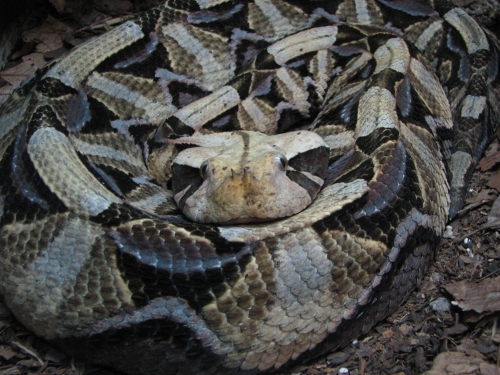
Snakes · Difficulty: Expert
Key facts and care guidance for Gaboon viper (Bitis gabonica) (origin: Tropical West, Central and East Africa (rainforest and forest edge)). Adult size around 125–155 cm, große Weibchen bis etwa 175 cm; sehr massig. Life expectancy over 15 years. The values below are carefully researched guidance.
Short answers
Gaboon viper: How big does the enclosure need to be?
150×80×80 cm (adult; a generous floor area, a very heavily built animal).
Gaboon viper: What temperature does it need?
Daytime 24–28 °C, basking spot 28–30 °C (local hot spot), at night 22–24 °C.
Gaboon viper: Does it need UVB lighting?
UVB: UVB not essential (a forest-floor dweller), weak UVB is tolerated.
Gaboon viper: How long do they live?
Life expectancy: over 15 years.
Gaboon viper: Is it suitable for beginners?
No – better suited to experienced keepers (difficulty: Expert).
Climate
- Daytime temperature
- 24–28 °C
- Night temperature
- 22–24 °C
- Basking spot
- 28–30 °C (local hot spot)
- Humidity
- 70–90 %
- UVB
- UVB not essential (a forest-floor dweller), weak UVB is tolerated
Enclosure
- Minimum size
- 150×80×80 cm (adult; a generous floor area, a very heavily built animal)
- Substrate
- A thick layer of leaf litter over damp coco soil or a peat substitute; cork tubes and roots as hides; a large water basin
Feeding
- Food
- Frozen mice, rats and small rabbits (a powerful feeder)
- Feeding interval
- adults every 2–4 weeks
Key facts
- Adult size
- 125–155 cm, große Weibchen bis etwa 175 cm; sehr massig
- Life expectancy
- over 15 years
- Origin
- Tropical West, Central and East Africa (rainforest and forest edge)
- Protection status
- A VENOMOUS SNAKE – keeping it requires a permit, notification and proof of expertise in many German states (e.g. Bavaria, Berlin, Hesse); North Rhine-Westphalia has banned new acquisitions since 2021; not listed under CITES, but observe the states' dangerous-animal law (a separate, secured snake room)
- Brumation
- None (tropical); a slight seasonal variation in temperature and humidity to stimulate breeding
- Cohabitation
- Keep them singly – strictly; they cope badly with disturbance; put them together only briefly and under supervision for breeding, and never keep males together
Notes
Highly venomous and medically significant (the longest fangs of any snake, with a large venom yield) – strictly for experienced specialists with a safety concept and access to antivenom. Sluggish, but it strikes at lightning speed. At too high a humidity plus warmth there is a risk of respiratory infections – ventilate well.
Do you keep this species?
Add your animal to Reptoria – Reptoria reminds you about feeding and shedding. Add your animal for free →
Related species
- Horned adder (Bitis caudalis) – Expert
- Rhinoceros viper (Bitis nasicornis) – Expert
- Puff adder (Bitis arietans) – Expert
- West African gaboon viper (Bitis rhinoceros) – Expert
- Peringuey's adder (Bitis peringueyi) – Expert
- Savanna vine snake (Thelotornis capensis) – Expert
- Egyptian cobra (Naja haje) – Expert
- Egyptian saw-scaled viper (Echis pyramidum) – Expert
What you need to start
To keep Gaboon viper (Bitis gabonica) you typically need: a suitable enclosure (150×80×80 cm (adult; a generous floor area, a very heavily built animal)), substrate (A thick layer of leaf litter over damp coco soil or a peat substitute; cork tubes and roots as hides; a large water basin), a heat source with a thermostat, UVB lighting, thermometer and hygrometer, a water dish and hides. You will find equipment in the Reptoria marketplace.
The complete, interactive care database is in the Reptoria app.
Last updated: 2 November 2026 · Editor: Reptoria editorial team · Sources include: https://en.wikipedia.org/wiki/Gaboon_viper, https://reptile-database.reptarium.cz/species?genus=Bitis&species=gabonica, https://www.snakesociety.nl/jaargangen/1999e/Litteratura%20Serpentium%2019-4%20106-109%20Bakker%20and%20Bakker,%20Bitis%20gabonica,%20the%20Gaboon%20viper.pdf
All values are non-binding guidance and do not replace expert advice. Research thoroughly from several sources before acquiring and keeping an animal, and observe the applicable law (species and animal protection in particular).