West African gaboon viper (Bitis rhinoceros)
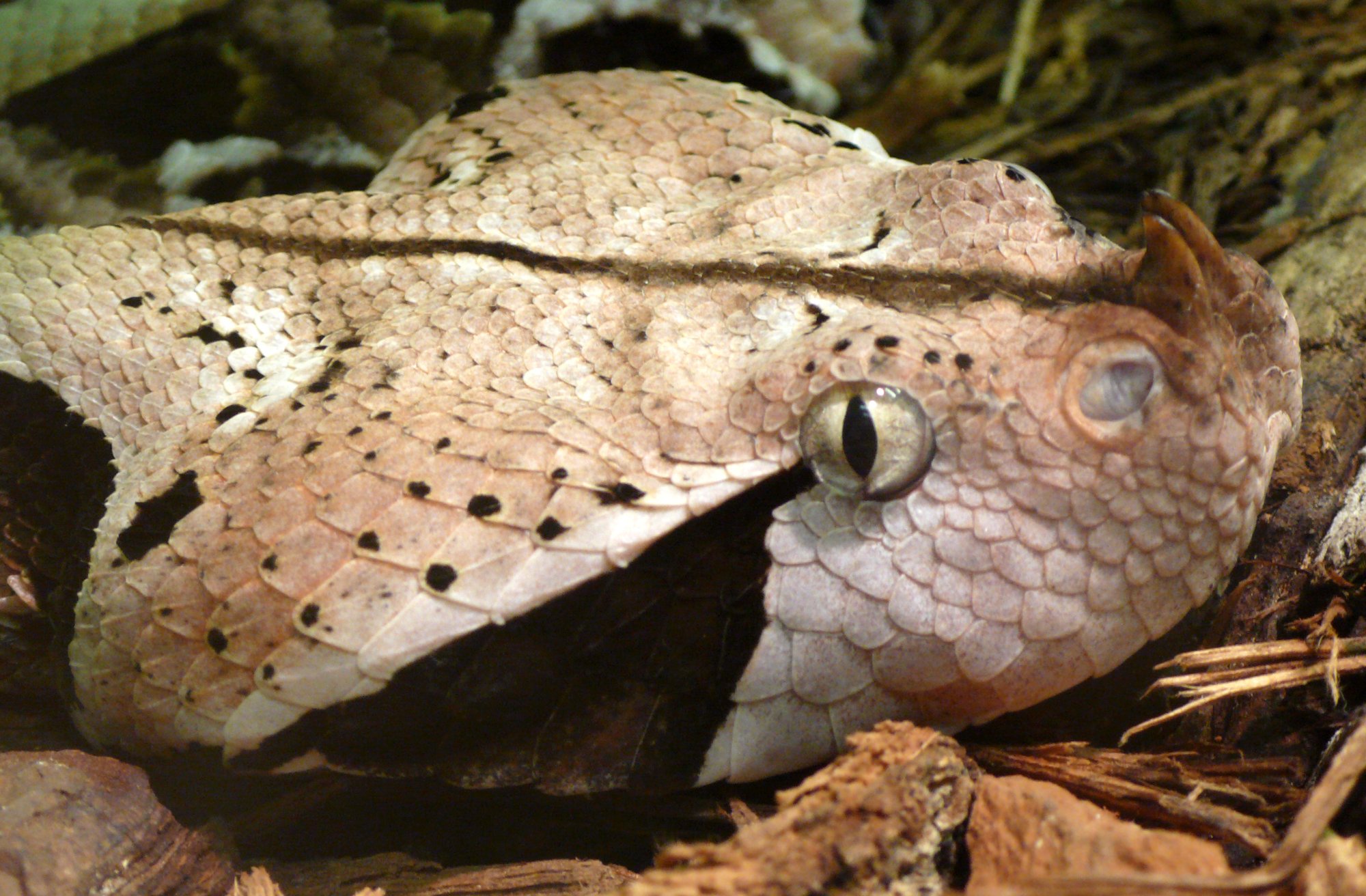
Snakes · Difficulty: Expert
Key facts and care guidance for West African gaboon viper (Bitis rhinoceros) (origin: West Africa (Guinea to Ghana and Togo) – rainforest). Adult size around 130–180 cm, große Tiere regelmäßig um 2 m; sehr massig. Life expectancy over 15 years. The values below are carefully researched guidance.
Short answers
West African gaboon viper: How big does the enclosure need to be?
150×80×80 cm (adult, a generous floor area).
West African gaboon viper: What temperature does it need?
Daytime 24–28 °C, basking spot 28–30 °C (local hot spot), at night 22–24 °C.
West African gaboon viper: Does it need UVB lighting?
UVB: UVB not essential (a forest-floor dweller).
West African gaboon viper: How long do they live?
Life expectancy: over 15 years.
West African gaboon viper: Is it suitable for beginners?
No – better suited to experienced keepers (difficulty: Expert).
Climate
- Daytime temperature
- 24–28 °C
- Night temperature
- 22–24 °C
- Basking spot
- 28–30 °C (local hot spot)
- Humidity
- 70–90 %
- UVB
- UVB not essential (a forest-floor dweller)
Enclosure
- Minimum size
- 150×80×80 cm (adult, a generous floor area)
- Substrate
- A thick layer of leaf litter over damp coco soil; cork tubes as hides, a large water basin
Feeding
- Food
- Frozen food: mice, rats, and for larger animals rabbits
- Feeding interval
- adults every 2–4 weeks
Key facts
- Adult size
- 130–180 cm, große Tiere regelmäßig um 2 m; sehr massig
- Life expectancy
- over 15 years
- Origin
- West Africa (Guinea to Ghana and Togo) – rainforest
- Protection status
- A VENOMOUS SNAKE – keeping it requires a permit, notification and proof of expertise depending on the German state; North Rhine-Westphalia bans new acquisitions; not listed under CITES
- Brumation
- None (tropical)
- Cohabitation
- Keep them singly. Gaboon vipers are solitary, and hungry animals strike at anything that moves — two animals in one enclosure can be neither fed nor tended safely. Males fight fierce combat bouts in the breeding season that put strain even on sturdy enclosures. For breeding, introduce the female to the male under supervision and separate them again afterwards.
Notes
The western sister species of the Gaboon viper, long treated as its subspecies. Very long fangs and a large venom yield – medically highly significant. It seems sluggish, but strikes at lightning speed without warning. Only with a secured snake room and an emergency plan.
Do you keep this species?
Add your animal to Reptoria – Reptoria reminds you about feeding and shedding. Add your animal for free →
Look for West African gaboon viper (Bitis rhinoceros) in the marketplace →
Related species
- Gaboon viper (Bitis gabonica) – Expert
- Horned adder (Bitis caudalis) – Expert
- Rhinoceros viper (Bitis nasicornis) – Expert
- Puff adder (Bitis arietans) – Expert
- Peringuey's adder (Bitis peringueyi) – Expert
- Savanna vine snake (Thelotornis capensis) – Expert
- Egyptian cobra (Naja haje) – Expert
- Egyptian saw-scaled viper (Echis pyramidum) – Expert
What you need to start
To keep West African gaboon viper (Bitis rhinoceros) you typically need: a suitable enclosure (150×80×80 cm (adult, a generous floor area)), substrate (A thick layer of leaf litter over damp coco soil; cork tubes as hides, a large water basin), a heat source with a thermostat, UVB lighting, thermometer and hygrometer, a water dish and hides. You will find equipment in the Reptoria marketplace.
The complete, interactive care database is in the Reptoria app.
Last updated: 2 November 2026 · Editor: Reptoria editorial team · Sources include: https://en.wikipedia.org/wiki/Bitis_rhinoceros, https://en.wikipedia.org/wiki/Gaboon_viper, https://reptile-database.reptarium.cz/species?genus=Bitis&species=rhinoceros, https://www.snakesociety.nl/jaargangen/1999e/Litteratura%20Serpentium%2019-4%20106-109%20Bakker%20and%20Bakker,%20Bitis%20gabonica,%20the%20Gaboon%20viper.pdf
All values are non-binding guidance and do not replace expert advice. Research thoroughly from several sources before acquiring and keeping an animal, and observe the applicable law (species and animal protection in particular).