Giant African land snail (Lissachatina fulica)
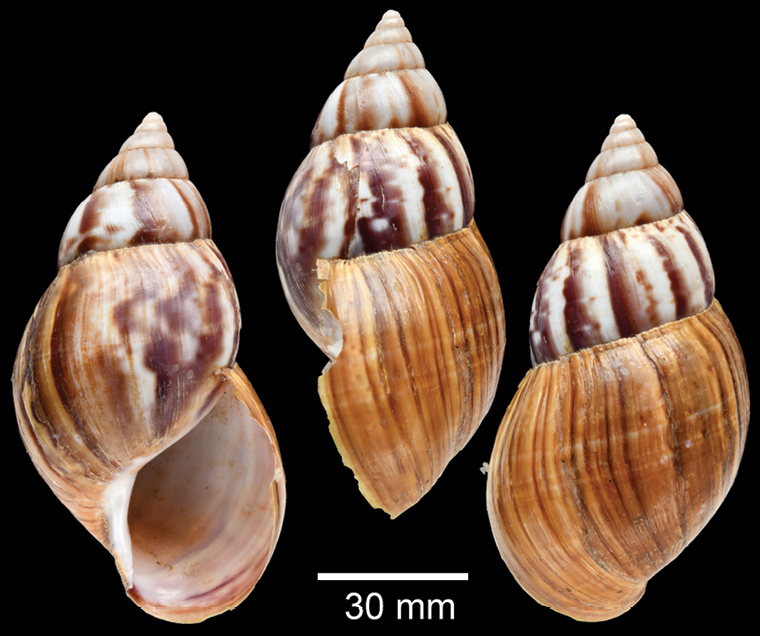
Invertebrates · Difficulty: Beginner
Key facts and care guidance for Giant African land snail (Lissachatina fulica) (origin: East Africa (Kenya / Tanzania); introduced worldwide as an invasive species). Adult size around shell usually 10–15 cm (up to ~20 cm). Life expectancy 5–7 years (up to ~10). The values below are carefully researched guidance.
Short answers
Giant African land snail: How big does the enclosure need to be?
From 80×40×40 cm for 1–3 adult animals, from 100×50×50 cm for groups of 5 or more.
Giant African land snail: What temperature does it need?
Daytime 23–26 °C, at night 22–24 °C.
Giant African land snail: Does it need UVB lighting?
UVB: No UVB needed (nocturnal); only a day/night rhythm.
Giant African land snail: How long do they live?
Life expectancy: 5–7 years (up to ~10).
Giant African land snail: Is it suitable for beginners?
Yes – it is considered suitable for beginners (difficulty: Beginner).
Climate
- Daytime temperature
- 23–26 °C
- Night temperature
- 22–24 °C
- Basking spot
- —
- Humidity
- 80–90 %
- UVB
- No UVB needed (nocturnal); only a day/night rhythm
Enclosure
- Minimum size
- from 80×40×40 cm for 1–3 adult animals, from 100×50×50 cm for groups of 5 or more
- Substrate
- Peat-free, calcium-rich soil (potting/garden soil with leaf mould, mixed with garden lime), 10–15 cm deep and at least one and a half times the shell length; sphagnum and leaf litter on top, kept permanently moist and warm
Feeding
- Food
- Vegetables (cucumber, courgette, lettuce, carrot), fruit, dandelion; a cuttlebone or calcium is essential for the shell
- Feeding interval
- Fresh food daily (in the evening); always offer a calcium source
Key facts
- Adult size
- shell usually 10–15 cm (up to ~20 cm)
- Life expectancy
- 5–7 years (up to ~10)
- Origin
- East Africa (Kenya / Tanzania); introduced worldwide as an invasive species
- Protection status
- No CITES listing; freely keepable in Germany. WARNING: strictly banned as an invasive species in many countries (including the USA). Never release into the wild!
- Brumation
- None (tropical). Cold or dry conditions risk aestivation – keep them constantly warm and humid.
- Cohabitation
- Group keeping with three to five animals is common; two also works, and the snails like to rest close together. Keeping a single snail is possible, but it lacks contact with conspecifics, which is why most keepers advise against it. Never mix different giant African land snail species (different requirements, hybridisation). Pay attention to stocking density, a permanent calcium supply and hygiene; search for clutches weekly and remove them.
Notes
Very keen to breed (it lays hundreds of eggs) – check clutches regularly and freeze them to avoid overpopulation and illegal release. The main mistakes: too dry or too cold, and a lack of calcium (a brittle shell).
Do you keep this species?
Add your animal to Reptoria – Reptoria reminds you about feeding and shedding. Add your animal for free →
Look for Giant African land snail (Lissachatina fulica) in the marketplace →
Related species
- Giant African land snail (Lissachatina immaculata) – Beginner
- Zanzibar land snail (Lissachatina reticulata) – Beginner
- Roman snail (Helix pomatia) – Beginner
- Flame land snail (Limicolaria flammea) – Beginner
- Garden snail (Cornu aspersum) – Beginner
- Giant West African land snail (Archachatina marginata) – Beginner
- Cuban land snail (Caracolus sagemon) – Intermediate
- Giant land snail (Megalobulimus oblongus) – Intermediate
What you need to start
To keep Giant African land snail (Lissachatina fulica) you typically need: a suitable enclosure (from 80×40×40 cm for 1–3 adult animals, from 100×50×50 cm for groups of 5 or more), substrate (Peat-free, calcium-rich soil (potting/garden soil with leaf mould, mixed with garden lime), 10–15 cm deep and at least one and a half times the shell length; sphagnum and leaf litter on top, kept permanently moist and warm), a heat source with a thermostat, UVB lighting, thermometer and hygrometer, a water dish and hides. You will find equipment in the Reptoria marketplace.
The complete, interactive care database is in the Reptoria app.
Last updated: 9 October 2026 · Editor: Reptoria editorial team · Sources include: EU-VO 338/97 (Anhang, Fassung 2026/1383), Wikipedia DE, Wikipedia EN, achatschnecken-team.de, drta-archiv.de
All values are non-binding guidance and do not replace expert advice. Research thoroughly from several sources before acquiring and keeping an animal, and observe the applicable law (species and animal protection in particular).