Gidgee skink (Egernia stokesii)
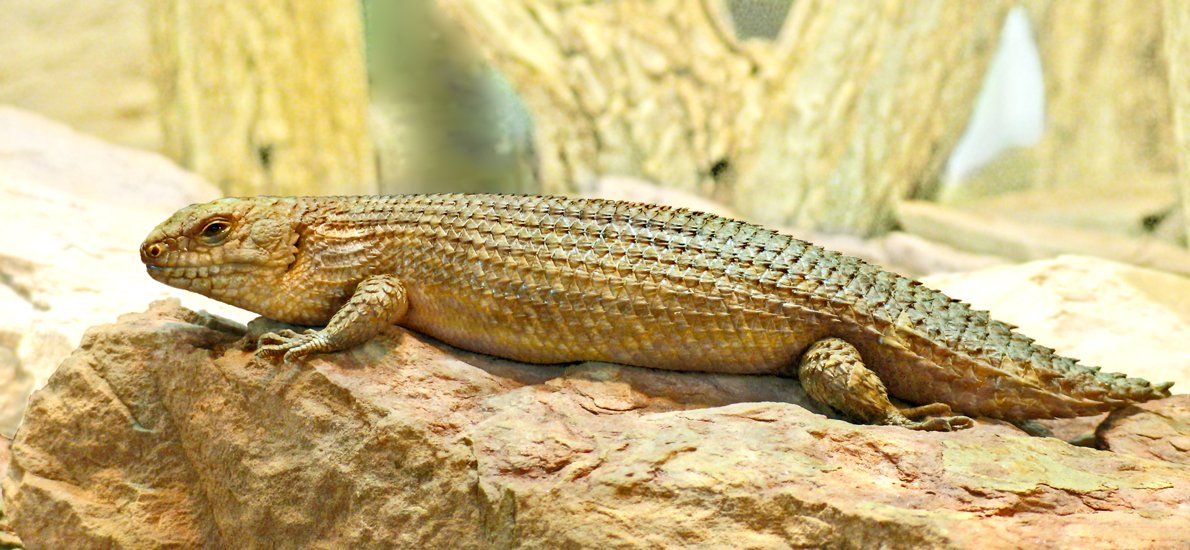
Skinks · Difficulty: Intermediate
Key facts and care guidance for Gidgee skink (Egernia stokesii) (origin: The dry, rocky regions of central, western and southern Australia; a crevice dweller in arid and semi-arid country). Adult size around 25–30 cm total length (a strong, spiny gripping tail). Life expectancy 20–25+ years. The values below are carefully researched guidance.
Short answers
Gidgee skink: How big does the enclosure need to be?
100×50×50 cm for one animal; at least 150–180×60×50 cm for a group.
Gidgee skink: What temperature does it need?
Daytime 26–32 °C (warm side up to 35 °C), basking spot 40–48 °C, at night 18–22 °C.
Gidgee skink: Does it need UVB lighting?
UVB: UVB needed (Ferguson zone 3, UV index 4–6; a high-output UVB lamp).
Gidgee skink: How long do they live?
Life expectancy: 20–25+ years.
Gidgee skink: Is it suitable for beginners?
Rather not – it is considered an intermediate species (difficulty: Intermediate).
Climate
- Daytime temperature
- 26–32 °C (warm side up to 35 °C)
- Night temperature
- 18–22 °C
- Basking spot
- 40–48 °C
- Humidity
- 40–60 % (dry, with a locally humid floor hide)
- UVB
- UVB needed (Ferguson zone 3, UV index 4–6; a high-output UVB lamp)
Enclosure
- Minimum size
- 100×50×50 cm for one animal; at least 150–180×60×50 cm for a group
- Substrate
- A sand-loam mix they can dig in (8–10 cm) with rock structures, rock crevices and bark as hides
Feeding
- Food
- Omnivorous: mostly insects (crickets, roaches, black soldier fly larvae) plus greens and vegetables, a little fruit and flowers; more plant-based as adults
- Feeding interval
- adults insects 2–3×/week, green food almost daily; juveniles daily; calcium and D3 ~2×/week
Key facts
- Adult size
- 25–30 cm total length (a strong, spiny gripping tail)
- Life expectancy
- 20–25+ years
- Origin
- The dry, rocky regions of central, western and southern Australia; a crevice dweller in arid and semi-arid country
- Protection status
- Not listed under CITES or EU law, no registration duty in Germany. Australian export is prohibited → captive-bred animals only; document the lineage
- Brumation
- A cooler winter rest to stimulate breeding is recommended: ~6–10 weeks at 15–20 °C, with reduced lighting and no feeding; it is not vital for survival
- Cohabitation
- A group (family unit) is the housing form closest to natural behaviour: a real exception among skinks, since in the wild this species lives in stable aggregations of up to 17 related animals with long-term pair bonds. Only one adult male per terrarium – two males will fight. A ratio of one male to one or more females, ideally raised together; do not combine unfamiliar adults.
Notes
Very robust, long-lived, live-bearing (a litter of about 1–8). Common mistakes: too small or too poorly structured → stress and aggression; too little UVB → MBD and rickets; too damp → skin problems; and strange males or two males kept together. It dislikes being handled; when threatened it wedges itself into rock crevices with its spiny tail.
Do you keep this species?
Add your animal to Reptoria – Reptoria reminds you about feeding and shedding. Add your animal for free →
Look for Gidgee skink (Egernia stokesii) in the marketplace →
Related species
- Tree skink (Egernia striolata) – Beginner
- Cunningham's skink (Egernia cunninghami) – Intermediate
- Black rock skink (Egernia saxatilis) – Intermediate
- Hosmer's spiny-tailed skink (Egernia hosmeri) – Intermediate
- Desert skink (Egernia formosa) – Intermediate
- King's skink (Egernia kingii) – Intermediate
- Eastern crevice skink (Egernia mcpheei) – Intermediate
- Richard's crevice skink (Egernia richardi) – Intermediate
What you need to start
To keep Gidgee skink (Egernia stokesii) you typically need: a suitable enclosure (100×50×50 cm for one animal; at least 150–180×60×50 cm for a group), substrate (A sand-loam mix they can dig in (8–10 cm) with rock structures, rock crevices and bark as hides), a heat source with a thermostat, UVB lighting, thermometer and hygrometer, a water dish and hides. You will find equipment in the Reptoria marketplace.
The complete, interactive care database is in the Reptoria app.
Last updated: 9 October 2026 · Editor: Reptoria editorial team · Sources include: https://en.wikipedia.org/wiki/Gidgee_skink, https://reptile-database.reptarium.cz/species?genus=Egernia&species=stokesii
All values are non-binding guidance and do not replace expert advice. Research thoroughly from several sources before acquiring and keeping an animal, and observe the applicable law (species and animal protection in particular).