Tree skink (Egernia striolata)
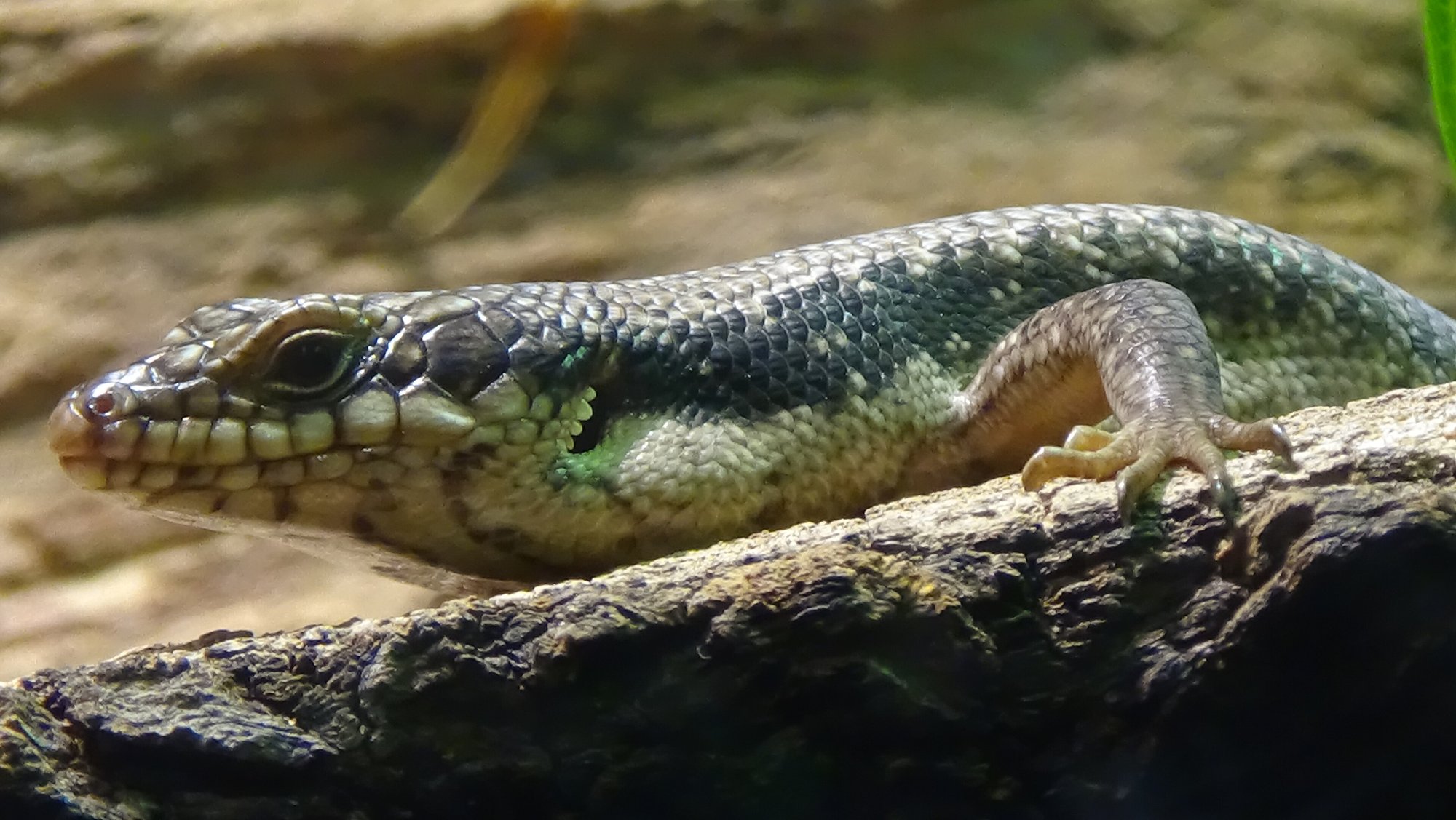
Skinks · Difficulty: Beginner
Key facts and care guidance for Tree skink (Egernia striolata) (origin: Eastern and southern Australia). Adult size around 18–22 cm total length. Life expectancy 15–20 years. The values below are carefully researched guidance.
Short answers
Tree skink: How big does the enclosure need to be?
120×60×60 cm.
Tree skink: What temperature does it need?
Daytime 26–32 °C, basking spot 42 °C, at night 16–20 °C.
Tree skink: Does it need UVB lighting?
UVB: Essential, medium strength (UVB 5–6%).
Tree skink: How long do they live?
Life expectancy: 15–20 years.
Tree skink: Is it suitable for beginners?
Yes – it is considered suitable for beginners (difficulty: Beginner).
Climate
- Daytime temperature
- 26–32 °C
- Night temperature
- 16–20 °C
- Basking spot
- 42 °C
- Humidity
- 40–55 %
- UVB
- Essential, medium strength (UVB 5–6%)
Enclosure
- Minimum size
- 120×60×60 cm
- Substrate
- Sand-loam, pieces of bark, stone slabs, climbing branches
Feeding
- Food
- Insects, leafy greens, fruit, flowers
- Feeding interval
- 3–4×/week
Key facts
- Adult size
- 18–22 cm total length
- Life expectancy
- 15–20 years
- Origin
- Eastern and southern Australia
- Protection status
- Export from Australia is prohibited – only European captive-bred animals
- Brumation
- A cooler spell of 8–10 weeks
- Cohabitation
- As a family group: a fixed pair with its offspring. In the wild the species lives in groups of two to ten, usually two to four animals, that are related to one another and recognise each other by scent; pairs stay together for years. Two adult males do not get along. One male with several females is not this species' natural structure and should only be attempted with plenty of space and visual cover. Unfamiliar adult animals are not readily accepted — new groupings are introduced slowly, with several hiding crevices, several basking spots and separate feeding stations. Juveniles can be raised together without problems.
Notes
Live-bearing and decidedly social – it lives in stable family groups with the young alongside their parents. It needs flat bark and stone crevices as retreats.
Do you keep this species?
Add your animal to Reptoria – Reptoria reminds you about feeding and shedding. Add your animal for free →
Look for Tree skink (Egernia striolata) in the marketplace →
Related species
- Cunningham's skink (Egernia cunninghami) – Intermediate
- Black rock skink (Egernia saxatilis) – Intermediate
- Hosmer's spiny-tailed skink (Egernia hosmeri) – Intermediate
- Desert skink (Egernia formosa) – Intermediate
- King's skink (Egernia kingii) – Intermediate
- Eastern crevice skink (Egernia mcpheei) – Intermediate
- Richard's crevice skink (Egernia richardi) – Intermediate
- Pygmy spiny-tailed skink (Egernia depressa) – Intermediate
What you need to start
To keep Tree skink (Egernia striolata) you typically need: a suitable enclosure (120×60×60 cm), substrate (Sand-loam, pieces of bark, stone slabs, climbing branches), a heat source with a thermostat, UVB lighting, thermometer and hygrometer, a water dish and hides. You will find equipment in the Reptoria marketplace.
The complete, interactive care database is in the Reptoria app.
Last updated: 2 November 2026 · Editor: Reptoria editorial team · Sources include: Wikipedia EN, inaturalist.org, reptilesmagazine.com, eu_annex.txt (lokal, VO (EU) 2026/1383), gutachten.txt (lokal, BML 1997)
All values are non-binding guidance and do not replace expert advice. Research thoroughly from several sources before acquiring and keeping an animal, and observe the applicable law (species and animal protection in particular).